

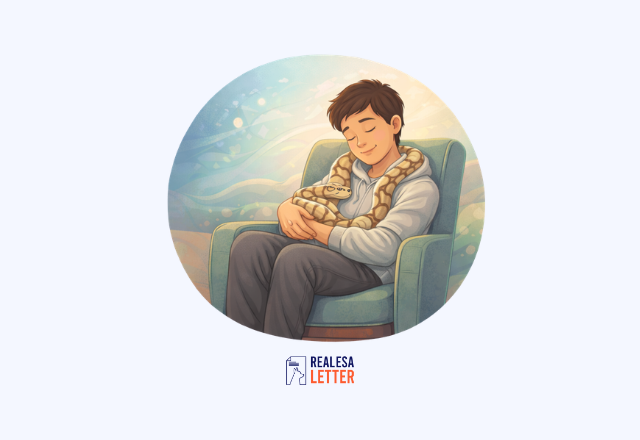
Yes, a snake can absolutely be an emotional support animal (ESA).
While dogs and cats are the most common ESAs, snakes are a legal and increasingly popular choice for people managing anxiety, depression, PTSD, and other mental health conditions. As long as your snake provides genuine emotional comfort and you have a valid ESA letter from a licensed mental health professional (LMHP), your snake qualifies for the same housing protections as any other ESA under the Fair Housing Act.
In this guide, you'll learn exactly how snakes qualify as ESAs, which breeds work best, what conditions qualify, and how to get your official ESA letter.
Benefits of Emotional Support Snakes
Although snakes are unconventional companions, they can offer meaningful psychological benefits for certain individuals. Emotional support animals provide comfort through presence rather than task-based training, and for some people, reptiles create a uniquely calming and grounding experience.
Their quiet nature, slow movements, and predictable behavior can promote a sense of stability, especially for individuals who feel overwhelmed by high-energy pets. While research on snakes specifically is limited, broader studies on human-animal interaction suggest that companion animals may help reduce stress, support emotional regulation, and improve overall wellbeing.
Snakes offer distinct emotional support benefits that appeal to specific personality types and therapeutic needs:
Calming Presence
The slow, deliberate movements of snakes create a naturally soothing atmosphere. Watching a snake's rhythmic motion can induce meditative states similar to watching fish in an aquarium, reducing heart rate and promoting relaxation.
Tactile Therapy
Handling a snake provides unique sensory stimulation. The smooth, cool scales and gentle muscle contractions offer grounding tactile feedback that can help individuals experiencing anxiety or dissociation reconnect with the present moment.
Low-Maintenance Companionship
Unlike dogs or cats requiring constant attention, snakes are independent creatures. This suits individuals with depression who may struggle with demanding pet care routines while still benefiting from companionship.
Routine and Responsibility
Caring for a snake establishes predictable routines, feeding schedules, habitat maintenance, and handling sessions, which provide structure beneficial for managing depression and anxiety.
Non-Judgmental Acceptance
Snakes don't react to human emotions with judgment or demands. This unconditional acceptance creates a safe emotional space for people dealing with social anxiety or trauma.
Conversation Starter
For those with social anxiety, an unusual pet like a snake can facilitate social interactions and connections with fellow reptile enthusiasts, reducing isolation.
Minimal Space Required
A snake's enclosure (terrarium) takes up far less space than the living area needed for a dog or cat, making snakes ideal for studio apartments or small homes.
Odor-Free
Snakes don't have the typical pet odors associated with fur and dander. Maintained properly, their enclosure is virtually odor-free.
Hypoallergenic
Unlike cats and dogs, snakes don't produce dander. This makes them an ideal ESA for people with animal allergies, and it means your neighbors won't have grounds to complain about allergic reactions.
Completely Quiet
Snakes don't bark, meow, or make any disruptive noise. This is a major advantage in apartments or shared housing where noise-related ESA complaints can be an issue.
Scientific Perspective on Reptile Therapy
While research specifically on snakes as ESAs remains limited, studies on human-animal bonds demonstrate that interaction with pets releases oxytocin (the "bonding hormone") and reduces cortisol (stress hormone) levels.
The unique qualities of reptiles, their quiet nature, predictable behavior, and minimal demands, make them particularly suitable for individuals who find traditional pets overwhelming.
What Is an Emotional Support Snake?
An emotional support snake is a non-venomous reptile that provides therapeutic comfort to a person living with a diagnosed mental or emotional disability. Unlike a traditional pet, an ESA snake holds a recognized legal status under federal housing law, meaning your landlord must accommodate it, even in a no-pet building, as long as you have a valid ESA letter from a licensed mental health professional.
Snakes may not be the first animal that comes to mind for emotional support, but for many people, particularly those who find calm in quiet, low-stimulation environments, they can be more effective than a dog or cat.
Legal Rights: Where Can Emotional Support Snakes Go?
The Fair Housing Act (FHA) provides the primary legal protection for emotional support snakes. Under this federal law:
Housing Rights Include:
- Living in no-pet housing with your ESA snake
- Exemption from pet deposits and monthly pet fees
- Exemption from breed or species restrictions (with rare exceptions)
- Reasonable accommodation in housing policies
Requirements:
- Valid ESA letter from a licensed mental health professional
- Letter must be dated within one year
- The snake must not pose a direct threat to others' safety
- The snake must not cause substantial property damage
Landlord Obligations: Landlords and housing providers must make reasonable accommodations for ESA snakes unless they can demonstrate that:
- The accommodation creates an undue financial burden
- The snake fundamentally alters the nature of the housing
- The snake poses a direct threat despite reasonable precautions
Understanding when landlords can deny an ESA helps you navigate potential housing challenges.
Your ESA snake is protected under the Fair Housing Act (FHA). Here's what that means in practice:
No Pet Fees or Deposits
Your landlord cannot charge you a pet deposit, pet fee, or additional monthly pet rent for your emotional support snake. This is explicitly prohibited by the FHA.
No-Pet Housing Policies Don't Apply
Even if your lease or building has a strict "no pets" policy, your landlord must make a reasonable accommodation for your ESA snake once you provide a valid ESA letter.
Landlord Cannot Simply Refuse
A landlord may only legally deny an ESA if:
- Your animal poses a direct threat to the health or safety of others, or
- Accommodating the animal would cause undue financial hardship to the property owner.
A general dislike of snakes is NOT a legal reason to deny your ESA.
If Your Landlord Refuses Your ESA Snake:
You have the right to file a housing discrimination complaint with the U.S. Department of Housing and Urban Development (HUD) at hud.gov. HUD investigates these complaints and can take action against landlords who violate the FHA.
Can You Fly with an Emotional Support Snake?
No, you cannot bring an emotional support snake on a commercial airline in the United States.
In 2020, the U.S. Department of Transportation (DOT) updated its Air Carrier Access Act (ACAA) rules. Airlines are now only required to accommodate trained psychiatric service dogs (not ESAs) in the cabin. As a result, virtually all major U.S. airlines, including Delta, United, American, and Southwest, no longer accept emotional support animals, including snakes, in the cabin.
What this means for your ESA snake:
- Full housing protections under the Fair Housing Act
- No airline cabin access under current DOT rules
- Some hotels may accommodate ESAs; always confirm in advance
If you need to travel with your snake, contact your airline about their pet-in-cargo policies for reptiles, or look into driving as an alternative for shorter distances.
Public Access Restrictions
Unlike service dogs, emotional support snakes have no public access rights under federal law. Businesses, restaurants, stores, and other public establishments can legally deny entry to ESAs. Only housing and (previously) air travel received federal ESA protections.
What Mental Health Conditions Qualify You for an Emotional Support Snake?
To qualify for an emotional support snake, you must have a diagnosed mental or emotional disability recognized by the Diagnostic and Statistical Manual of Mental Disorders (DSM-5). A licensed mental health professional (LMHP) must evaluate your condition and determine that an ESA would provide meaningful therapeutic benefit.
Common qualifying conditions include:
- Generalized Anxiety Disorder (GAD)
- Post-Traumatic Stress Disorder (PTSD)
- Major Depressive Disorder
- Bipolar Disorder
- Panic Disorder
- Social Anxiety Disorder
- Obsessive-Compulsive Disorder (OCD)
- Attention-Deficit/Hyperactivity Disorder (ADHD)
- Phobias and specific mood disorders
- Learning disabilities that substantially limit daily life
You don't need to have a severe disability to qualify. If your condition impacts your daily functioning, your sleep, relationships, work, or ability to manage stress, and a snake provides genuine relief, you may be eligible.
Important: The LMHP does not automatically approve everyone. Your evaluation is personalized, and approval depends on your specific needs and circumstances.
Best Snake Species for Emotional Support
Not all snake species are equally suited to life as an emotional support animal. Temperament, size, care requirements, and handling tolerance are important factors to consider when selecting a species.
Ideally, an ESA snake should be calm, manageable in size, and known for predictable behavior. Beginners should avoid highly defensive or large constrictor species that require advanced handling skills. Choosing the right species increases safety, reduces stress for both owner and animal, and supports a stable therapeutic bond.
Top ESA Snake Species
- Size: 3-5 feet
- Temperament: Extremely docile and calm
- Benefits: Easy to handle, rarely aggressive, manageable size
- Considerations: Occasionally defensive when young but typically very gentle
- Care Level: Beginner-friendly
- Size: 3-5 feet
- Temperament: Gentle, curious, and tolerant of handling
- Benefits: Active without being aggressive, beautiful color variations
- Considerations: More active than ball pythons, requiring secure enclosures
- Care Level: Excellent for beginners
- California Kingsnake (Lampropeltis californiae)
- Size: 3-4 feet
- Temperament: Generally docile once accustomed to handling
- Benefits: Hardy, easy to care for, striking patterns
- Considerations: Can be slightly defensive as juveniles
- Care Level: Beginner to intermediate
- Rosy Boa (Lichanura trivirgata)
- Size: 2-3 feet
- Temperament: Extremely calm and slow-moving
- Benefits: Smaller size ideal for apartments, very gentle
- Considerations: Slower growth rate, less readily available
- Care Level: Beginner-friendly
- Kenyan Sand Boa (Eryx colubrinus)
- Size: 2-3 feet
- Temperament: Docile and undemanding
- Benefits: Small, hardy, minimal space requirements
- Considerations: Spends most time burrowed, less interactive
- Care Level: Very easy for beginners
Species to Avoid as ESAs
- Reticulated pythons (too large, potentially aggressive)
- Green tree pythons (defensive, require advanced care)
- Venomous species (safety and legal concerns)
- Wild-caught specimens (unpredictable temperament)
- Large constrictors over 8 feet (safety concerns)
What Are Essential Care Requirements for ESA Snakes?
Emotional support snakes require specialized care to ensure their health, safety, and wellbeing. A secure, escape-proof enclosure with proper locking mechanisms is essential, as snakes are skilled at finding gaps. Maintaining correct temperature gradients, humidity levels, and lighting conditions is critical for digestion and immune function.
Owners must also provide appropriate substrate, hiding areas, and clean water at all times. Feeding typically involves frozen-thawed rodents on a consistent schedule based on species and age. Regular habitat cleaning and access to an experienced exotic veterinarian are necessary to prevent illness and ensure long-term care success.
Housing Setup
Enclosure Size:
- Minimum: Snake length = enclosure perimeter
- Ball python: 40-gallon breeder tank minimum
- Corn snake: 20-40 gallon tank depending on size
- Secure locking lid essential (snakes are escape artists)
Habitat Essentials:
- Temperature gradient: 75-85°F with basking spot 88-92°F
- Heat source: Under-tank heater or ceramic heat emitter
- Hide boxes: At least two (warm side and cool side)
- Water bowl: Large enough for soaking
- Substrate: Aspen shavings, cypress mulch, or paper towels
- Climbing branches (for active species)
Feeding Requirements
Diet:
- Frozen-thawed rodents (mice or rats depending on snake size)
- Never feed live prey (injury risk to snake)
- Feeding frequency: Weekly for juveniles, every 10-14 days for adults
Feeding Best Practices:
- Feed in separate container to avoid substrate ingestion
- Allow 24-48 hours of no handling after feeding
- Monitor feeding response and body condition
Health and Veterinary Care
Routine Care:
- Annual veterinary check-ups with reptile-experienced vet
- Monitor for respiratory infections (wheezing, mucus, mouth breathing)
- Check for mites and parasites
- Watch for shedding problems (retained eye caps, incomplete sheds)
Signs of Illness:
- Refusing food for extended periods
- Lethargy beyond normal behavior
- Unusual swelling or lumps
- Discharge from mouth or nostrils
- Abnormal feces
Time and Financial Commitment
Initial Setup Costs: $300-$600
- Enclosure and equipment: $200-$400
- Snake purchase: $50-$200 (depending on species and morph)
Ongoing Monthly Costs: $30-50
- Food: $20-$30
- Bedding: $10-$15
- Electricity (heating): Minimal
Lifespan: 15-30 years depending on species
How to Qualify Your Snake as an Emotional Support Animal
Before beginning the qualification process, it’s important to understand that emotional support animals are recognized under federal housing law when they are part of a legitimate mental health treatment plan.
The species of the animal does not automatically disqualify it, what matters is clinical necessity and proper documentation. Housing providers may evaluate accommodation requests, but they cannot deny them solely because the animal is unconventional. Having complete and compliant paperwork significantly reduces delays or misunderstandings.
Working with a licensed professional ensures your request is both legally valid and clinically appropriate.
Below are the steps to properly qualify your snake as an emotional support animal.
Step 1: Determine Eligibility
To qualify for an ESA snake, you must:
- Have a diagnosed mental or emotional disability
- Experience symptoms that interfere with daily functioning
- Benefit therapeutically from the snake's presence
Step 2: Consult a Licensed Mental Health Professional
You need an evaluation from a licensed healthcare provider such as:
- Psychiatrist
- Psychologist
- Licensed Clinical Social Worker (LCSW)
- Licensed Professional Counselor (LPC)
- Licensed Mental Health Counselor (LMHC)
The provider must be licensed in your state of residence. Understanding who can write an ESA letter helps ensure you work with qualified professionals.
Step 3: Obtain an ESA Letter
A legitimate ESA letter must include:
- Provider's letterhead
- Provider's license number, type, and issuing state
- Date of issuance
- Statement that you have a mental health condition
- Statement that the snake is necessary for your mental health
- Provider's signature
Getting Your ESA Letter: If you don't have an established relationship with a mental health provider, legitimate online services like RealESALetter.com connect you with licensed professionals for remote consultations. After assessment, qualified individuals receive a valid ESA letter that meets all federal housing requirements.
Step 4: Present Documentation to Your Landlord
Once you have your ESA letter:
- Provide a copy to your landlord or property manager
- Keep the original for your records
- Landlords can verify the provider's credentials
- They cannot ask about your specific diagnosis or disability details
How Long Is an ESA Letter Valid?
An ESA letter is valid for 12 months from the date of issue. After that, you'll need to renew it with your LMHP to maintain your housing protections. Many landlords request an updated letter annually, so it's best to renew before it expires to avoid gaps in your accommodation.
What Must Your ESA Letter Include?
A legally valid ESA letter must contain:
- The LMHP's full name, license type, license number, and issuing state
- Date of issue and a statement of your qualifying disability
- A clear recommendation that an emotional support animal (your snake) is part of your treatment
- The provider's signature on professional letterhead
⚠️ Warning: Avoid Fake ESA Letter Services
Many websites offer "instant" ESA letters, registrations, or certificates without a real clinical evaluation. These are not legally valid. No registry, ID card, or vest makes your snake an official ESA, only a letter from a licensed mental health professional does.
If your landlord receives a fake ESA letter, they can legally deny your accommodation request. Always verify that your provider connects you with a real LMHP licensed in your state.
Potential Obstacles and Is a Snake the Right ESA for You?
Emotional support snakes can present unique challenges that prospective owners should carefully consider. Social stigma is common, as many people fear or misunderstand snakes. Some housing providers may initially resist accommodation requests due to unfamiliarity with reptiles, making knowledge of your legal rights essential.
Veterinary care can also be limited, since not all clinics treat exotic animals. Proper enclosure security is critical, as snakes are skilled escape artists and loose animals can create serious issues.
A snake may be a good fit if you prefer a quiet, low-maintenance companion, live in a smaller space, work long hours, or already have reptile experience. However, snakes may not be ideal if you want a highly interactive pet, travel frequently, live with someone who fears reptiles, or cannot maintain proper temperature-controlled housing.
Social Stigma: Many people fear or dislike snakes due to cultural conditioning. Be prepared for negative reactions from neighbors, guests, or housing providers.
Housing Provider Resistance: Some landlords may initially resist accommodating a snake ESA due to unfamiliarity with reptiles. Know your rights and provide educational resources when necessary.
Limited Veterinary Access: Not all veterinarians treat reptiles. Research exotic animal vets in your area before acquiring a snake.
Escape Risks: Snakes are notorious escape artists. Secure housing with locking mechanisms is non-negotiable to prevent escapes that could alarm neighbors or violate lease terms.
Is a Snake the Right ESA for You?
Choosing a snake as an emotional support animal requires careful consideration of your lifestyle, comfort level, and long-term commitment. Unlike dogs or cats, snakes are quiet, independent, and require specialized habitat conditions.
They do not offer interactive affection in the traditional sense, but they can provide calming presence and structured care routines. It’s important to evaluate whether their temperament and care needs align with your emotional and practical capabilities. Housing setup, feeding requirements, and household dynamics all play a role in suitability.
Consider a snake if you:
- Have experience with or strong interest in reptiles
- Prefer quiet, low-maintenance companions
- Live in a smaller space
- Work long hours and can't provide constant attention
- Find traditional pets overwhelming or triggering
A snake may not be ideal if you:
- Seek an interactive, responsive companion
- Are uncomfortable with feeding frozen rodents
- Travel frequently
- Live with others who fear snakes
- Cannot provide appropriate temperature-controlled housing
In summary, Emotional support snakes are an unconventional but increasingly considered option for individuals managing certain mental health conditions. While they may not be the right fit for everyone, snakes can offer unique benefits, including a calming presence, grounding tactile interaction, and quiet companionship.
For individuals who prefer low-maintenance pets or who feel connected to reptiles, an ESA snake may align well with their personality and lifestyle. Under the Fair Housing Act (FHA), individuals with a valid ESA letter from a licensed mental health professional may be entitled to reasonable housing accommodations, even in properties with no-pet policies.
Understanding these legal protections is essential, as proper documentation is required to secure those rights. Obtaining a legitimate ESA letter ensures your housing protections are recognized and your therapeutic need is formally supported.
Frequently Asked Questions
Can I have an emotional support snake in any apartment?

Yes, under the Fair Housing Act, you can have an emotional support snake in apartments with no-pet policies, provided you have a valid ESA letter from a licensed mental health professional.
Landlords must make reasonable accommodations unless they can demonstrate the snake poses a direct threat or causes undue financial burden. Species restrictions typically don't apply to ESAs, though extremely large or venomous snakes may face legitimate safety-based denials.
Do emotional support snakes need special training?
No, emotional support snakes require no specialized training. Unlike service animals that must perform specific disability-related tasks, ESAs provide therapeutic benefit through companionship alone.
However, acclimating your snake to regular handling and ensuring a calm temperament improves the therapeutic relationship and makes care easier.
Can airlines deny my emotional support snake?
Yes. Since December 2020, airlines no longer recognize ESA protections for any animals. Snakes traveling by air are treated as regular pets and subject to airline pet policies, carrier fees, and restrictions.
Many airlines prohibit reptiles in passenger cabins entirely. Always contact your specific airline well in advance to understand their reptile transport policies.
Can my landlord require a pet deposit for my ESA snake?
No. Under the Fair Housing Act, landlords cannot charge pet deposits for ESAs or pet rent. However, you remain financially responsible for any actual damage your snake causes beyond normal wear and tear. Landlords can deduct repair costs from your security deposit if documented damage occurs.
Do I need to tell my landlord my snake is an ESA before moving in?
While not legally required to disclose before signing a lease, it's often strategically wise to discuss your ESA needs during the application process.
If the lease is already signed and contains no-pet clauses, you can request reasonable accommodation by providing your ESA letter. Landlords have a legal obligation to respond to accommodation requests within a reasonable timeframe.

WRITTEN BY
Dr. Avery Langston
Dr. Avery Langston is a licensed clinical therapist with more than 12 years of professional experience in emotional support animal (ESA) assessments, mental health counseling, and evidence-based therapeutic interventions. With a strong foundation in clinical psychology and a passion for mental-health education, Avery has guided thousands of individuals through the ESA qualification process while promoting emotional healing and stability. As a senior content contributor for RealESALetter.com, Avery focuses on writing accurate, accessible, and legally informed articles on ESA rights, housing protections, and mental wellness. Her mission is to help readers understand their ESA benefits clearly and confidently, backed by real clinical expertise.

Share this Article