Sign In / Create Account
Pet Deposit for ESAs: Can Landlords Legally Charge You in 2026?
No, landlords cannot legally charge you a pet deposit for an Emotional Support Animal (ESA) in 2026. Under the federal Fair Housing Act (FHA), ESAs are legally classified as assistance animals rather than pets. Because they are viewed as medical accommodations, charging pet-specific upfront deposits or monthly fees constitutes housing discrimination.

Key Takeaways:
HUD Rescinded Its ESA Guidance: On 22 May 2026, HUD permanently withdrew the two notices that made pet deposit waivers automatic.
The Fair Housing Act Still Applies: Landlords must still consider accommodation requests, but each ESA waiver is now judged case by case.
A Written Request, with valid ESA Letter Is Now Essential: Submit a reasonable accommodation request with an ESA letter from a licensed clinician, and file an FHA claim within two years if refused.
Pet Fees Are Different From Security Deposits: A landlord can charge the standard security deposit every tenant pays, plus the real cost of any damage your animal causes.
State Laws Were Not Changed: California, New York, Illinois, Tennessee, Utah, and Indiana still protect ESA owners, and state agencies still take complaints.
A pet deposit waiver request requires clinical documentation of a disability-related need.
Every RealESALetter.com letter names the issuing clinician, their state license number, and the date of issue.
Pet Deposits for an ESA: What Federal Law Says Now
Federal law enforcement agency, HUD no longer presumes that a pet deposit must be waived for an untrained ESA. The Fair Housing Act still requires housing providers to grant reasonable accommodations to tenants with disabilities, but as of 22 May 2026 HUD released a memo with important new enforcement guidance regarding the use of an animal as a reasonable accommodation.
Waiving a pet deposit is now decided on the facts of each request, and the documentation presented.
Recent change: Starting May 22, 2026, HUD no longer treats a pet deposit waiver for an untrained emotional support animal as automatically approved.
- 17 September 2025: HUD withdrew FHEO Notice 2013-01 and FHEO Notice 2020-01, both documents providing rules for how landlords must handle housing requests for service and emotional support animals.
- 22 May 2026: FHEO permanently rescinded both notices and adopted a new enforcement standard, effective immediately.
Important Legal Conditions & Restrictions for an ESA pet deposit
- Valid Documentation is Mandatory
To claim this exemption, you must provide a legitimate ESA letter. This letter must be written by a licensed healthcare professional (such as a therapist, psychiatrist, or doctor). It must state that you have a diagnosed disability and that the animal provides essential support that alleviates its symptoms. Online registries, certificates, or vest marketplaces do not grant legal protections.
RealESALetter.com letters are issued by licensed clinicians who evaluate the disability-related need first, which is exactly what a case-by-case waiver request now turns on.
- You Are Still Liable for Damages
While landlords cannot collect a preventative pet deposit, they can still deduct money from your standard general security deposit if your ESA causes physical damage to the property. If the damage exceeds the security deposit, you are legally responsible for paying the repair costs out of pocket.
- Exempted Properties
A landlord is not required to accommodate your ESA if the building falls under specific FHA exemptions:
- Owner-occupied buildings with four or fewer units.
- Single-family houses rented or sold without the use of a real estate broker.
Breed and size limits raise other concerns from landlords, apartment pet policy breed restrictions explain how those rules apply to an ESA under the Fair Housing Act.
What Still Protects ESA Owners From Pet Deposit and Fees
State and local fair housing laws, existing lease agreements, and the right to file private lawsuits are what still protect emotional support animal (ESA) owners from pet fees.
State and Local Fair Housing Statutes
The federal HUD memo explicitly states that state and local laws are entirely unaffected. Many states possess independent fair housing laws that explicitly define and protect untrained emotional support animals:
- Explicit State Rules: States like California, New York, Illinois, Tennessee, Utah, and Indiana have their own robust housing protections or definitions for support animals.
- State Enforcement: In these jurisdictions, state civil rights agencies or fair housing units will continue to process discrimination complaints and enforce pet-fee waivers for legitimate ESA owners, regardless of HUD’s internal changes.
Every RealESALetter.com letter names the issuing clinician, their state license number, and the date of issue the details a housing provider needs to assess a pet deposit waiver under 42 U.S.C. § 3604(f)(3)(B).
Pet Deposit vs Pet Fee vs Security Deposit: What Each Charge Means for ESA
Explore the following to see exactly how federal law treats each housing charge for ESA owners.
Pet Deposit
|
Pet Fee
|
Security Deposit
|
Key Protections for ESA at a Glance
Charge Type | Allowed for Pets? | Allowed for ESAs? | Tenant Liability for Damage? |
Pet Deposit | Yes | No | N/A |
Pet Fee / Pet Rent | Yes | No | N/A |
Standard Security Deposit | Yes | Yes | Yes (If ESA causes damage) |
What a Landlord Can Still Charge an ESA Owner
Under the Fair Housing Act (FHA), landlords can charge for actual property damage caused by the animal but cannot charge pet rent, pet fees, or pet deposits for an Emotional Support Animal (ESA).
Here is list of rental charges landlords can and cannot charge.
What a Landlord CAN Charge
- Property Damage Costs: Landlords can charge you for the exact cost of repairing physical damage caused by your ESA, such as scratched walls, torn carpets, or chewed molding.
- Standard Security Deposits: Landlords can still charge you the normal, building-wide security deposit required of all tenants, as long as it is not a specific "pet deposit".
- Deductions From Security Deposit: If your ESA damages the unit, the landlord can deduct the repair costs from your standard security deposit upon move-out.
What a Landlord CANNOT Charge
- Pet Rent: Monthly recurring fees for having an animal in the unit are completely waived.
- Pet Deposits: One-time refundable deposits specifically meant to hedge against pet damage are illegal for ESAs.
- Pet Fees: Upfront, non-refundable fees required to allow an animal on the premises cannot be applied.
- Application Fees for the Animal: Landlords cannot charge an administrative fee to process your ESA paperwork.
The process of drafting and submitting the request are the same whether the dispute is about a deposit, a fee, or the animal itself, and our step-by-step walkthrough of the ESA accommodation request process covers the full sequence.
How to Request an ESA Pet Deposit Waiver or Refund
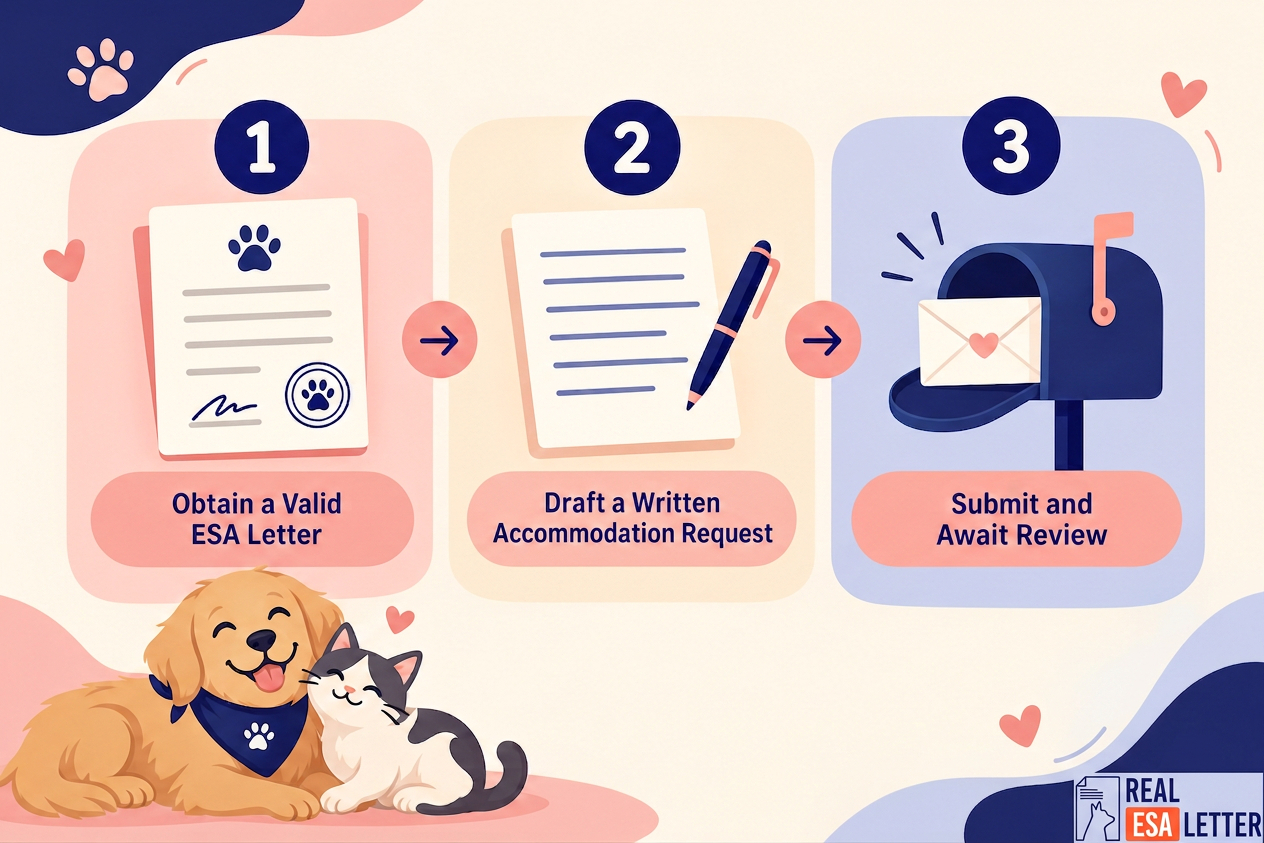
To request an Emotional Support Animal (ESA) pet deposit waiver or refund, you must submit a written reasonable accommodation request along with a valid ESA letter from a state-licensed healthcare professional.
Steps to Request an ESA Pet Deposit Waiver
Conclusion:
Federal enforcement of ESA fee waivers narrowed on 22 May 2026, but the Fair Housing Act, the two-year right to sue, and state ESA laws all still stand. A pet deposit waiver now rests on clinical evidence rather than a blanket rule. A letter documenting a licensed clinician's evaluation and your disability-related need for the animal is what supplies that evidence. To legally bypass pet fees,get a valid ESA letter from a licensed healthcare professional, who understands federal and your state laws.
Frequently Asked Questions
Does the HUD animal-accommodation memorandum apply to Section 504 or the ADA?

No. The HUD memorandum strictly applies to the Fair Housing Act. It does not affect complaints under Section 504 of the Rehabilitation Act or the ADA.
Do I have to pay a pet deposit if I have an ESA?
It depends on your state law and your housing provider's response to a written accommodation request. Federal enforcement narrowed in May 2026, but state emotional support animal protections were not changed.
Does an ESA letter waive a pet deposit?
Not automatically. An ESA letter documents the disability-related need that a fact-specific accommodation request now has to establish, and it remains required for any waiver request.
Can I get my pet deposit back with an ESA letter?
Possibly, but not automatically. A tenant who has already paid a pet deposit should submit a written reasonable accommodation request with clinical documentation. If the housing provider refuses, a Fair Housing Act claim can be filed within two years.
Do state ESA laws still apply to pet deposits?
Yes. HUD's May 2026 memorandum governs federal complaint processing only. State and local emotional support animal protections were not changed, and in several states they are broader than federal law. Because the answer depends on where you rent, compare ESA laws state by state before deciding whether a pet deposit is contestable.
Dr. Avery Langston is a health and wellness writer with 12+ years of experience covering ESA rights, housing laws, and mental health. As a senior contributor for RealESALetter, she helps readers understand ESA regulations and legal protections.

Darren Rafel is a licensed clinical social worker with active LCSW licenses across 13 states, including California, New Jersey, Texas, Florida, and Arkansas. He conducts ESA evaluations with direct clinical experience using pet therapy as part of mental health treatment.

Don't worry. Your pet stays with you.
Housing law is on your side
- 1A few questions. That's your paperwork
- 2A licensed therapist reviews your case
- 3Official ESA letter, ready to send
Not accepted? Full refund, guaranteed