Licensed in All 50 States Letters Accepted Nationwide 100% Money-Back Guarantee

Home

>

Blog

>

Esa Letter Rejected

Harper Jefcoat
Harper Jefcoat

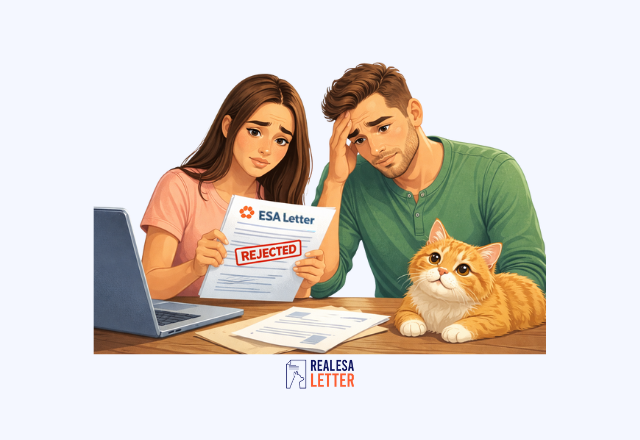
ESA Letter Rejection Explained: What You Need to Know to Get Approved

Read Time

11 min read

Why Your ESA Letter Was Rejected

On This Page

ESA letters are often rejected when they fail to meet legal requirements, lack proper provider credentials, or fail to comply with California’s AB 468 standards. A denial is frustrating, especially when your emotional support animal plays a crucial role in your well-being. 

Many people believe that having a real ESA letter is enough, only to discover that their documentation doesn’t meet legal requirements. Most rejections happen because people unknowingly use fake websites, outdated services, or providers who aren’t licensed in their state. 

Let’s break down why ESA letters get denied and what steps you can take to fix the issue and move forward.

Common Reasons for Rejection of Your ESA Letter

Many ESA letters are rejected because they fail to meet the legal and professional standards required under the Fair Housing Act. Understanding these reasons makes it easier to identify what went wrong with your own documentation. 

1. You Used an Online ESA “Registration” or “Certification.”

Many people rely on websites that offer instant ESA registrations, certificates, or ID cards. These services look official but have no legal standing. There is no federal ESA registry or certification system. The Fair Housing Act recognizes only one document: a legitimate ESA letter written by a licensed mental health professional.

Signs your letter came from a fake service:

  • Promises of “instant approval” with no evaluation
  • ESA ID cards or badges instead of a letter
  • “Lifetime registration” or “national registry” claims
  • No real provider’s name or license listed

If your landlord saw any of these signs, the rejection was inevitable. Registrations are not real. Only an ESA letter written after a proper evaluation counts.

2. The Letter Was Not Written by a Licensed Mental Health Professional (LMHP)

A landlord can deny an ESA letter if the person who wrote it is not legally qualified to diagnose or evaluate mental health conditions. Many cheap ESA websites use unlicensed contractors or people with no mental health credentials.

A valid ESA letter must come from:

  • Psychologist (PhD)
  • Psychiatrist (MD/DO)
  • Licensed Clinical Social Worker (LCSW)
  • Licensed Professional Counselor (LPC)
  • Licensed Mental Health Counselor (LMHC)
  • Licensed Marriage & Family Therapist (LMFT)
  • relevant Nurse Practitioners (state-dependent)

Landlords can verify licenses through state databases. If the provider’s credentials don’t appear there, your letter is invalid.

3. The Provider Was Not Licensed in Your State

Even if your provider is licensed, your landlord can reject the ESA letter if the license is not from your state. The Fair Housing Act requires that the mental health professional be licensed in the state where the tenant lives. If you’re unsure who qualifies, review who can write an ESA letter to ensure your provider meets the legal requirements.

For example:

  • You live in Texas
  • Your provider is licensed in New Jersey
  • Landlord verifies the license

This is one of the most common reasons people are denied without knowing why.

4. Your ESA Letter Was Missing Required Legal Details

A legitimate ESA letter must include specific elements. If any of these are missing or unclear, landlords are legally allowed to deny the request.

A valid ESA letter must include:

  • Provider’s full legal name
  • Provider’s license number
  • License issuing state
  • License type
  • License issue and expiration date
  • Official clinic letterhead
  • Clinic address and phone number
  • Statement that you have a mental/emotional disability
  • Statement that the ESA helps reduce symptoms
  • Date of issuance (must be recent)
  • Provider’s signature

Letters lacking these details appear unverified or informal, which leads to rejection.

5. Your ESA Letter Was Too Old or Expired

Most landlords require ESA letters that are less than 12 months old, and this has become standard practice across housing providers. If your letter is older than a year or reflects outdated information, your landlord is allowed to reject it. 

Older letters often create problems when the provider is no longer practicing, the letter mentions symptoms that are no longer current, the tenant’s address has changed, or your mental health needs a refreshed evaluation. 

Renew your ESA letter regularly to avoid these issues. An updated, current letter resolves this problem immediately.

6. The ESA Letter Looked Fake or Unprofessional

Landlords see fake ESA letters often, so they can recognize suspicious formatting. Letters that look copied, poorly formatted, or unusually short raise red flags.

Landlords often reject letters that have:

  • No letterhead
  • No clinic contact details
  • Typos or grammar errors
  • Generic templates
  • No signature
  • Missing date
  • Fake-looking seals

If you’re unsure how a proper ESA letter should look, review a sample of a legitimate ESA letter to compare your document against the correct format. Even if the letter comes from a real provider, poor formatting can still lead to denial.

Check out our sample ESA letter to see exactly what a compliant document should look like before submitting yours:

Sample ESA Letter

7. You Did Not Follow the Landlord’s Accommodation Process

Some landlords require specific forms in addition to your ESA letter. If you only submitted the letter and ignored the required steps, the landlord may reject the request until the process is complete.

Examples of additional requirements might include:

  • A reasonable accommodation form
  • Provider verification form
  • Tenant acknowledgment form

This does not mean your ESA is denied permanently; it means your application is incomplete.

8. The Landlord Had Concerns About the Animal’s Behavior

Even with a valid ESA letter, landlords may deny the animal (not the disability) if it poses a safety threat. The Fair Housing Act allows them to reject ESAs that:

  • Have a history of aggression
  • Bite or threaten people
  • Damage property
  • Disturb neighbors consistently

This is not discrimination; it is a safety exception.

9. You Didn’t Respond to Reasonable Questions

Landlords cannot ask for your diagnosis, medical history, or personal health records. But they can ask simple clarification questions if something in the letter is unclear.

Common landlord questions include:

  • “Can you confirm the provider is licensed in this state?”
  • “Can you provide the provider’s full contact details?”
  • “When was the letter issued?”

If you didn’t answer or sent incomplete replies, your request might have been rejected.

If your ESA letter was denied, don’t wait! Connect with a licensed mental health professional to get proper guidance today. 

What To Do If Your ESA Letter Is Rejected by Your Landlord

If your landlord denies your ESA letter, don’t panic. In many cases, the denial happens because something in the documentation was unclear, missing, or misunderstood. Below are 10 practical actions you can take to resolve the issue effectively and legally.

Make Sure Your ESA Letter Is Actually Legitimate

The first step is to double-check that your ESA letter meets all legal requirements. Many tenants unknowingly use letters from fake ESA sites that sell “registrations,” “certifications,” or “instant approvals.” These are not valid and will always be denied.

A legitimate ESA letter must include:

  • Your LMHP’s full name, license number, license state, and contact details
  • The provider’s signature and the date of issuance
  • Official letterhead from the provider or clinic
  • A statement confirming that you have a mental/emotional disability under the DSM-5
  • Confirmation that an ESA helps reduce symptoms related to that disability
  • Your name and basic identifying information
  • A brief description of the animal
  • The provider must be licensed in your state

Your letter should also be issued within the last 12 months. If everything checks out, you can move on to the next step.

Talk to Your Landlord Calmly and Clearly

Before assuming the worst, try discussing the situation with your landlord. Keep the conversation steady and respectful. Many denials happen because landlords misunderstand ESA laws or confuse ESAs with pets.

You can mention the Fair Housing Act (FHA) and explain that ESAs are protected assistance animals. You may also share official HUD resources to help them understand the law.

If the landlord still refuses, move to the next step.

Ask for a Written Reason for the Denial

If your landlord continues to deny your ESA, ask them to provide their reason in writing. This helps in two ways:

  1. You get clarity about what exactly needs to be fixed.
  2. You now have documentation in case you need to file a complaint later.

A landlord must provide a valid, legally acceptable reason for the denial.

Remind Your Landlord That an ESA Is Not a Pet

Sometimes landlords deny ESAs because they confuse them with regular pets. You may need to clearly explain that:

  • ESAs are assistance animals
  • “No-pet” policies do not apply
  • Pet fees, pet deposits, and breed restrictions cannot be charged

Because fake ESA letters are common, landlords tend to be skeptical. A simple clarification that your ESA is a mental health accommodation—not a pet—can resolve misunderstandings quickly.

File a Complaint With HUD

If your landlord still refuses despite having valid documentation, you can file a complaint with the U.S. Department of Housing and Urban Development (HUD).

To file, you should gather:

  • Your ESA letter
  • The written denial from your landlord
  • Dates of communication and any messages exchanged
  • Landlord’s name and address
  • Your contact information

HUD accepts complaints:

  • Online
  • By phone
  • By mail (paper form)

HUD will review your case, contact your landlord, and may take action if discrimination is found. Housing providers are also prohibited from retaliating against you for filing a complaint.

Contact Your Local Fair Housing Agency

If you prefer a faster or more local solution, you can reach out to:

  • Your state’s civil rights office
  • A local fair housing agency
  • City or county disability services

These agencies often resolve housing disputes more quickly and can help mediate between you and your landlord. You can also escalate your complaint to the Civil Rights Division of the Department of Justice if needed.

Speak With a Fair Housing Attorney

If the situation becomes difficult or the landlord refuses to follow the law, consider consulting a fair housing attorney. These lawyers specialize in housing discrimination and ESA rights.

A lawyer can:

  • Review your ESA letter
  • Communicate directly with your landlord
  • Send a formal demand letter
  • File a complaint on your behalf
  • Represent you in court, if necessary

Many tenants find that once a lawyer becomes involved, landlords quickly change their approach.

Check Whether Your State Offers Extra ESA Protections

Beyond federal protections under the FHA, some states and cities offer additional ESA rights. For example:

  • New York: NYC Human Rights Law protects ESA owners in housing
  • California: Civil Rights Department (CRD) enforces disability housing protections

Research your state’s laws on ESA to see whether you have extra resources or legal advantages available to you.

Inform Landlord of Legal Consequences

If your landlord is simply unaware of ESA laws, you can remind them that denying a legitimate ESA letter can result in:

  • HUD penalties
  • Fines
  • Legal action
  • Damages for discrimination

You don’t need to threaten them. A simple, factual explanation is enough. Many landlords change their position once they understand the potential legal consequences.

How to Get a Valid ESA Letter 

Understanding the structure and legal requirements of an ESA letter helps clarify why landlords accept some letters and reject others. The following section explains the key elements that make an ESA letter valid under housing laws. 

Step 1: Work With a Legit Licensed Mental Health Provider

This is non-negotiable. Avoid websites selling “registrations” or “instant approvals”. A real ESA assessment involves a short evaluation or questionnaire reviewed by a licensed provider.

Step 2: Make Sure the Provider Is Licensed in Your State

Before scheduling, double-check the provider’s license number in your state’s public database. If they are not licensed where you live, your landlord will reject the letter again.

Step 3: Ensure the ESA Letter Includes All Required Details

Your provider must include:

  • Full name
  • License number
  • License state
  • Clinic information
  • Date
  • Signature
  • Clear disability and need statement

This prevents most rejections.

Step 4: Submit Your ESA Letter in Writing and Keep Proof

Send your letter through:

  • Email
  • Tenant portal
  • Certified mail (rarely needed)

Keep all communication documented.

If you want a legit ESA letter, there’s no need to guess what’s required. Get assessed by a licensed mental health professional who can provide fully compliant ESA documentation.

In conclusion, if your ESA letter was rejected, it does not mean your needs are not real or that you did anything wrong. Most denials happen because the documentation didn’t meet the requirements of the Fair Housing Act, not because you don’t qualify. 

By getting a proper ESA letter from a licensed mental health provider in your state, you ensure your request is compliant, verifiable, and legally protected. Once your documentation is valid, your landlord must accept your emotional support animal unless the animal poses a genuine safety risk.

Using a reliable and legitimate service is key to preventing future denials. Working with licensed providers ensures you receive an online ESA letter that meets all Fair Housing Act requirements. With proper documentation in place, you can avoid unnecessary stress and confidently maintain your emotional support animal in your home.

Frequently Asked Questions

Can you be denied an ESA letter?

FAQ Icon

Yes. You can be denied an ESA letter if a licensed mental health professional determines that you do not have a qualifying emotional or mental health condition.

They must believe that an emotional support animal is necessary as part of your care for the letter to be approved. You can also be denied if you try to obtain a letter through fake ESA websites that offer instant approvals, registrations, or certificates without any real evaluation. 

How can I get a legit ESA letter?

FAQ Icon

To get a legitimate ESA letter, you must complete a mental health evaluation with a licensed mental health professional (LMHP) who is licensed to practice in your state. 

After the evaluation, the provider will issue a formal ESA letter on official letterhead. This includes their license number, license state, contact information, your need for an ESA, and how the animal helps with your symptoms. Avoid websites that sell ESA “registrations,” “certifications,” or ID cards; these are not legally valid.

How can an ESA be verified?

FAQ Icon

A landlord can verify an ESA by checking the credentials of the provider who issued the letter, not by asking for your diagnosis or medical records. They can:

  • Confirm the provider’s license number and licensing state
  • Verify that the provider is licensed in the tenant’s state
  • Confirm the clinic or practice information
  • Request clarification if the letter is missing required details

They cannot call the provider to ask about your condition, but they can confirm that the letter was written by a legitimate, licensed professional.

When can a landlord legally reject an ESA in Texas?

FAQ Icon

In Texas, a landlord can legally reject an ESA if:

  • The ESA letter is fake, incomplete, or not written by a licensed professional
  • The provider is not licensed in Texas
  • The tenant does not have a qualifying disability under the Fair Housing Act
  • The animal poses a direct threat to others (aggressive, violent behavior)
  • The animal causes major property damage
  • The ESA request places an “undue burden” on the housing provider

Texas follows the federal Fair Housing Act, so ESA rights and denial conditions are the same as in most states. A landlord in Texas cannot deny an ESA simply because of breed size, weight, pet rules, or a “no-pet” policy.

Harper Jefcoat

WRITTEN BY

Harper Jefcoat

Harper Jefcoat is a licensed mental health professional with over a decade of experience in emotional support animal (ESA) evaluations, counseling, and ESA-related legal guidance. With a strong background in therapy and mental health advocacy, Harper has helped thousands of clients receive legitimate ESA letters while promoting emotional well-being. As the official blog author for RealESALetter.com, Harper is dedicated to educating the public on ESA benefits, laws, and mental wellness.

Get Approved Quickly by Real Doctors.

Fully Legitimate and Safe.

legally compliant Apply Now

Share this Article

Closed Icon

Login

Enter your email and password to access your account

Please enter a valid email address

Please enter your password

Show Password

Don’t have an account? Sign Up

Forgot Your Password?

Enter your registered email to receive your password

Please enter a valid email address

Return to login page or signup to create a new account

OTP

Check Your Email to Verify Your Account

We’ve sent a 4-digit verification code to .

Enter it below to confirm your email and continue your ESA process.

Didn’t get the code? Resend Code

Entered the wrong email? Go Back

Mail gif

Your password has been sent to