Sign In / Create Account
What Does a Real ESA Letter Look Like? All You Need to Know
A real ESA letter is a one-page medical document with a licensed mental health professional's letterhead. It's not a certificate, badge, or registry card.

An ESA letter from RealESALetter.com looks exactly like the licensed documentation a landlord expects to see.
Below, you'll see exactly what's written on one, what's required, and what a fake version gets wrong.
Key Takeaways
One-Page Format: A real ESA letter is a single page, usually 200 to 300 words.
Six Required Fields: Provider credentials, license number, issue date, patient ID, statement of need, and signature.
Not a Certificate: A legitimate letter has no badges, seals, or registry numbers.
Same Format Nationwide: The required format doesn't change by state. Only some content details do.
The Basic Format of a Real ESA Letter
An ESA letter is short by design, usually 200 to 300 words on a single page. There's no cover sheet, exhibits, or attachments beyond the signed letter itself.
It reads like a doctor's referral note: plain, clinical, and brief, written and signed by a licensed mental health professional on that provider's own letterhead.
For a full breakdown of what is an ESA letter and how it's legally different from other animal documentation, see our complete guide.
Before applying for an ESA letter online, it helps to know what the finished document actually looks like, so there are no surprises when it arrives.
And if you're not yet sure your condition qualifies, start with qualifying conditions for an ESA before requesting one.
Here is a sample ESA letter:
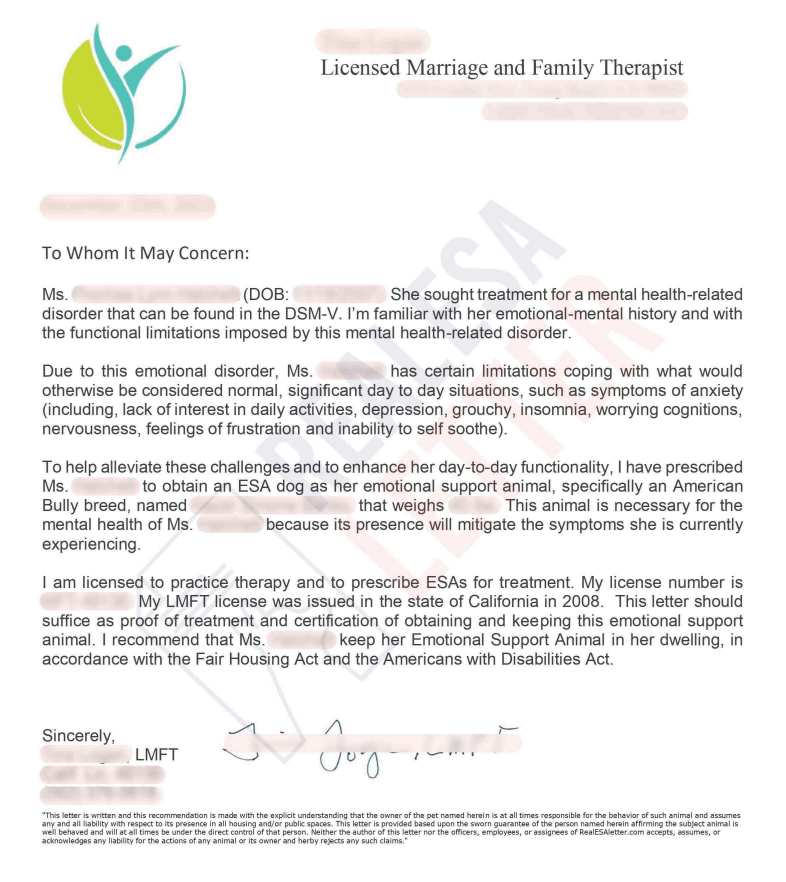
See What's Actually Written on ESA Letter
A typical ESA letter follows six parts, always in the same order.
Here's roughly how each part reads in practice:
Header
Dr. Jane Whitfield, LCSW Cedar Grove Behavioral Health 414 Maple Street, Suite 200, Denver, CO 80202 (303) 555-0148 · jwhitfield@cedargrovebh.com License #: LCSW.0041782, State of Colorado
Why it matters: this is what lets a landlord independently verify the provider is real and currently licensed, instead of just taking the letter's word for it.
Patient Statement
"This letter confirms that [Patient Name] is currently under my care and has been diagnosed with a mental health condition recognized under the DSM-5."
Why it matters: this confirms an actual, ongoing patient relationship exists, the detail that separates a legitimate letter from a same-day online form.
Statement of Need
"Due to this condition, [Patient Name] experiences symptoms, including heightened anxiety and difficulty with emotional regulation, that are significantly eased by the presence of an emotional support animal."
Why it matters: this is the legal nexus connecting the diagnosis to the animal. Without it, a letter is just a diagnosis disclosure, not grounds for a reasonable accommodation request.
Recommendation
"Based on my clinical evaluation, I am recommending an emotional support animal as part of [Patient Name]'s ongoing treatment plan."
Why it matters: this is the line that turns the clinical assessment into an actual, actionable request a landlord can respond to.
Animal Details
species and breed of the ESA (for example, "domestic shorthair cat" or "Labrador retriever mix").
Why it matters: it ties the accommodation to one specific animal, so the letter can't later be stretched to cover a different pet.
Signature Block
The provider's signature, printed name, license type, and the date the letter was issued.
Why it matters: a dated, genuine signature is what makes the letter enforceable, an unsigned or undated letter isn't a valid accommodation request.
Only a licensed mental health professional, a therapist, psychologist, psychiatrist, or LCSW, can complete this document. Exact wording varies by provider, but this structure is consistent across legitimate letters. Read to understand who can write an ESA letter.
Required Fields on a Legitimate ESA Letter
A valid ESA letter must include six specific fields to be considered legitimate.
- Provider credentials: name, practice, and license type of the person who wrote it
- State license number: lets a landlord confirm the provider is real and currently licensed
- Issue date: most letters are treated as valid for about one year from this date
- Patient identification: your full name and confirmation that you're an active patient
- Patient clinical condition and need: a short line connecting your condition to the need for an ESA
- Provider signature: wet or digital, dated by the provider
Every RealESALetter.com letter includes the clinician's state license number, issue date, and direct contact information, as required under the Fair Housing Act.
If you're wondering how long an ESA letter stays valid, the issue date above is where that clock starts.
Has HUD's 2026 Guidance Changed What's Written on the Letter?
No, the letter's format and required fields haven't changed. What changed is how much federal enforcement weight it carries once a landlord sees it.
The header, statement of need, animal details, and signature described above are the same fields a legitimate ESA letter has contained for over a decade. What's different is the regulatory backdrop behind that letter.
The Fair Housing Act itself hasn't changed, and a reasonable accommodation request can still be made and evaluated case by case.
For the full breakdown and understanding, see our HUD ESA enforcement guide.
What an ESA Letter Does NOT Look Like
A legitimate ESA letter can never look like:
- Not a certificate: no gold seals, decorative borders, or "official" graphics
- Not an ID card: no wallet card, vest tag, or laminated badge
- Not a registry entry: there's no U.S. government ESA registry, so a "registration number" means nothing on its own
- Not proof by itself: a letter without a real license number or provider signature isn't valid, no matter how official it looks
If you're evaluating whether an online ESA letter service is legitimate, the presence or absence of these exact details is the easiest way to check.
Does the ESA Letter Format Change by State?
No, the required format of an ESA letter is the same in every state. Only some content requirements change from state to state.
The letterhead, credentials, and signature requirements come from the federal Fair Housing Act, so they apply nationwide. What does vary is state-specific detail, for example, a handful of states require a minimum length of relationship with your provider before they can write the letter.
Check state-specific ESA laws for your state's exact rules.
The Bottom Line
A real ESA letter is a plain, one-page document, nothing more than that. If your current letter, or the one you're about to get, is missing any of these pieces, that's worth addressing before you hand it to a landlord.
Ready to see if you qualify? Start your free ESA letter evaluation and get a properly formatted letter from a licensed provider.
Frequently Asked Questions
Does the ESA letter need a wet signature, or is a digital signature acceptable?

A digital signature is accepted by most landlords and providers. It just needs to be a real signature, not a typed name. Some states or specific landlords may still ask for a wet signature, so it's worth checking local requirements if you anticipate pushback.
Does it have to be mailed, or is a digital copy of the ESA letter accepted?
A digital copy, PDF or email attachment is standard and accepted almost everywhere. Very few landlords still require a physical mailed original, though it's reasonable to keep one printed copy on hand just in case.
Does the ESA letter need to be printed on special letterhead, or can it be a plain page?
It needs to be on the provider's own official letterhead, not a generic template. The letterhead itself doesn't need to be elaborate, a standard practice header with the provider's name, address, and contact information is enough.
Does the ESA letter need a raised seal, stamp, or notarization to look official?
No. A raised seal or notarization isn't required, and most legitimate letters don't have one. What makes a letter official is the provider's license number, signature, and letterhead, not a decorative seal.
Does the ESA letter look different for a cat versus a dog?
No. The letter's format stays the same regardless of species. Only the animal-details field changes. The provider simply notes the type and breed of the animal in that one section.
Does an ESA letter for housing look different from one for travel or school?
No. The same document format works across housing, campus housing, and most other uses. What can differ is which specific details a landlord, school, or airline asks to see, not the letter's underlying format.
Harper Jefcoat is a content writer with 10+ years of experience covering ESA laws, mental wellness, and emotional support animal benefits. As a blog author for RealESALetter, he educates readers on ESA regulations and promotes ethical documentation practices.

Tina Logan is a Licensed Marriage and Family Therapist with 20+ years of clinical experience and an active California Board of Behavioral Sciences license. She conducts ESA and psychiatric service dog evaluations for RealESALetter assessing whether an ESA or task-trained PSD is clinically appropriate.

Don't worry. Your pet stays with you.
Housing law is on your side
- 1A few questions. That's your paperwork
- 2A licensed therapist reviews your case
- 3Official ESA letter, ready to send
Not accepted? Full refund, guaranteed