Sign In / Create Account
Are Emotional Support Animals Allowed in Hotels?
Emotional support animals are not legally allowed in hotels, because temporary lodging is not covered by the Fair Housing Act . Under the Americans with Disabilities Act, only service animals qualify for guaranteed access to hotels and other places of public accommodation.

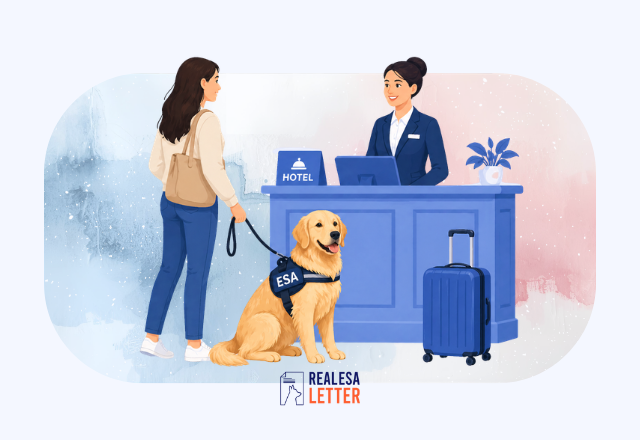
ESAs are not service animals under the ADA, so hotels may treat them as regular pets.
Here’s how hotel ESA policies work, what federal law says, and what you should expect before booking your stay.
Key Takeaways
Hotels Can Say No: The ADA only protects trained service animals in public places. Each hotel decides about ESAs on its own.
Housing Law Stops at the Door: The Fair Housing Act covers homes and apartments. Hotels and motels are not covered.
Expect Pet Fees: One-time fees run $25 to $150 per stay. Nightly fees run $10 to $50. Weight and breed limits also apply.
Service Dogs Are Treated Differently: Hotels must allow them with no fee. Staff can ask only two questions.
30 Nights Can Change Things: A long stay may count as your home under the FHA. Courts have not settled this yet.
Your Letter Still Helps: Showing a letter from a licensed therapist can win approval. Some hotels waive the fee.
Where Your Pet Can Go: Guest rooms, lobbies, and hallways are usually fine. Restaurants, pools, and gyms are not.
Two States Add Protection: California and New York ban disability discrimination in businesses. Neither state forces hotels to accept ESAs.
How Hotels Generally Handle ESAs?
Most hotels decide whether to accept ESAs based on their own pet policies, rather than federal law. Here's how these policies typically work:
- Standard pet rules apply. Since an ESA is not classified as a service animal, a hotel can treat it as an ordinary pet. You will usually need a pet-friendly property, and you may have to pay standard pet fees and follow the hotel's weight and breed restrictions.
- There are no automatic exemptions. Federal housing protections such as the Fair Housing Act do not extend to short-term hotel stays, and a doctor's ESA letter does not guarantee that a hotel will accept your animal.
- Trained service animals are the exception. Fully trained service dogs that perform tasks for a person with a disability are allowed in all guest areas of a hotel, cannot be charged a pet fee, and the handler remains responsible for any damage caused.
Because acceptance is set property by property, the same ESA can be welcomed at one Marriott and refused at another location of the same chain. This is the critical distinction between an emotional support animal and a service animal: a service animal must be accommodated, while an ESA is accepted only at the hotel's discretion.
Always contact the specific hotel in advance to confirm its pet policy and that a pet-friendly room is available.
An ESA letter carries no legal weight at a hotel, but presenting one often helps, and some properties reduce or waive pet fees voluntarily. RealESALetter.com letters include the clinician's license details, so front desk staff can verify one on the spot.
Emotional Support Animals vs. Service Animals in Hotels
Most hotels classify emotional support animals under their standard pet policies rather than as service animals. This classification has significant implications for fees, restrictions, and accommodation requirements. Understanding how hotels categorize your ESA helps you anticipate potential challenges and plan accordingly.
Service Animal | Emotional Support Animal (ESA) | |
Governing law | ADA (42 U.S.C. § 12182) | No federal hotel protection |
Must the hotel allow it? | Yes | No, it is the hotel's discretion |
Pet fees charged? | No, prohibited | Yes, the hotel may charge |
Documentation required? | No, staff may ask only two questions | An ESA letter helps but is not legally required |
Can the hotel ask about your disability? | No | No |
Can the hotel deny access? | Only if the animal is out of control or poses a direct threat | Yes, at any time, for any reason |
Breed or size limits apply? | No | Yes, the hotel's own rules apply |
The Legal Limits of ESA Rights in Hotels
Two federal laws are often confused here, and they apply to very different situations.
The Americans with Disabilities Act (ADA)
The ADA governs public accommodations, including hotels, restaurants, and stores. Under the ADA (42 U.S.C. § 12182 and 28 C.F.R. § 36.302(c)), hotels are required to accommodate service animals only: dogs, and in limited cases miniature horses, that are individually trained to perform tasks for a person with a disability.
Emotional support animals are not covered by the ADA. As a result, hotels are not federally required to waive pet fees, modify no-pet policies, or make special accommodations for ESAs. When a hotel allows an ESA, it does so voluntarily under its pet-friendly policy.
The Fair Housing Act (FHA)
The Fair Housing Act (42 U.S.C. § 3604(f)) protects ESAs in residential housing and requires landlords to make reasonable accommodations, even in no-pet buildings. But the FHA applies only to long-term housing. Hotels, motels, and short-term lodging are not considered housing under the FHA, so it does not require hotels to accommodate ESAs or waive fees.
Why Hotels Are Not Required to Accommodate ESAs
The absence of ESA hotel protections comes from how the law classifies hotels: temporary lodging and public accommodations, not residential housing. Only service animals receive guaranteed access.
This gives hotels broad discretion. Some chains choose to welcome ESAs as part of flexible pet programs, while others apply standard pet rules, including fees, breed limits, and size restrictions.
The Extended-Stay Exception (30+ Nights)
There is one narrow situation where the FHA could apply to a hotel stay: an extended stay of 30 or more consecutive nights. When a guest stays in a hotel long enough for the room to become their primary residence, the situation may change.
Some courts and housing advocates have argued that the property could qualify as a dwelling under the Fair Housing Act (FHA). If that interpretation applies, the hotel may be required to reasonably accommodate an ESA, including waiving pet fees.
This is not settled law, and outcomes vary by state and property type. If you are planning a stay of 30 or more nights, ask whether long-term stays are treated differently, and present your ESA letter with a specific reference to the FHA if the stay qualifies as a primary residence.
Extended Stay America, Candlewood Suites, and Staybridge Suites regularly host long-term guests and may be more familiar with this nuance.
For standard stays under 30 nights, the FHA does not apply. Do not cite it when booking a typical short-term stay, because it will not help and may create friction with staff.
Do Hotels Have to Allow Service Animals?
Yes. Hotels are legally required to allow trained service animals under the ADA, with no pet fee and no breed or size restriction. This is the opposite of the rule for ESAs.
Because service animals are protected, staff may ask only two questions:
- Is this a service animal required because of a disability?
- What work or task has the dog been trained to perform?
Staff cannot ask about your disability, demand documentation, require the animal to wear a vest, or charge a pet fee. A hotel may only remove a service animal if it is out of control and the handler does not regain control, or if it poses a direct threat to health or safety.
Can Hotels Charge for Service Dogs?
No. Charging a pet fee for a trained service dog is not permitted under the ADA. A hotel may charge you for actual damage the animal causes, the same way it would charge any guest for damage, but it cannot impose a standard pet fee or deposit on a service dog.
Can Hotels Charge for Emotional Support Animals?
Yes. Because ESAs are not protected in hotels under federal law, a hotel that charges pet fees can apply those same fees to an ESA. There is no federal rule that forces a hotel to waive them. Some properties reduce or waive fees voluntarily when you present a valid ESA letter, but that is a courtesy, not an obligation.
Emotional Support Animal Hotel Fees: What to Expect
Costs vary widely by brand, location, and property class. Typical structures include:
Fee type | Typical range | Notes |
One-time pet fee | $25 to $150 per stay | Usually non-refundable |
Nightly pet fee | $10 to $50 per night | Adds up on longer stays |
Refundable deposit | $100 to several hundred dollars | Returned after a clean-room inspection |
Cleaning fee | Varies | Sometimes included in the pet fee, sometimes separate |
Hotel pet fees change frequently and differ between locations of the same chain. Always confirm every potential charge during booking, request written confirmation of any fee waiver, and re-verify with your specific property 24 to 48 hours before arrival.
Common Hotel Restrictions for ESAs
Hotels that accept ESAs usually apply standard pet rules:
- Size and weight limits. Many cap animals at around 50 pounds, though some accept larger animals with advance approval.
- Breed restrictions. Breeds often deemed high-risk, such as pit bulls, rottweilers, German shepherds, and Doberman pinschers, may be prohibited regardless of ESA status. Restrictions vary by property.
- Room availability. Pet-friendly rooms are often limited, and may be specific ground-floor rooms or wings.
- Supervision. Animals generally cannot be left unattended, or must be crated if you step out.
- Leash and control. Outside the room, ESAs must be leashed or otherwise controlled.
- Behavior. Hotels can remove animals that are aggressive, excessively noisy, or destructive.
Can You Bring an Emotional Support Cat to a Hotel?
Yes, at pet-friendly hotels that accept cats, an emotional support cat is treated the same way as an ESA dog: allowed at the hotel's discretion, usually with a pet fee, and subject to the property's rules.
A few cat-specific points:
- Not every pet-friendly hotel accepts cats. Some limit their pet policy to dogs, so confirm that cats are included before booking.
- Bring a portable litter box, litter, and a familiar carrier, and set the litter box up in the bathroom away from sleeping areas.
- Cats are often quieter neighbors than dogs, which can help with approval, but the same fees and supervision rules apply.
Kimpton, La Quinta, and Red Roof Inn are among the chains most likely to welcome cats, since their pet policies tend to be broad. Always confirm with the specific location.
Where Your ESA Can and Can't Go Inside a Hotel
Access usually mirrors standard pet rules. Typically allowed:
- Your own guest room
- Lobby and check-in areas, while leashed
- Hallways and elevators, in transit to your room
- Designated pet relief areas and outdoor grounds
Typically not allowed:
- Restaurants, breakfast rooms, and dining areas
- Pools, hot tubs, and fitness centers
- Spas and business centers
- Meeting and event rooms
Trained service animals, by contrast, may accompany their handler anywhere guests are normally allowed.
What Hotels Can Legally Ask About Your ESA
Because ESAs are not covered by the ADA in hotels, the strict two-question limit that applies to service animals does not apply to ESAs. A hotel may ask:
- What type of animal is it?
- What is its size and breed?
- Do you have documentation, such as an ESA letter?
- Is the animal vaccinated?
A hotel cannot ask about the specific nature of your psychiatric or mental health condition. Disclosing a diagnosis is never required.
You are also not required to present an ESA letter, register your ESA anywhere, or have it wear a vest. That said, voluntarily presenting a valid ESA letter from a licensed mental health professional often smooths the process and can result in a fee waiver at properties that offer them.
A licensed mental health professional issues an ESA letter from RealESALetter.com and includes the clinician's state license number, issue date, and direct contact information, so a hotel can verify it independently.
If you don't yet have documentation, you can get an emotional support animal letter online through a live telehealth evaluation with a licensed clinician before your trip.
Major Hotel Chain ESA and Pet Policies
Policies change frequently, and franchise locations often differ from corporate standards. Always verify with your specific property before booking.
Chain | General approach | Typical fee | Notes |
La Quinta Inn & Suites | Very pet-friendly | Often none | Many locations have no weight limit |
Red Roof Inn | Pet-friendly | Often none | One well-behaved pet per room at most locations |
Kimpton | Very pet-friendly | None at most properties | No weight or breed limits at most properties |
Marriott (Residence Inn, TownePlace) | Varies by brand | Around $100 per stay at extended-stay brands | Extended-stay brands are more accommodating |
Hilton (Hampton, Homewood, DoubleTree) | Franchise-dependent | $50 to $150 per stay | Weight limits often around 75 lbs |
Holiday Inn / IHG (Candlewood, Staybridge) | Varies; extended-stay friendlier | Candlewood around $75 to $150 per stay | Ask about FHA rules for 30+ nights |
Best Western | Set by each franchise | Varies | Call the specific property |
Extended Stay America | Pet-friendly | About $25 per night, capped per stay | Guests have had success with FHA requests on 30+ night stays |
Marriott Emotional Support Animal Policy
Marriott has no single company-wide ESA guarantee; policy varies by brand and property, and ESAs are treated as pets.
Extended-stay brands such as Residence Inn and TownePlace Suites tend to be the most accommodating, with pet fees commonly around $100 per stay. Standard Marriott and Courtyard properties vary widely, so confirm directly with your location.
Hilton ESA Policy
Hilton's policy is franchise-dependent. Many properties accept pets with fees of roughly $50 to $150 per stay and weight limits of around 75 pounds. Hampton Inn locations vary, and Homewood Suites extended-stay properties tend to be more accommodating. ESAs do not receive automatic fee waivers.
How to Book a Hotel With Your ESA
Careful research is the difference between a smooth stay and a check-in problem.
- Book directly. Reserve through the hotel's own website or phone line so staff can note your request and make exceptions.
- Contact the property before booking. Explain that you have an ESA and ask about their specific policy, fees, room availability, and any breed or size limits. Keep the tone courteous rather than demanding.
- Share useful details. Species, breed, size, weight, and temperament. Hotels accommodate well-behaved, appropriately sized animals more readily.
- Mention your documentation. Say you have an ESA letter from a licensed mental health professional and offer to share it.
- Get it in writing. Ask staff to note the conversation on your reservation and send written confirmation of any waiver or arrangement.
- Request the right room. A ground-floor room near an exit makes bathroom breaks easier and reduces disturbance.
- Reconfirm 24 to 48 hours before arrival. This prevents surprises at check-in.
What Documentation to Prepare
Hotels are not required to request or accept ESA paperwork, but having it ready demonstrates responsibility and can help.
- ESA letter. A current ESA letter from a licensed mental health professional, on letterhead, with the provider's license information.
- Vaccination records. Especially rabies and core vaccines.
- Health certificate. Useful for extended stays or cautious properties.
- ID tags. With your contact information.
- Photo ID. For standard check-in.
How to Prepare Your ESA for a Hotel Stay
While emotional support animals don't require the specialized training mandated for service animals, preparing your ESA with basic behavioral skills is essential for successful hotel stays and maintaining positive relationships with accommodating properties.
Basic Obedience: Your ESA should reliably respond to fundamental commands including sit, stay, come, and down. These commands help you maintain control in hotel environments where unexpected situations may arise.
Housetraining: Complete, reliable housetraining is non-negotiable for hotel stays. Your ESA must consistently use designated outdoor areas for elimination and show no tendency toward indoor accidents. Any housetraining failures can result in cleaning fees, permanent bans, or damage to the reputation of ESA travelers generally.
Calm Behavior: An ESA at hotel properties must not create noise, disturbances, or safety concerns. Your ESA should remain calm in new environments, around strangers, and when exposed to unfamiliar sounds, smells, and situations common in hotel settings.
No Destructive Behavior: Chewing furniture, scratching doors, tearing bedding, or damaging property is unacceptable and will result in substantial damage charges. Practice leaving your ESA alone for brief periods to ensure they won't engage in destructive behavior when you step out temporarily.
Socialization: Expose your ESA to various environments, people, and situations before hotel travel. Well-socialized animals adapt more easily to the new sights, sounds, and experiences of hotel stays.
Noise Control: Excessive barking, howling, or meowing disturbs other guests and violates hotel quiet enjoyment policies. Train your ESA to remain quiet or address vocalization issues before traveling.
Consider working with a professional dog trainer or animal behaviorist if your ESA displays concerning behaviors. Investment in behavioral training protects your access to future accommodations and ensures positive experiences for everyone.
Health and Hygiene Preparation
Maintaining your ESA's health and cleanliness is crucial for hotel stays and demonstrates respect for the property and other guests:
Veterinary Checkup: Schedule a wellness examination before traveling to confirm your ESA is healthy and address any medical concerns. Discuss motion sickness medication if your animal experiences travel-related nausea.
Current Vaccinations: Ensure all vaccinations are up-to-date, particularly rabies, distemper, parvovirus, and kennel cough for dogs, or feline distemper and rabies for cats. Carry documentation as proof.
Parasite Prevention: Administer current flea, tick, and heartworm prevention to protect your ESA and prevent introducing pests to hotel rooms. Many hotels specifically prohibit animals with active flea infestations.
Grooming: Bathe your ESA shortly before travel to minimize odors and shedding. Trim nails to prevent damage to hotel flooring and furniture. Brush thoroughly to remove loose fur that could accumulate in hotel rooms.
Dental Care: Address dental hygiene to minimize bad breath, which can be particularly noticeable in enclosed hotel room spaces.
Special Needs: If your ESA has medical conditions requiring medication, treatments, or special care, prepare everything necessary to maintain their health routine during travel.
Bringing a clean, healthy, well-groomed animal significantly reduces the likelihood of complaints, damage charges, or accommodation refusals
Packing Essential Supplies
Comprehensive packing ensures your ESA's needs are met, and hotel property remains protected throughout your stay:
Food and Water:
- Sufficient food for the entire stay, plus extra in case of travel delays
- Portable food and water bowls
- Bottled water if your ESA has a sensitive stomach or you're traveling to areas with different water sources
Bedding and Comfort Items:
- Familiar blankets or bedding to cover hotel furniture and provide comfort
- Favorite toys for mental stimulation and stress relief
- Crate or carrier, if your ESA is crate-trained, is particularly useful if you need to leave them briefly
Waste Management:
- Waste bags for dogs
- Portable litter box and litter for cats
- Enzymatic cleaning solution for potential accidents
- Puppy pads as backup protection for hotel flooring
Protective Gear:
- Leash, harness, and collar with identification tags
- Protective booties if traveling to areas with extreme temperatures
- Raincoat or protective outerwear if weather conditions require
Health Supplies:
- All necessary medications with clear dosing instructions
- First aid kit specifically for animals
- Veterinary contact information and records
- Prescription documents for medications that are controlled substances
Cleaning Tools:
- Lint rollers for removing fur from furniture and bedding
- Pet-safe cleaning wipes
- Towels for drying wet paws or cleaning up minor messes
- Air freshener or odor neutralizer (pet-safe formulas)
Documentation:
- ESA letter and copies
- Vaccination records
- Hotel confirmation with notes about ESA accommodation
- Emergency veterinary clinic information for your destination
Thorough preparation demonstrates responsible animal ownership and minimizes the risk of problems during your hotel stay.
During Your Hotel Stay: Best Practices
The check-in process sets the tone for your entire hotel stay with your emotional support animal. Handling this interaction professionally prevents misunderstandings and establishes positive relationships with hotel staff:
Arrive Prepared: Have all relevant documentation readily accessible, including your reservation confirmation, ESA letter, and vaccination records. Don't make staff wait while you search through luggage.
Discreet Introduction: Keep your emotional support animal in the hotel calm and well-controlled during check-in. If possible, have a travel companion manage your animal while you handle registration paperwork or complete check-in procedures before bringing your ESA into the lobby.
Confirm Arrangements: Verify that front desk staff have noted your ESA accommodation in the system. Review any fees, deposits, or special room assignments related to your animal.
Ask for Information: Request details about designated pet relief areas, nearby parks or walking trails, waste disposal locations, and any specific hotel rules about animals in common areas.
Review Policies: Clarify the hotel's expectations regarding leaving your ESA alone in the room, using elevators or stairs, accessing amenities like pools or fitness centers, and any time restrictions for moving through the property.
Provide Contact Information: Share your cell phone number and confirm the best way for hotel staff to reach you if any concerns arise related to your ESA during your stay.
Express Appreciation: Thank staff for accommodating your emotional support animal. Positive interactions encourage hotels to maintain ESA-friendly policies and treat future guests with animals favorably.
Hotel Room Setup and Protection
Once you access your room, take immediate steps to protect hotel property and create a comfortable environment for your ESA:
Initial Inspection: Examine the room for potential hazards to your animal, including accessible electrical cords, small objects that could be swallowed, toxic plants, or gaps where small animals could become trapped.
Furniture Protection: Place your ESA's blankets or bedding on furniture they're likely to use, including beds, chairs, and sofas. This protects hotel linens and upholstery from fur, dirt, and potential damage.
Create a Designated Space: Establish a specific area for your ESA's belongings, including food bowls, water, toys, and bedding. This contained space minimizes disruption to the room and makes cleanup easier.
Bathroom Arrangements: If you have a cat, set up the litter box in the bathroom away from sleeping areas. Ensure dogs have quick access to outdoor relief areas by requesting a ground-floor room near exits.
Temperature Control: Adjust climate controls to keep your ESA comfortable, particularly if you'll be leaving them alone for short periods. Avoid extreme temperatures that could cause distress.
Secure Valuables: Place your own valuables in the room safe or secure locations where your ESA cannot accidentally damage them.
Window Safety: Keep windows and balcony doors securely closed if your ESA could potentially escape or fall. Many animals become curious in new environments and may behave unpredictably.
Minimizing Disturbances to Other Guests
Considerate behavior protects your access to future hotel accommodations and maintains positive perceptions of emotional support animals:
Noise Management: Keep your ESA quiet, particularly during late evening and early morning hours. Address barking, meowing, or other vocalizations immediately to prevent complaints from neighboring rooms.
Common Area Etiquette: When moving through hallways, lobbies, and other shared spaces, keep your ESA on a short leash under close control. Not all guests are comfortable around animals, and some may have allergies or phobias.
Elevator Protocol: If other guests are uncomfortable sharing elevators with your animal, politely wait for the next car. Maintain control of your ESA in confined spaces.
Designated Relief Areas: Use only approved outdoor areas for your ESA's bathroom needs. Always clean up immediately after your animal and dispose of waste properly in designated receptacles.
Avoid Prohibited Spaces: Respect restrictions on animals in dining areas, pools, fitness centers, and other locations where health codes or hotel policies prohibit pets.
Supervised Bathroom Breaks: Take your ESA out regularly, particularly after meals and before bedtime, to prevent indoor accidents. Establish a consistent schedule adapted to your animal's needs.
Damage Prevention: Never allow your ESA on hotel furniture unsupervised. Monitor behavior to prevent scratching, chewing, or other destructive actions.
Leaving Your ESA in the Hotel Room
Many hotels require animals to remain supervised at all times, but if your property allows brief unattended periods, follow these critical guidelines:
Check Policy First: Verify the hotel's specific rules about leaving animals alone in rooms. Some properties strictly prohibit it, while others allow brief absences with conditions.
Crate Training: If your ESA is crate-trained, using a secure crate when you leave reduces the risk of destructive behavior or escape attempts.
Time Limits: Minimize the duration your ESA is left alone. Brief errands are typically acceptable, but extended absences increase the likelihood of problems.
Bathroom Break: Take your ESA for a bathroom break immediately before leaving to reduce the chance of indoor accidents.
Comfort Items: Leave familiar toys, bedding, or clothing with your scent to provide comfort and reduce anxiety.
White Noise: Consider leaving a television or radio playing at low volume to mask hallway sounds that might trigger barking or anxiety.
Do Not Disturb Sign: Place a "Do Not Disturb" sign on your door to prevent housekeeping from entering while your ESA is alone, which could result in escape or staff injury.
Communication: Inform front desk staff that your animal is temporarily alone in the room and provide your contact number in case of emergencies.
Return Promptly: If you receive any contact from hotel staff about noise complaints or concerns related to your ESA, return immediately to address the situation.
Never leave your emotional support animal alone if they have separation anxiety, destructive tendencies, or excessive vocalization problems. Your responsibility for your animal's behavior doesn't end when you leave the room.
Alternatives to Traditional Hotels
- When traditional hotels present challenges, vacation rentals offer flexible alternatives that often welcome emotional support animals with fewer restrictions:
- Airbnb and VRBO: These platforms allow property owners to set individual pet policies. Many hosts welcome animals without the standardized restrictions common in hotels. Filter search results for "pets allowed" and communicate directly with hosts about your emotional support animal.
- Private Home Rentals: Entire home rentals provide privacy, dedicated outdoor spaces, and fewer concerns about disturbing other guests. These properties often suit ESAs better than shared-space accommodations.
- Negotiate with Owners: Direct communication with vacation rental owners allows you to explain your ESA situation, provide documentation, and negotiate any additional cleaning fees or security deposits.
- Extended Stay Options: For longer trips, monthly vacation rentals often provide better value and more ESA-friendly arrangements than hotels charging daily pet fees.
- Transparent Communication: Always disclose your emotional support animal during booking inquiries. Unexpected animals create conflicts and may result in booking cancellations or additional charges.
- Review Property Rules: Carefully read pet policies regarding size restrictions, breed limitations, outdoor access, and any requirements for supervision or containment.
- Consider Location: Properties in residential neighborhoods may have noise restrictions or homeowner association rules affecting animals. Urban rentals might offer easier bathroom access but less private outdoor space.
Pet-Friendly Hotel Chains
Certain hotel chains have earned reputations for particularly accommodating pet policies, making them reliable choices for ESA travelers:
- Kimpton Hotels: Industry-leading pet policy with no size restrictions, no pet fees, and welcoming amenities including pet beds, bowls, and treats. Kimpton properties provide some of the most ESA-friendly accommodations available.
- La Quinta Inn & Suites: No pet fees at most locations, acceptance of multiple pets, and relatively few size or breed restrictions make La Quinta a budget-friendly ESA option.
- Red Roof Inn: Economy-friendly choice allowing one pet per room with no additional fees and no weight restrictions at most locations.
- Loews Hotels: Premium properties with "Loews Loves Pets" program offering welcome amenities, treats, and dedicated pet services. Fees apply but accommodations are high-quality.
- Aloft Hotels: Modern, pet-friendly Marriott brand with stylish "Arf" program providing pet beds, treats, and welcome amenities. Fees vary by location.
- Best Western: Franchise-based chain with individual property pet policies, but many locations welcome animals with reasonable fees and fewer restrictions than competitors.
- Extended Stay America: Budget extended-stay properties that typically accept pets with modest daily fees, making them economical for longer trips.
- Research specific properties within these chains, as franchise locations may implement different policies than corporate standards.
What to Do If a Hotel Denies Your ESA
Hotels have the legal right to deny an ESA. If it happens, work through these steps in order:
- Ask for the specific reason. Breed restriction, no-pet policy, no available room, or missing documentation each have different solutions.
- Ask to speak with a manager. Front-desk staff may not know all the options a manager can authorize. Escalate politely.
- Offer your ESA letter. Many managers make exceptions when they see formal documentation. Do not claim legal rights the ADA or FHA do not give you in a hotel, because that tends to backfire.
- Offer a deposit. If the concern is damage risk, offering a refundable deposit often resolves breed or size hesitation.
- Document everything. If you are still denied, record the staff member's name, the date, time, and reason given.
- File a complaint if discrimination was involved. If you believe the denial was based on your disability rather than a legitimate animal policy, you can complain to the U.S. Department of Justice or the chain's corporate customer service. Most ESA denials are legally permitted, so pursue this only for disability-based discrimination.
- Find an alternative. Ask for a nearby pet-friendly recommendation, or search BringFido, Booking.com, or Hotels.com.
If you travel often and keep hitting hotel barriers, a Psychiatric Service Dog (PSD) may fit better. A PSD is trained to perform tasks for a psychiatric disability and receives full ADA public access rights, including mandatory hotel acceptance with no fees.
Do Any States Give ESAs Extra Hotel Protections?
Most states follow federal law: hotels are not required to accommodate ESAs and may charge fees and impose restrictions. Two states create limited additional considerations.
California. The Unruh Civil Rights Act (Cal. Civ. Code § 51) prohibits disability-based discrimination in all business establishments, including hotels. It does not require a hotel to accept ESAs, but a hotel cannot use a no-pet policy as a way to exclude guests specifically because of a disability-related need. If a California hotel refuses your ESA, the reason given matters legally, so document it.
New York. The New York State Human Rights Law (N.Y. Exec. Law § 296) covers disability discrimination in places of public accommodation. Like California, it does not mandate ESA access, but policies that effectively screen out guests with disabilities may face scrutiny. This applies statewide.
All other states. Federal law applies. Hotels are not required to accommodate ESAs and may charge fees and impose breed and size limits.
Bottom Line
Traveling with an ESA takes more planning than a standard stay, but it can still go smoothly. Because hotels have discretion over animal policies, research pet-friendly properties, contact them directly, prepare your documentation, and make sure your animal is calm and well-behaved in public.
Although ESAs do not have the legal protections service animals have in hotels, many properties choose to welcome them.
For travelers who need one,
RealESALetter.com connects people with licensed mental health professionals who evaluate ESA eligibility and issue letters that comply with the federal Fair Housing Act and applicable state law.
Frequently Asked Questions
Can hotels charge for emotional support animals?

Yes. Hotels can charge fees for emotional support animals because ESAs are not legally protected in hotels under federal law. Unlike service animals, ESAs are not covered by the ADA in public accommodations. Some hotels may waive fees voluntarily, but they are not required to do so.
Can hotels refuse my emotional support animal?
Yes, hotels can legally refuse emotional support animals. Unlike service animals, which are protected by the Americans with Disabilities Act (ADA), emotional support animals have no federal protections in hotel settings. Hotels are classified as public accommodations, not housing, so the Fair Housing Act also doesn't apply.
Individual hotels may choose to accommodate ESAs as a courtesy or under their pet policies, but they're not legally required to waive pet restrictions, fees, or breed limitations for emotional support animals. Some states have additional protections, but federally, hotels have broad discretion in setting animal policies.
Can I leave my ESA alone in the hotel room?
This depends entirely on the specific hotel's policy. Many hotels prohibit leaving animals unattended in guest rooms due to concerns about noise disturbances, property damage, or escape. Some properties allow brief absences if the animal is crated or has demonstrated calm behavior.
Always verify the hotel's policy on unattended animals during booking. If you must leave your ESA alone, inform the front desk, place a, Do Not Disturb, sign on your door, minimize the time away, and ensure your animal has had a recent bathroom break. Never leave an ESA alone if they have separation anxiety or destructive tendencies.
Do I need to register my ESA to stay in hotels?
No legitimate ESA registry exists. Websites selling ESA registrations, certifications, or official ESA IDs are scams that provide no legal protection or benefits. The only documentation that matters is an ESA letter from a licensed mental health professional who has evaluated you and prescribed emotional support animal therapy for a diagnosed mental health condition.
Hotels that accommodate ESAs may request to see this letter, but registration certificates or ID cards from online services hold no legal weight and won't influence hotel decisions. Save your money and avoid ESA registration scams.
Does an ESA letter work for hotels?
An ESA letter does not give you a legal right to bring an ESA into a hotel, because hotels are not covered by the Fair Housing Act. However, presenting a valid letter from a licensed mental health professional often helps, and some hotels reduce or waive pet fees when they see one.
Dr. Avery Langston is a health and wellness writer with 12+ years of experience covering ESA rights, housing laws, and mental health. As a senior contributor for RealESALetter, she helps readers understand ESA regulations and legal protections.

Darren Rafel is a licensed clinical social worker with active LCSW licenses across 13 states, including California, New Jersey, Texas, Florida, and Arkansas. He conducts ESA evaluations with direct clinical experience using pet therapy as part of mental health treatment.

Don't worry. Your pet stays with you.
Housing law is on your side
- 1A few questions. That's your paperwork
- 2A licensed therapist reviews your case
- 3Official ESA letter, ready to send
Not accepted? Full refund, guaranteed