Sign In / Create Account
Emotional Support Animal VS Service Animal
Emotional Support Animals (ESAs) provide therapeutic comfort without specialized task training and are not covered by the ADA's public access provisions. Service animals are trained to perform disability-related tasks and are protected under the Americans with Disabilities Act (ADA), giving them broad public access rights.

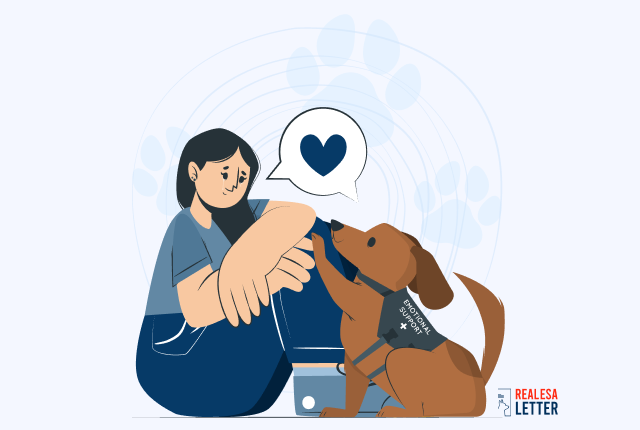
The key distinction between ESA and service animal centers in specialized training capabilities and legal access.
Let's uncover ESA vs service animal differences, benefits, eligible species, ESA dog requirements, and documentation processes.
Key Takeaways
Training Is the Dividing Line: Service animals learn specific tasks. ESAs need no training at all.
Species Rules Differ Sharply: ESAs can be any domesticated animal. Service animals must be dogs or miniature horses.
Miniature Horse Limits: Under 100 pounds and 34 inches tall.
Dogs Dominate Service Work: They make up 97 percent of service animals.
Service Dogs Do Physical Work: They open doors and brace for balance and prevent wheelchair tipping.
You Can Have Both: Some people need physical assistance and emotional support at once.
Key Differences Between Emotional Support Animals and Service Animals
Although emotional support animals and service animals are often confused, the table below highlights their key differences in purpose, training, and legal protection.
Feature | Emotional Support Animal (ESA) | Service Animal |
Primary role | Provides emotional comfort and companionship | Performs specific tasks related to a disability |
Type of assistance | Emotional and psychological support | Task-based physical or psychiatric assistance |
Training required | No specialized training required | Extensive, task-specific training required |
Considered a service animal under law | No | Yes |
Public access rights (ADA) | Not allowed in most public places | Allowed in public spaces |
Housing protection (FHA) | Yes, with a valid ESA letter | Yes |
Air travel rights | Treated as a pet by most airlines | Allowed with proper documentation |
Legal recognition | Limited (mainly housing) | Strong federal protections |
Documentation needed | ESA letter from a licensed mental health professional | No registry required; task-based verification |
Some people confuse these categories and call them "emotional service animals," but the term is not legally defined. The distinction between the ADA-protected service animal and the FHA-protected emotional support animal is clear: one is task-trained, the other is not.
Services Provided by ESA and Service Animals
Many people do not know the differences between emotional support animals vs. service animals. Broadly, service animals are nothing like ESAs. Service animals are specifically trained to perform different tasks for their owners. An ESA just provides emotional support as a companion and friend without actually any physical help for the patient.
Protection Provided by The Law
Patients and owners of service animals largely depend on their animals as they perform physical tasks for them. Because of this, the service animals are provided with legal protection under the Americans with Disabilities Act (ADA).
In contrast to this, emotional support animals do not enjoy such protection under the law. Though they are protected under the Fair Housing Act and Air Carrier Access Act, there are many places that do not allow ESAs into their premises, restaurants and other public places.
In case of a service animal, you can take it anywhere with you. Either in a public place or an office, a service dog can not be denied entrance.
Certification
Service animals don't require official documentation. Physical disabilities (mobility challenges, blindness, hearing loss) are often visible, so businesses and landlords can recognize a service animal by its task-training and the handler's apparent need.
Emotional support animals are different. You need a legitimate ESA letter, issued by a licensed mental health professional (therapist, psychiatrist, or LCSW), to claim housing protections and travel rights.
This letter documents your disability-related need for an ESA and is your legal proof. An ESA letter from RealESALetter.com is written by a mental health professional licensed in your state, the documentation the Fair Housing Act relies on to establish an ESA.
Psychiatric Service Dog vs Emotional Support Animal
Psychiatric service dogs (PSDs) and emotional support animals are often confused because both work for mental health conditions. However, they're legally distinct.
A psychiatric service dog is trained to perform specific tasks for mental health disabilities, deep pressure therapy during panic attacks, interrupting self-harm behaviors, waking the handler from nightmares, or reminding to take medication.
These trained tasks make PSDs task-working animals under the ADA, giving them public access rights like other service animals. An emotional support animal, by contrast, provides support through companionship and presence alone, no trained tasks.
ESAs are protected in housing under the Fair Housing Act, but they don't have public access rights. The key difference: PSDs perform trained interventions; ESAs provide comfort through presence.
Emotional Support Animals vs Service Dogs vs Therapy Dogs
Other than emotional support animals and service dogs, there are other kinds of animals that are different from them. Therapy dogs work in hospitals, nursing homes, and rehabilitation centers and spend some time with them.
These dogs do not need to be trained but they just need to be disciplined, comfortable around strangers, and good at socializing with other people.
Usually, the dog owners are with them to control them and therapy dogs have fewer rights than both service and emotional support dogs.
Benefits Overview: Emotional Support Animals vs Service Animals
While both emotional support animals and service animals provide valuable benefits to their owners, they work differently and address different types of needs.
Understanding these distinct benefits helps individuals determine which type of animal assistance aligns with their specific health requirements.
Emotional Support Animals (ESAs) provide therapeutic benefits through companionship and presence, reducing symptoms of mental health conditions and improving overall emotional well-being.
Service Animals, by contrast, provide physical task assistance and active intervention for disability management, actively performing specific trained functions to maintain safety and independence.
Benefits Comparison Table
Benefit | Emotional Support Animal (ESA) | Service Animal |
MENTAL HEALTH | ||
Anxiety Relief | Calming contact can ease anxiety and lower the body's stress response | Psychiatric service dogs interrupt panic cycles and ground anxious owners through trained intervention |
Depression Support | Unconditional love, daily purpose through pet care, motivation to engage | Trained to interrupt depressive spirals; retrieves medication during crisis |
PTSD & Trauma | Safe presence reduces hypervigilance; comfort during flashbacks | Grounding techniques, waking from nightmares, protective behaviors during episodes |
PHYSICAL HEALTH | ||
Blood Pressure | May lower blood pressure and heart rate through calming contact | Improves through reduced stress and increased mobility |
Sleep Quality | Can improve sleep and reduce nightmares by easing nighttime anxiety | Improved sleep through better pain management and symptom control |
General Wellness | Boosted immune function, reduced inflammation, faster recovery from illness | Overall health improvement through increased activity and independence |
DISABILITY-SPECIFIC | ||
Mobility | No assistance (presence only) | Opens/closes doors, picks up items, provides balance support, assists with stairs |
Seizure Management | No training or alerts | Detects pre-seizure changes and alerts handler before seizure occurs; prevents injuries |
Wheelchair Users | No physical support | Retrieves items, opens doors, provides bracing, prevents tipping |
Fatigue/Chronic Pain | Emotional support reduces stress impact | Weight bearing assistance, mobility support, helps with positioning |
SOCIAL & EMOTIONAL | ||
Loneliness | Reduces loneliness for people living alone by providing steady companionship | Enables independence, allowing participation in activities that reduce social isolation |
Social Connection | Increases social interaction (walking dog, pet conversations) | Allows participation in activities that would otherwise be impossible/unsafe |
Emotional Regulation | Presence provides comfort; unconditional acceptance | Trained interventions during emotional crises (interruption, grounding) |
Sense of Purpose | Daily care responsibilities create routine and purpose | Trained working relationship creates meaningful partnership |
Which Should You Choose?
Choose an ESA if you:
- Have anxiety, depression, PTSD, or trauma-related conditions
- Need emotional support and companionship
- Want to reduce stress and improve mental health
- Struggle with loneliness or isolation
- Want better sleep and physical health through stress reduction
Choose a Service Animal if you:
- Have mobility disabilities requiring physical assistance
- Have seizure disorder needing medical alerts
- Have psychiatric disability requiring crisis intervention through trained tasks
- Need specific trained tasks for daily functioning
- Require public access for independence
You might need both if you have:
- Both physical and mental health disabilities
- Multiple conditions requiring different types of support
- Resources to maintain multiple animals
Animals as ESA vs Service Animals: What Species Are Allowed?
One of the biggest misconceptions is that any animal can be a service animal. In reality, emotional support animals and service animals have very different species requirements.
Emotional support animals can be virtually any domesticated animal. This includes dogs, cats, rabbits, birds, fish, and more. Their benefit comes from companionship and emotional connection.
Service animals are limited to only dogs and miniature horses. They must be trained to perform specific disability-related tasks. This requires strength, reliability, and advanced training. Understanding this distinction helps you determine what type of animal assistance is appropriate for your needs.
Side-by-Side Comparison
Aspect | Emotional Support Animal (ESA) | Service Animal |
Species Allowed | Any domesticated animal | Dogs, miniature horses only |
Examples | Dogs, cats, rabbits, birds, fish | Dogs (all sizes, breeds) |
Size Limitations | No size restrictions | No size, weight, or breed limit for service dogs; miniature horses generally stand 24 to 34 inches and weigh 70 to 100 pounds |
Physical Strength | Not required for support | Required to perform tasks |
Why Species Work | Emotional bond, companionship | Task training, strength needed |
Best Choice | Dogs, cats most popular | Dogs (the ADA's primary service animal; miniature horses are the only other species) |
Can a cat be ESA? | Yes, excellent choice | No, not allowed |
Can dog be both? | Yes, emotionally bonded | Yes, if professionally trained |
Legal Classification | ESA letter from provider | ADA defined, task trained |
If you have a psychiatric service dog, you can also obtain a PSD letter online through a legitimate provider that can be simple and convenient option.
What are ESA Dog Requirements?
Unlike service animals who are individually trained to perform tasks, the ESAs do not require extensive training. They just have to provide comfort and affection to the individual.
ESA dog requirements can be as follows:
- It is very important to make sure that your emotional support dog is well behaved.
- Your pet or an emotional support dog shouldn’t disturb the people. Even if at home or on the airplane.
- According to the Americans with Disability Act (ADA), a service animal or emotional support animal is not registered. There is no certification for an ESA. All you need is a valid ESA letter from a licensed mental health professional.
How to Register a Dog as an Emotional Support Animal?
There is no such thing as ESA registration. Many websites sell an "ESA registration" or a "registry number" for a fee, but these products have no legal standing, and paying for one does not protect your housing rights.
To get an ESA you just need a letter by the mental health professional. The letter will include the following information about you and your ESA:
- Your name
- Name of the disability
- How the disability is a hindrance in your daily routine
- Reasons to get an ESA
- Details about the federal laws about the disabled and the ESA
Once your evaluation is complete, your licensed provider issues your ESA letter. Keep it on hand to present to a landlord when you request a housing accommodation.
In practice, this means the focus is on a proper clinical evaluation and documentation rather than any form of registration or certification.
How to Certify a Service Animal?
Unlike an ESA for which you need a real ESA letter, a service animal does not need any official document. Physical disability like being in a wheelchair or being blind or deaf is visible and the people could determine it themselves that your dog or miniature horse is a service animal.
A service animal does not require registration or medical records. Under the ADA, a business or landlord may only ask whether the dog is a service animal required because of a disability and what task it performs.
For air travel, airlines require the DOT Service Animal Air Transportation Form rather than medical records. Animals play an important role in improving quality of life, and both emotional support animals and service animals provide meaningful support in different ways.
For individuals seeking guidance on psychiatric service dogs, RealESALetter.com also provides professional PSD consultations with licensed mental health professionals and can issue appropriate documentation when clinically justified.
Are you struggling to understand whether you need an ESA letter or a PSD letter? Connect with a licensed mental health professional to complete a proper evaluation and find out your eligibility, along with the right documentation for your needs.
Harper Jefcoat is a content writer with 10+ years of experience covering ESA laws, mental wellness, and emotional support animal benefits. As a blog author for RealESALetter, he educates readers on ESA regulations and promotes ethical documentation practices.

Tina Logan is a Licensed Marriage and Family Therapist with 20+ years of clinical experience and an active California Board of Behavioral Sciences license. She conducts ESA and psychiatric service dog evaluations for RealESALetter assessing whether an ESA or task-trained PSD is clinically appropriate.

Don't worry. Your pet stays with you.
Housing law is on your side
- 1A few questions. That's your paperwork
- 2A licensed therapist reviews your case
- 3Official ESA letter, ready to send
Not accepted? Full refund, guaranteed