Sign In / Create Account
Is Ross Dog Friendly? Everything Pet Owners Need to Know
Yes, many Ross Dress for Less locations are considered dog friendly. Well-behaved, leashed dogs are commonly allowed, but policies can vary by store management.
Because Ross does not publish a formal nationwide pet policy, it’s best to call your local store before visiting.
Service dogs are always permitted under the Americans with Disabilities Act (ADA). Emotional support animals (ESAs) do not have the same public access rights and may be denied entry.
Here are the key rules, exceptions, and legal distinctions every dog owner should understand.

What Is Ross Dress for Less?
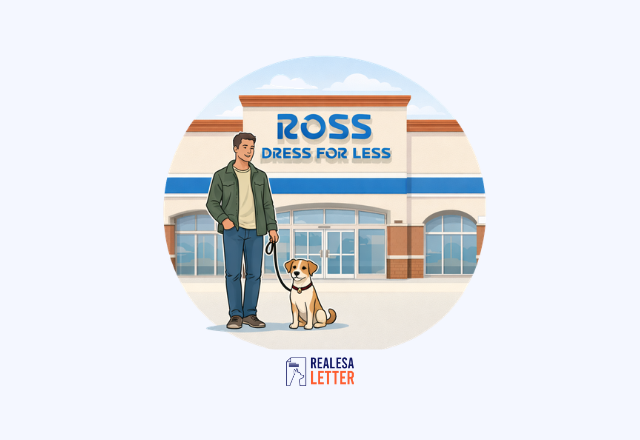
Ross Dress for Less, commonly called "Ross," is one of the largest off-price retail chains in the United States, operating more than 1,700 stores across 41 states. Unlike department stores that run predictable inventory cycles, Ross stocks a constantly rotating mix of brand-name and designer goods at prices typically 20 to 60% below traditional retail. That unpredictability is part of its appeal, as every visit feels like a treasure hunt.
Ross sells a wide variety of merchandise, including:
- Clothing and footwear for men, women, and children
- Home décor, bedding, and kitchenware
- Beauty and personal care products
- Toys, pet supplies, and seasonal items
- Accessories and luggage
For millions of American households, Ross is a regular weekend destination. The chain operates no e-commerce platform, meaning the only way to shop is in person, which is exactly why so many pet owners ask whether their dog can come along.
With over 65% of U.S. households now owning at least one pet, according to the American Pet Products Association, pet-friendly retail policies are more relevant than ever. Ross, to its credit, has generally leaned into welcoming that demographic rather than turning it away.
What is the Ross Dog Policy?
All Ross stores welcome service dogs without exception, as required by U.S. federal legislation. Beyond that, the majority of Ross locations are also friendly to regular pet dogs though the final call rests with each store's manager. If you are unsure about a specific location, the safest move is to call ahead before making the trip.
According to the Americans with Disabilities Act (ADA), all service dogs and psychiatric service dogs are permitted in public spaces alongside their handlers. A service dog is defined as a dog that has been individually trained to perform a specific task that directly assists a person living with a disability.
The task must be tied to the disability itself for instance, a psychiatric service dog may nudge its owner to interrupt a traumatic flashback, or gently remind them to take their medication at the right time.
For pet dogs that fall outside the service animal definition, access comes down to the individual store's management. Reasons for variability from one location to another include:
- Local health codes or state-specific regulations on animals in retail spaces
- Shopping center lease agreements, since a mall-based Ross may face stricter rules than a standalone strip-mall location
- Individual manager preferences, especially in stores that have previously received allergy or safety complaints
- Seasonal traffic, as some managers adopt a more cautious stance during busy shopping periods
The good news is that the core expectations are consistent across pet-friendly Ross locations: dogs must stay on a leash at all times, remain well-behaved and non-aggressive, and owners must be prepared to clean up any accidents immediately.
Ross does not discriminate by breed or size, so all dogs are treated equally under this informal policy. The golden rule is simple: call your specific store before you go. A 60-second phone call removes all uncertainty and saves you an unnecessary trip.
Are Dogs Allowed in Ross?
Whether dogs are allowed at Ross is not a simple yes or no, it genuinely depends on which store you are visiting.
Ross does not enforce a strict no-pet policy at the corporate level, so the decision lands entirely with the management team at each location. Many Ross stores happily welcome a well-behaved, leashed dog regardless of breed or size, while others may decline based on local preferences or store circumstances.
A practical way to gauge a location before you visit is to check whether you have personally seen dogs inside that Ross before, or whether other shoppers in your area have reported bringing their dogs without issue.
If dogs are a regular sight at your local Ross, that is a strong indicator the store is pet-friendly. That said, policies can shift with management changes, so it is always worth confirming before you make the trip.
The most reliable approach is straightforward: call the store directly. A quick search of Ross on Google Maps will pull up the phone number and contact details for any Ross location in your state. One short call removes all the uncertainty and tells you exactly where that store stands before you load your dog into the car. Here is what to keep in mind when you reach out:
- Ask to speak with a manager rather than a general associate, as they hold the final say on pet access
- Confirm whether your specific dog's size or breed raises any concerns, even though Ross has no formal breed restrictions
- Ask about the store's expectations, such as leash requirements or where to avoid in the store with a dog
- If you are visiting during a busy season like the holidays, confirm again closer to your trip as policies can tighten during high-traffic periods
Getting this confirmation in advance means you and your dog can enjoy the shopping trip without any surprises at the door.
Ross Service Dog Policy
When it comes to service dogs, there is zero ambiguity. All Ross locations, in every state, under every manager, are legally required to admit service dogs and their handlers. This is not a store preference. It is federal law under the Americans with Disabilities Act (ADA), and it applies uniformly to all public retail businesses in the United States.
Under the ADA, a service animal is defined as a dog that has been individually trained to do work or perform tasks for a person with a disability, and that task must be directly related to the disability. Common service dog types include:
- Guide dogs that assist individuals with visual impairments
- Hearing alert dogs that signal sounds to deaf or hard-of-hearing handlers
- Mobility assistance dogs that help with balance, bracing, or retrieving items
- Seizure response dogs trained to respond to epileptic episodes
- Diabetic alert dogs that detect dangerous blood sugar changes
- Psychiatric service dogs (PSDs) that perform specific tasks for mental health conditions
Ross staff cannot deny entry to a service dog handler, require documentation, demand a vest or ID card, or ask about the handler's diagnosis. Staff are permitted to ask only two specific questions, covered in detail in Section 8.
One important nuance: service dogs are generally permitted off-leash if the leash or harness physically interferes with the dog's trained tasks. However, the dog must remain under effective control at all times through voice commands or other means.
If a service dog is behaving aggressively or posing a direct threat, the business may ask the handler to remove it, but the handler's disability and the dog's presence alone are never valid grounds for refusal.
Can Ross Staff Ask for Proof of a Service Dog?
The answer is straightforward and absolute: No. Ross staff cannot ask for any proof, certification, documentation, or registration of a service dog. The ADA is explicit on this, and it applies to every retail business covered under the law, including every Ross location in the country.
Under ADA regulations, a business employee may ask a service dog handler exactly two questions and no more:
- "Is this a service animal required because of a disability?"
- "What work or task has the dog been trained to perform?"
These questions exist to help staff understand that the dog is a working animal, not to screen credentials that don't legally exist. Staff cannot:
- Ask the handler to name or describe their disability
- Request a doctor's note, therapist's letter, or any medical documentation
- Demand the dog wear a vest, patch, harness, or identifying badge
- Require the dog to perform its trained task as a demonstration
- Check any "service dog registry" or certification number
There is no official federal service dog registry in the United States. Online services that sell certificates, ID cards, or registration numbers have no legal standing. ADA status is determined entirely by the dog's trained task and the handler's disability, not by paperwork.
If a Ross employee asks questions beyond the two permitted inquiries, calmly state: "Under the ADA, I'm only required to confirm that she is a service dog trained to assist with a disability. I'm not required to provide documentation or describe my condition."
That is typically sufficient. If the issue escalates, file a formal complaint with the U.S. Department of Justice or contact the ADA National Network at 1-800-949-4232.
Psychiatric Service Dogs (PSDs) at Ross
Psychiatric service dogs are one of the most misunderstood categories of working animals, even among retail employees, so understanding their status is critical for handlers who shop at Ross.
The key fact: A psychiatric service dog is a fully recognized service animal under the ADA. PSDs are not ESAs, not comfort animals, and not simply pets whose owners have anxiety. They are trained working animals with complete federal public access rights.
A PSD is a dog individually trained to perform specific tasks that directly mitigate a handler's psychiatric disability. Qualifying conditions typically include PTSD, major depressive disorder, generalized anxiety disorder, OCD, bipolar disorder, and schizophrenia, among others.
Common PSD trained tasks include:
- Room searches to check that a space is safe before a PTSD handler enters
- Interrupt behaviors to break a panic attack, nightmare, or dissociative episode through physical contact
- Blocking to create a physical barrier between the handler and strangers in crowded spaces
- Medication reminders by nudging the handler at scheduled times
- Deep pressure therapy by applying trained body weight during anxiety or trauma responses
- Grounding cues to redirect a handler experiencing hyperarousal or flashback states
Dogs trained to support handlers with PTSD or anxiety disorders are among the most common PSD placements, and their public access rights are identical to any other service dog under federal law.
Ross staff cannot question their legitimacy beyond the two permitted questions, cannot require documentation, and cannot refuse entry. If you encounter resistance, calmly state that your dog is a service animal trained to perform tasks related to your disability.
Are Emotional Support Animals (ESAs) Allowed in Ross?
No, emotional support animals (ESAs) do not have a legal right to enter Ross stores. Under the Americans with Disabilities Act (ADA), only trained service dogs are guaranteed public access to retail businesses like Ross Dress for Less.
An ESA provides therapeutic comfort and companionship for individuals living with mental health conditions. However, because emotional support animals are not trained to perform specific disability-related tasks, they are not granted the same federal public access protections as service dogs.
In practice, whether an ESA can enter Ross depends on the individual store. Some locations allow pet dogs and may permit a well-behaved, leashed ESA to accompany its owner. However, this is entirely at the discretion of store management and not a legal requirement.
For ESA owners, this means access may be allowed in some Ross stores but denied in others. Service dogs, on the other hand, must always be permitted under federal law.
Where ESA protections are strong and legally enforceable:
- Housing (Fair Housing Act): Landlords must generally make reasonable accommodations for ESA owners, including waiving no-pet policies and pet fees
- Certain travel contexts: Individual airlines set their own ESA policies following 2021 DOT rule changes
- Workplaces: Some employers make reasonable accommodations, though this varies
If you rely on an emotional support animal for mental health and want to protect your housing rights, obtaining proper documentation from a licensed mental health professional is essential. Those searching for the best emotional support animal certification should ensure the process includes a legitimate clinical evaluation rather than instant approvals or generic registrations.
Platforms like RealESALetter.com connect individuals with licensed therapists who conduct thorough assessments and issue valid ESA letters, providing the legal documentation required under housing laws and ensuring your companion receives recognition where it matters most.
It is also worth stating clearly: misrepresenting an ESA as a service dog to gain retail access is illegal in many states and causes real harm to people who genuinely depend on trained service animals.
Tips for Bringing Your Dog to Ross
Even with a confirmed pet-friendly store and a well-socialized dog, a little preparation goes a long way. The retail environment presents unique stimuli that dogs don't encounter in daily routines, including tight aisle spacing, new fabric smells, shopping carts, unfamiliar flooring textures, and a constant flow of strangers. Dogs that are calm outdoors can behave differently in enclosed, stimulating indoor spaces.
Before You Go
Always call the store first and confirm the current policy directly with a manager, not just an associate. Once you have a green light:
- Exercise your dog beforehand, as a 20 to 30 minute walk significantly reduces in-store restlessness
- Pack a 4 to 6 foot leash (avoid retractable leashes in tight retail spaces)
- Bring waste bags, a collapsible water bowl, and high-value training treats
- Skip the visit if your dog is unusually reactive, unwell, or hasn't been socialized in public spaces before
If your dog isn't yet comfortable in busy retail environments, working through emotional support dog training exercises beforehand can make a meaningful difference in how they handle new spaces, sounds, and people.
While You're Shopping
Keep your dog on a short leash, positioned at your side or slightly behind you. This signals calm leadership and prevents uninvited approaches to other shoppers. Actively monitor your dog for stress signals throughout the visit:
- Excessive panting or yawning
- Tail tucking or low body posture
- Lip licking or pinned ears
- Attempts to pull toward the exit
Honor those signals. A trip cut short is always better than a stressed or reactive dog creating an incident. Avoid the home décor and housewares sections if your dog is easily startled, as merchandise stacked near floor level increases the chance of accidental knockdowns. If a stranger reaches toward your dog without asking, it's perfectly appropriate to say, "Please ask before petting; she's still working on her manners in new spaces."
If an Accident Happens
Clean it up immediately and thoroughly. Alert a staff member so they can sanitize the area with appropriate products. Handling it responsibly is the single most important thing you can do to preserve your welcome status at that location long-term.
What If Your Local Ross Doesn't Allow Dogs?
Encountering a Ross that declines to admit your dog can be frustrating, especially if it's a location you visit regularly. Your best response depends entirely on your dog's legal status.
If your dog is a trained service dog or PSD: Federal law is on your side. Politely inform the staff member that your dog is a service animal under the ADA and that federal law requires their admission. Provide the two-question answers clearly and calmly. If the manager still refuses:
- Do not argue on the floor
- Note the date, time, manager's name, and store address
- File a formal ADA complaint at justice.gov/crt/disability-rights-section
- Contact the ADA National Network for guidance and support
If your dog is an ESA or pet dog: The store is within its rights to decline. In this case, your options are to accept the decision and return without your dog, ask politely whether an exception can be made, or shift to a more consistently dog-friendly retailer. Since Ross has no online store, in-person shopping is required, so planning ahead with a confirmed pet-friendly location is the best long-term strategy.
It's also worth knowing that management turnover happens frequently in retail. A location that turned you away under one manager may have a completely different and more welcoming stance after a management change. Don't write a location off permanently.
Other Dog-Friendly Retail Stores in the U.S.
Ross is part of a growing culture of pet-welcoming retail across the United States. As pet ownership has surged and consumers make purchasing decisions based on lifestyle alignment, more retailers have recognized that pet-friendly policies build loyalty and increase dwell time. Knowing which stores reliably welcome your dog means you can build a genuinely pet-inclusive shopping routine.
Most Reliably Dog-Friendly Chains:
- PetSmart — All 1,650+ locations; welcomes dogs, cats, birds, and other pets
- Petco — All 1,400+ locations; same policy as PetSmart
- Bass Pro Shops / Cabela's — Most locations; wide aisles and outdoor-enthusiast culture make it ideal
- The Home Depot — Most locations; warehouse-style space is very dog-practical
- Tractor Supply Co. — Most locations; actively markets to pet owners and hosts adoption events
- Pottery Barn / West Elm — Most locations; well-known for dog-welcoming culture
- Nordstrom / Nordstrom Rack — Most locations; follows the brand's long pet-friendly tradition
- Costco — Service dogs only at most locations; worth checking individual stores for pet policy
Manager-Discretion Stores (Call Ahead):
Store | Policy |
No official pet policy; manager decides | |
Service animals only per corporate policy | |
Service animals only per corporate policy | |
Barnes & Noble | Some locations allow dogs |
Macy's | Some locations allow dogs |
Victoria's Secret | Most freestanding stores; mall locations vary |
Final Thoughts
So, is Ross dog friendly? In most cases, yes, and that's genuinely good news for the millions of Americans who want to include their dogs in everyday life. Ross's broadly welcoming stance, confirmed by both official statements and widespread real-world experience, makes it one of the more dog-tolerant mainstream retailers in the U.S. today.
The takeaways are simple:
- Call ahead to confirm your specific store's current policy
- Keep your dog leashed, calm, and well-behaved at all times
- Know your rights, since service dogs and PSDs have full ADA protection everywhere, while ESAs and pet dogs rely on the store's goodwill
- Have an ESA letter if housing or travel protections are what you need, as a licensed professional through RealESALetter.com can help you get proper documentation
Shopping with your dog should be a positive experience for everyone involved. A little preparation and awareness of the rules ensures it stays that way, at Ross and everywhere else you go together.
Frequently Asked Questions
What is the pet policy at Ross Dress for Less?

Ross Dress for Less does not publish a formal pet policy on its website. Based on confirmed customer service responses, leashed pets are welcome while shopping and the company's goal is to accommodate all customers.
Because individual store managers hold discretion, policies can vary by location. Dogs must remain leashed, behave well, and owners must clean up any accidents immediately.
Does Ross have a no-pet policy?
No, Ross does not have a strict no-pet policy. Based on its own verified statement, Ross welcomes leashed pets.
However, because there is no formal written nationwide policy, some individual store managers may decline entry to non-service animals based on local regulations, shopping center rules, or personal discretion. The safest approach is to call your local store ahead of your visit to confirm their current stance.
Can Ross ask for proof of a service dog?
No. Under the ADA, Ross staff are legally limited to two questions only: whether the dog is a service animal required because of a disability, and what work or task the dog has been trained to perform.
They cannot ask for documentation, certification, ID cards, or require the dog to demonstrate its trained task. There is no official federal service dog registry, and any third-party registration products carry no legal standing.
What dogs are not allowed in Ross?
Ross does not restrict any specific breed or size. However, dogs that are aggressive, disruptive, or creating safety concerns for other shoppers or staff can be asked to leave regardless of breed.
Dogs that eliminate in the store without the owner cleaning it up may also result in the handler being asked to leave. Essentially, any dog whose behavior causes a disturbance or direct threat can be removed, but well-behaved dogs of all breeds are welcome where the store permits pets.
Are dogs allowed in fitting rooms at Ross?
This is left to the store manager's discretion. Most Ross locations that permit dogs in the store do allow well-behaved, leashed dogs to accompany owners into fitting rooms.
However, it is not guaranteed. If this matters to your visit, ask a staff member directly when you arrive, as fitting room policies can differ even within dog-friendly Ross locations.
Dr. Avery Langston is a licensed clinical therapist with more than 12 years of professional experience in emotional support animal (ESA) assessments, mental health counseling, and evidence-based therapeutic interventions. With a strong foundation in clinical psychology and a passion for mental-health education, Avery has guided thousands of individuals through the ESA qualification process while promoting emotional healing and stability. As a senior content contributor for RealESALetter.com, Avery focuses on writing accurate, accessible, and legally informed articles on ESA rights, housing protections, and mental wellness. Her mission is to help readers understand their ESA benefits clearly and confidently, backed by real clinical expertise.
Dr. Whitfield is a licensed psychologist with 14 years of clinical practice specialising in trauma, anxiety disorders, and psychiatric service animal evaluations. He conducts PSD assessments for RealESALetter across all 50 states.