If you've recently adopted a senior dog, noticed bad habits in your adult dog, or are wondering about the best age to start training a puppy, you're likely asking the same question: how old is too old to train a dog?
The short, evidence-backed answer is: there is no age limit. Dogs can learn at every stage of life, from eight-week-old puppies to 12-year-old seniors. What changes is not the ability to learn, but the training approach, pace, and expectations at each age.
Let’s discuss the best age to train a dog, what to expect at every life stage, and how to successfully train puppies, adult dogs, and seniors.
The Science Behind "Old Dog, New Tricks"
Before diving into age-specific advice, it helps to understand how dogs actually learn. Dogs learn through a process called operant conditioning, a framework developed by behavioral scientist B.F. Skinner.
In simple terms, dogs repeat behaviors that produce a positive outcome and stop behaviors that produce no reward or an unpleasant consequence. This neurological process does not shut off at a certain birthday.
When a dog sits and receives a treat, their brain releases dopamine, a neurotransmitter tied to pleasure and motivation. Over repeated trials, the neural pathway connecting the cue, the behavior, and the reward becomes stronger and more automatic. This mechanism works in a six-month-old puppy and in a ten-year-old senior, because it is driven by brain chemistry, not calendar age.
What does change as dogs age is the speed of learning and memory retention. Research from VCA Animal Hospitals notes that after about seven years of age, dogs may not learn a new task as quickly and may not retain information as reliably.
That is a slower learning curve, not a closed door. The brain continues to form new connections in response to new experiences throughout a dog's life, a capacity known as neuroplasticity.
Additionally, canine cognitive dysfunction syndrome (CDS) is a real, age-related condition that can affect memory, orientation, and responsiveness to commands. According to the Cornell University College of Veterinary Medicine's Riney Canine Health Center, CDS causes brain deterioration similar to Alzheimer's disease in humans and is generally seen in dogs over nine years of age. Studies show that 28% of dogs aged 11 to 12 show at least one sign of cognitive impairment, rising to 68% in dogs aged 15 to 16.
Critically, however, even dogs with mild CDS benefit from continued mental stimulation. The American Kennel Club's Chief Veterinarian, Dr. Jerry Klein, has noted that mental stimulation through walks, games, puzzles, and training activities can help slow cognitive decline.
Research published by the Morris Animal Foundation confirms that dogs engaged in regular training activities are less likely to develop CDS in the first place. This means training is not just something you do despite a dog's age. It is one of the most powerful tools you have to protect the brain as the dog ages.
The takeaway: Age may slow the process, but it never makes training pointless or impossible.
How Age Affects Dog Training: A Stage-by-Stage Breakdown
Understanding how age shapes the training process means looking beyond simple labels like "young" or "old" and instead paying attention to what is actually happening inside the dog's brain and body at each stage. A dog's capacity to learn is not fixed. It shifts in response to neurological development, hormonal changes, physical health, accumulated experience, and the quality of the environment they have lived in.
Two dogs of the same age can be at completely different points in their training readiness depending on their breed, their history, and how consistently they have been engaged. A large working breed at eighteen months is neurologically closer to a puppy than a small companion breed at the same age.
A rescue dog at five years who has spent time in an enriched foster home will often train faster than a five-year-old dog who has spent years in social isolation. Age is a starting point for understanding, not a fixed verdict on what a dog can do.
What this means practically is that the stage-by-stage framework below should be read as a guide to general tendencies, not a rigid set of rules. The most important skill any owner can develop is the ability to read their individual dog rather than defaulting to assumptions based on age alone.
A dog that is struggling in training is communicating something specific: they may be overwhelmed, under-motivated, physically uncomfortable, confused by inconsistent cues, or simply not ready for the level of complexity being asked of them. In every one of those cases, the solution is an adjustment in approach, not a judgment about the dog's intelligence or willingness.
Every stage described below comes with its own version of that principle, and keeping it in mind across all of them is what separates owners who make consistent progress from those who plateau.
Puppies (8 Weeks to 6 Months): The Foundation Stage
Puppies are often described as sponges, and for good reason. Their brains are rapidly developing, forming neural pathways with every new experience. The window between 3 and 16 weeks is particularly important for socialization, meaning exposure to people, animals, sounds, environments, and handling.
What a puppy experiences and learns during this window shapes their confidence and emotional responses for the rest of their life. Missing this window does not ruin a dog, but it does mean more intentional work will be needed later to fill the gaps.
The challenge with puppies is not intelligence but impulse control. Their prefrontal cortex, the part of the brain responsible for decision-making and self-regulation, is still developing. Their attention spans are short, their energy is high, and consistency can feel like an uphill battle. Training sessions should be kept to three to five minutes for very young puppies, focused on one command at a time, always using positive reinforcement.
Potty training a puppy should begin the day your dog arrives home. Dogs naturally avoid soiling their sleeping areas, which means crate training and potty schedules work with the dog's instincts rather than against them. Your first night with a puppy sets the tone for boundaries, crate comfort, and sleep routines that will carry forward through every training stage that follows.
The commands to prioritize during puppyhood include sit, stay, come, down, and leave it. Leash manners and crate comfort should also begin early. These foundations make every stage of training that follows significantly easier because the dog already understands the core concept of responding to cues for rewards.
Research consistently shows that dogs trained in basic commands during puppyhood require far less remedial work as adults, and the bond formed during early training translates into better responsiveness throughout the dog's life.
Best approach: Short, frequent sessions of three to five minutes. Heavy socialization in varied environments. Positive reinforcement only. Focus on one skill at a time before adding complexity.
Adolescent Dogs (6 Months to 2 Years): The Frustrating Phase
This is the stage that trips up the most dog owners, and it is the stage most responsible for the persistent myth that certain dogs are simply "untrainable."
Adolescent dogs, especially large breeds that do not reach mental maturity until two or three years of age, can seem to forget everything they learned as puppies. Owners who worked hard during the puppy stage often feel blindsided when their dog suddenly ignores a recall command they had mastered months earlier.
This is not defiance. It is neurology. During adolescence, the canine brain undergoes significant reorganization. The prefrontal cortex is still maturing, hormonal changes influence behavior, and the dog's sensitivity to environmental stimulation peaks.
They are physically capable, intensely curious, and easily pulled away from learned behaviors by competing stimuli. Their ability to follow known commands in quiet, low-distraction environments is largely intact, but applying those same commands at a dog park, on a busy street, or in any exciting new environment requires deliberate retraining in those specific contexts.
Many owners give up during this phase and either rehome the dog or conclude that training has failed. This is a costly mistake. The skills built during puppyhood are not lost; they simply need to be practiced more broadly. Indoor dog games are especially useful during this phase for burning mental energy and reinforcing focus in a controlled environment before proofing commands outdoors.
Adolescent dogs thrive on structure, challenge, and short bursts of engagement. Recall training is the most critical skill to reinforce during this period because a dog that reliably comes when called is dramatically safer in every environment.
Games that make responding to your cue feel more rewarding than chasing a distraction are highly effective. Tug, chase, and find-it games can all be incorporated into training to tap into the adolescent dog's high drive.
If you find yourself struggling with a teenage dog, know that this phase passes reliably for almost every dog. The breeds that take longest to mature mentally, including many large working and herding breeds, also tend to have the most impressive capabilities once that maturity arrives. Consistency and structure now pay enormous dividends later.
Best approach: Increase structure, not punishment. Prioritize recall and impulse control. Proof all known commands in new environments progressively. Keep sessions engaging, reward-rich, and varied.
Adult Dogs (2 to 7 Years): Often the Easiest Stage
Adult dogs between two and seven years are frequently the most straightforward training subjects, despite the common assumption that puppies are easiest to train. Their brains are fully developed, their attention spans are longer than a puppy's, their emotional regulation is more stable, and they are less likely to be derailed by every new smell or sound in the environment.
An adult dog who has never received formal training still has every capacity to learn basic obedience commands and well beyond, often faster than an equivalently motivated puppy precisely because they can focus for longer periods.
The main challenge with adult dogs who have had no prior training is the presence of ingrained habits. A dog who has been jumping on guests for five years has been neurologically rewarded for that behavior thousands of times, even if the reward was unintentional.
Every time a guest laughed, made eye contact, or pushed the dog away (which many dogs experience as play), the jumping behavior was reinforced. Breaking that pattern does not require force; it requires withholding the reward entirely and consistently redirecting to an incompatible behavior, such as sitting for greetings.
If you have adopted an adult rescue dog, it is worth understanding that their behavior almost always reflects their previous environment rather than their fixed personality. A dog that was never asked to sit on command does not know how to do it, not because they are stubborn, but because the concept was never introduced.
That is a training gap, not a character flaw. Most rescue dogs settle into their new environment within a few weeks and then become highly receptive to learning because they are no longer in survival mode.
Adult dogs also have the advantage of clearer communication. When you give a cue and wait, an adult dog is more likely to offer deliberate behavior than a puppy, who may simply spin and offer random movements. This makes it easier to mark and reward precisely what you are asking for, which speeds up the actual learning process.
Best approach: Start with foundational obedience and address one bad habit at a time. Use positive reinforcement exclusively. Be fully consistent across all household members and environments.
Senior Dogs (7+ Years): Absolutely Still Trainable
This is where most people's concern lies, and it is where the biggest misconceptions persist. Senior dogs can absolutely learn new commands, modify existing behaviors, and benefit tremendously from continued training. To put senior training in perspective, it helps to know how long dogs live on average.
A small breed dog called "senior" at seven years may still have eight or more active years ahead. A large breed dog at that same age may have a shorter horizon, but that is still a meaningful stretch of time in which training can improve quality of life significantly.
What does change with senior dogs is the physical dimension of training. A dog with arthritis should not be asked to sit and stand repeatedly in a long session. A dog experiencing hearing loss will need hand signals instead of or alongside verbal cues.
A dog with vision changes may startle more easily and benefit from verbal warnings before being touched or approached. Adapting the physical requirements of training to match the dog's current body is not lowering your standards. It is applying good judgment.
The key is to assess what the senior dog can comfortably handle and build training around that reality rather than around what the dog could do at two years old. Less physically demanding options like "speak," "touch" (nose targeting), learning the names of specific toys, or a gentle adapted roll over are excellent choices.
These engage the mind without stressing the body. Nose work, in which the dog searches for a specific scent hidden in the environment, is one of the best activities for senior dogs because it is entirely low impact, deeply stimulating, and can be practiced indoors on any surface.
According to research published in the context of canine cognitive dysfunction, mental enrichment through training activities can actively slow cognitive decline and improve memory function in older dogs.
Veterinary neurologist Dr. Jerry Klein and the AKC both confirm that starting new training with a senior dog is highly beneficial. Rather than assuming their learning days are over, it’s one of the most proactive things an owner can do for their long-term brain health.
Best approach: Sessions of 10 to 15 minutes maximum. Low-impact, non-repetitive commands. Hand signals for dogs with hearing loss. Nose work and find-it games for cognitive enrichment. Veterinary check before beginning if behavior has changed recently.
When Training Becomes More Complex: Real Factors That Affect Learning
Age alone is rarely the true barrier to training a dog. In practice, the following factors have a far larger impact on training outcomes than the number of candles on a birthday cake.
Deeply Ingrained Habits
A behavior that has been practiced daily for years has been neurologically reinforced thousands of times. Each repetition strengthens the associated neural pathway, which is why a dog that has pulled on a leash for four years requires more consistent counter-training than a dog that has pulled for four weeks.
Untraining an ingrained habit is not impossible, but it requires one thing above all else: zero tolerance for the old behavior during the retraining period. Every single time the unwanted behavior is allowed to occur, the old pathway is reactivated and the new one is weakened. Inconsistency is the primary reason behavior modification fails, not the dog's age.
Physical Health and Pain
Pain is one of the most underrecognized factors affecting dog behavior and training responsiveness. A dog with undiagnosed hypothyroidism, dental pain, arthritis, or another underlying condition may appear stubborn, aggressive, or suddenly unresponsive to commands they have known for years.
In senior dogs especially, a sudden change in training behavior is often a health signal, not a training problem. Before investing significant time in a new training program for an adult or senior dog showing unexpected resistance, a full veterinary check-up is always the correct first step. Treating the underlying condition often resolves the behavior entirely.
Hearing and Vision Loss
Older dogs commonly experience gradual hearing and vision decline, often so gradually that owners do not notice until the loss is significant. A dog that stops responding to a verbal recall command may not be ignoring you.
They may simply not be hearing you. Dogs with hearing loss adapt well to consistent hand signals, visual cues, and even vibration-based communication using a vibrating collar set to a gentle buzz rather than a shock. Dogs with vision impairment benefit from predictable routines, verbal advance warnings before physical contact, and clear verbal cues that do not rely on the dog seeing a hand gesture.
Trauma and Prior Abuse
A dog that has come from an abusive or severely neglectful background may carry deep-seated fears and conditioned anxiety responses that complicate training in ways that have nothing to do with intelligence or willingness.
Fear-based responses are learned associations, and in extreme cases, particularly those involving fear responses that were established during the critical socialization window and never countered, they are among the most difficult things to modify.
With patient, gradual desensitization and counter-conditioning, meaningful progress is almost always possible. Complete elimination of a deep fear response may not be realistic in every case, but significant improvement in quality of life and management is achievable for the vast majority of dogs.
Canine Cognitive Dysfunction Syndrome (CDS)
As noted earlier, CDS is a medical condition that affects memory, learning, and orientation in senior dogs. If your older dog seems confused, has started having accidents indoors after years of reliable house-training, or appears disoriented in familiar spaces, it may be a sign of an underlying issue.
If they no longer respond to commands they have known for years or show changes in sleep, appetite, or social interaction, consult a veterinarian before adjusting your training approach.
CDS can be managed through medication, diet, and enrichment but it cannot be reversed, and early intervention produces significantly better outcomes than waiting until the condition has progressed.
How to Train an Older Dog: Practical Tips That Work
Training an older dog is less about overcoming a limitation and more about working with a different set of strengths. Adult and senior dogs bring patience, a calmer baseline energy, and a genuine desire to engage with their owners that younger dogs often lack.
What they need from you in return is a training framework built around clarity, calm repetition, and a genuine understanding of where they are physically and cognitively right now.
The single biggest mistake owners make with older dogs is applying the same high-volume, high-repetition approach that works with puppies. A puppy bounces back from a frustrating session and tries again five minutes later. An older dog that finishes a session feeling confused or pushed too hard is less likely to engage eagerly in the next one.
Protecting your dog's enthusiasm for training is as important as the training itself, because a dog that wants to participate will always outperform one that has learned to associate sessions with stress.
The practical reality is that older dogs train best when the environment around the training is managed as carefully as the training itself. That means feeding schedules, exercise timing, and pain management all factor into how well a session goes.
A senior dog that has been on their feet for two hours or is approaching a meal time will not perform at the same level as one that is rested, comfortable, and mildly hungry, since mild hunger sharpens food motivation without tipping into distraction.
If your older dog is on any medication, speak with your veterinarian about timing, since some medications affect alertness, appetite, or energy in ways that directly influence training responsiveness.
Setting up the conditions for success before a session begins is not over-engineering the process. It is the difference between a dog that makes progress in weeks and one that stalls for months with no clear reason why.
Start With a Veterinary Assessment
Before beginning any training program with an adult or senior dog, particularly one showing sudden behavioral changes, rule out medical causes first. Pain, hormonal imbalances such as thyroid dysfunction, vision or hearing changes, and cognitive issues all require different handling strategies.
A dog that receives treatment for an underlying condition often becomes dramatically more responsive to training with no other changes needed. This step is not optional with senior dogs. It is the foundation on which everything else is built.
Use Positive Reinforcement Exclusively
Regardless of the dog's age, punishment-based training methods are counterproductive in both the short and long term. A 2020 study published in PLOS One found that dogs trained in aversive-method schools showed significantly higher cortisol levels and more stress behaviors such as panting, yawning, and lip-licking compared to dogs trained with reward-based methods.
These negative outcomes are more pronounced in older dogs, who may already be managing physical discomfort or anxiety from health changes.
The ASPCA's official position on training methods states that humane training makes primary use of lures and rewards such as food, praise, petting, and play, and that training should not inflict unnecessary distress or discomfort on the animal.
Positive reinforcement, specifically rewarding the behavior you want with something the dog values, remains the most effective, most humane, and most evidence-supported approach at every life stage.
Keep Sessions Short and Focused
Where puppies benefit from three to five-minute sessions, adult and senior dogs do well with sessions of ten to fifteen minutes. Training should end before the dog becomes tired, confused, or disengaged.
A dog that finishes a session on a successful note and still wants more is in a much better state for the next session than a dog that was pushed until they gave up. Multiple short sessions distributed across the day are more effective than a single long one for both information retention and motivational maintenance.
Work on One Behavior at a Time
Attempting to address multiple problem behaviors simultaneously is overwhelming for any dog and especially for seniors whose processing speed may have slowed. Identify the behavior that most affects safety or quality of life, work on that one skill until it is consistent, and then move to the next. This focused approach also lets you accurately evaluate whether your training method is working without the noise of multiple simultaneous interventions.
Build on What They Already Know
If your adult or senior dog knows any commands at all, those are your starting points. Existing knowledge demonstrates that the dog has learned the fundamental concept of cue-behavior-reward, and building on that foundation is always faster than starting from zero.
Commands like heel are worth reinforcing at any age, as reliable loose-leash walking directly improves safety during outdoor exercise and enrichment time. Once a foundational skill is refreshed, new commands can be introduced as extensions of what the dog already understands.
Adapt to Physical Limitations
Modify commands and positions so that training is comfortable for the dog's body as it is today, not as it was years ago. A dog with joint pain can learn to touch a target stick, look at you on cue, or move to a specific spot on the floor without ever having to sit or lie down repeatedly. Routine physical care also plays a role here.
Keeping up with tasks like nail trimming reduces the discomfort that overgrown nails cause during standing and movement, which can quietly interfere with a dog's willingness to engage in training sessions. Small physical maintenance details compound into measurable training differences over time.
Use Mental Enrichment Tools Between Sessions
Structured training sessions are only one part of an enrichment strategy. Between formal sessions, tools like a snuffle mat provide low-impact cognitive stimulation that keeps an older dog's mind active without requiring commands, formal sequences, or extended concentration.
Scatter feeding, food puzzles, and hide-and-seek games with kibble or treats all engage the dog's natural foraging instincts and provide meaningful mental exercise that complements active training. The cumulative effect of daily passive enrichment on long-term cognitive health in senior dogs is well-supported by veterinary research.
Be Consistent Across the Household
One of the most common reasons training fails with dogs of any age is household inconsistency. If one person enforces no jumping on the sofa and another invites the dog up, the dog receives contradictory information and the behavior never resolves. All household members must apply the same rules and use the same verbal cues consistently.
This is especially important with adult and senior dogs who have established habits because even occasional reinforcement of an old behavior is enough to maintain it at significant strength.
Why It Belongs in Any Age-Appropriate Training Plan
Roll over consistently ranks among the top tricks dog owners search for because it sits at the sweet intersection of impressive and genuinely achievable. It is more than a party trick. Teaching roll over makes a dog comfortable being handled on their back, which pays dividends during grooming, veterinary exams, and injury checks.
It also delivers meaningful cognitive stimulation, requiring a dog to follow a multi-step lure sequence, track a moving target with their nose, and override the natural instinct to guard their belly. For older and senior dogs, it is one of the most valuable low-impact exercises available precisely because the mental demand is high while the physical strain, when taught correctly, stays low.
However, knowing how to introduce this trick correctly is what separates a dog that learns it in two sessions from one that stalls indefinitely. The full step-by-step breakdown is covered in the how to teach a dog to roll over guide, but the core principles that apply specifically in the context of age-appropriate training are worth understanding here.
The Prerequisite: "Down" Must Come First
Roll over is a chained behavior, meaning it is built from several smaller movements linked in sequence. The sequence begins from the lying-down position, so a dog that does not yet reliably respond to a "down" command cannot begin learning roll over.
Attempting to skip this prerequisite leads to confusion, frustration, and repeated failed sessions that erode the dog's enthusiasm for training. Reinforce "down" until it is consistent and quick before introducing roll over.
This prerequisite also makes roll over an ideal training goal to work toward progressively. If your adult or senior dog knows "sit" but not "down," you now have a clear, achievable roadmap: sit, then down, then roll over. Each command builds confidence and reinforces the dog's understanding of how the cue-reward system works.
Surface and Environment Matter More Than Most Owners Realize
Training roll over on a hard floor is uncomfortable for most dogs and potentially painful for senior dogs with bony prominences or joint conditions. A thick carpet, yoga mat, or area rug provides the grip and cushion a dog needs to feel secure while shifting their weight sideways and onto their back. Dogs trained on soft surfaces progress faster because they are not fighting discomfort in addition to learning a new behavior.
Equally important is the environment itself. Roll over requires a dog to place themselves in a physically vulnerable position, belly exposed, legs in the air. Dogs will only do this comfortably in spaces where they feel completely safe. Training in a quiet, familiar room away from other dogs, unfamiliar visitors, or loud sounds is not optional. It is the foundation that makes the rest possible.
The Luring Sequence: Nose, Shoulder, Backbone, Complete Arc
The hand motion used to lure a roll over is specific and matters. Starting with the dog in "down," a high-value treat is held at the dog's nose and slowly moved toward the shoulder on the side they naturally lean toward. As the dog's nose follows the treat, their weight shifts onto one hip and then onto their side. That moment of reaching the side position is rewarded immediately.
The American Kennel Club's step-by-step roll over guide confirms this nose-to-shoulder arc as the foundation of the entire luring sequence, noting that each stage should be reinforced separately before asking for the complete motion.
Once side-lying is reliable, the treat arc continues: from the shoulder, up and over toward the backbone, then down to the other side, completing a full rotation. Rewarding partial progress at each stage, like a head tilt, a hip shift, a full side roll, and eventually the complete rotation, helps build the behavior step by step.
Professional trainers call this process shaping through successive approximation.It respects the dog's pace and prevents the frustration that comes from asking for the full behavior before the dog is physically and mentally ready to offer it.
The Safety Exception: Deep-Chested Breeds
One critical point that applies to dogs of any age is the GDV (Gastric Dilation and Volvulus) risk in large, deep-chested breeds. German Shepherds, Great Danes, Standard Poodles, Weimaraners, Doberman Pinschers, and similar breeds are anatomically predisposed to this life-threatening condition, in which the stomach twists on itself and traps gas.
Physical movement and positional changes after eating can elevate risk. Always wait at least two hours after a meal before any training session involving body rolls for these breeds, and consult a veterinarian before introducing roll over to any large deep-chested dog regardless of age.
For senior dogs of any breed, a quick veterinary check before introducing roll over is a sound precaution. Dogs with spinal conditions, hip dysplasia, orthopedic injuries, or significant arthritis should skip this trick or work only on the initial phase of side-lying, which is far less physically demanding than the complete rotation.
Adapting Roll Over for Older Dogs Specifically
The most significant adjustment when teaching roll over to an adult or senior dog versus a puppy is pace. Puppies often move through the luring sequence quickly because novelty is inherently rewarding to them.
Older dogs, particularly those new to training, may need more sessions at each individual phase before they are confident enough to progress. That is not a failure. It is appropriate pacing.
For senior dogs with limited mobility, the full roll over may not be achievable or appropriate. In those cases, training only the side-lying portion, which carries most of the handling and cognitive benefit, is a completely valid endpoint. Rewarding a dog for being calm and comfortable on their side is meaningful progress that serves real practical purposes even if the complete rotation never follows.
The key principle is the same as it is across every aspect of training older dogs: meet the dog at their current capability, build confidence at each step, and let the dog's comfort set the ceiling rather than the trainer's ambition.
Training Senior Dogs and ESA Designation: What You Should Know
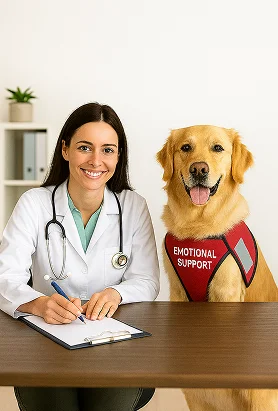
For many dog owners, training an older dog is directly connected to their animal's role as an emotional support animal (ESA). Unlike a psychiatric service dog, which must perform specific trained tasks related to a handler's disability, an ESA does not require task training. However, a well-behaved, reliably calm dog is significantly easier to live with, easier to have recognized by housing providers, and far less stressful for both the owner and the animal in shared spaces.
If your goal is to make your dog an ESA, combining valid documentation with consistent training produces the best real-world outcome. Emotional support dog training focuses on temperament stability, calm behavior in shared spaces, and reliable responsiveness to the owner's needs, all qualities that are achievable at any age with the right approach.
If you are wondering how to get an ESA letter for your dog, the process starts with a consultation with a licensed mental health professional who can evaluate whether your dog qualifies as part of your treatment plan.
RealESALetter.com connects you with clinician-issued documentation that is legitimate and accepted by housing providers nationwide, while continued training ensures your dog is the calm, reliable companion that makes that documentation meaningful in daily life.
What Is the Best Age to Start Training a Dog?
If you are asking this question because you are bringing home a new dog, the answer is to start the day they arrive. There is no such thing as starting too early. Even very young puppies begin forming behavioral associations from their first moments in your home, and every interaction you have with them in those early days is either teaching them something you want or something you do not want.
If you are asking because you have an adult or senior dog and you are wondering whether you missed your window, the answer is the same: start now. Today is always the right day to begin. The window for perfect socialization may have closed, but the window for learning, for modifying behavior, and for strengthening the bond between you and your dog never closes.
Training is not a phase of life for dogs the way formal schooling is for humans. It is an ongoing dialogue between the two of you that evolves as your dog's needs, capabilities, and circumstances change. A dog trained thoroughly as a puppy still benefits from maintained practice and new mental challenges as an adult.
A senior dog who has never been formally trained still gains genuine cognitive benefit from the introduction of new skills. The commitment to training your dog, regardless of when it begins, is one of the most consistent long-term investments in their wellbeing that any owner can make.
The Bottom Line: There Is No Age Limit on Training a Dog
Whether your dog is five months old, five years old, or fifteen years old, training is always possible, always beneficial, and always worth the effort. The dog's age determines your approach, your pacing, and your physical adaptations. It does not determine whether learning is possible.
The core truth remains the same across every life stage: dogs want to understand what is expected of them. Clarity, consistency, and reward-based communication give them that understanding. When you provide those things, dogs of every age try their best to meet you there.
Start today. It is never too late.


 Pricing
 PSD Letter
 Reviews
 ESA By States
 ESA Laws
 Resources