


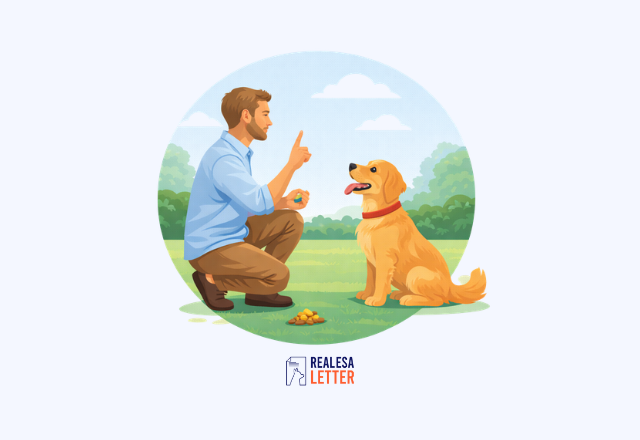
Teaching your dog to sit is the single most important first step in any dog training journey. It is the gateway command. Once mastered, it unlocks everything from "stay" and "down" to complex service dog tasks.
Whether you have just brought home a bouncy eight-week-old puppy or you are working with an older rescue dog, learning how to teach a dog to sit the right way will save you frustration, deepen your bond, and build lasting behavioral foundations.
Many dog owners make the mistake of jumping straight into treat-waving without understanding the mechanics behind the behavior. The sit command is not just about getting your dog's rear on the floor.
It is about building a shared communication system where your dog understands that good things happen when they respond to your cues. That mental connection is what separates a dog who sits once in a quiet room from a dog who reliably sits at the park, at the vet, or when a stranger approaches.
Let’s explore why teaching sit is important, eight expert tips, what to do if your dog won't sit, and sit training, which makes teaching your dog to sit faster, easier, and more reliably.
Why Teaching "Sit" Is the Foundation of All Dog Training
Before diving into the tips, it is worth understanding why sit is so important. The sit command does several things at once, and each benefit builds directly on the last.
First, it creates impulse control. Sitting requires your dog to pause and think before acting. This seemingly simple skill is a cornerstone of good canine behavior.
A dog who can pause before reacting is a dog who will not bolt out the front door, jump on guests, or lunge at other dogs on a leash. That split second of self-regulation that the sit command builds is what eventually carries over into every other area of your dog's behavior.
Second, sit builds a communication system. When your dog learns that the word "sit" means something specific and that doing it produces a reward, they begin to understand how to work with you.
That understanding forms the foundation for every command you will ever teach. Dogs that have a strong "sit" tend to learn new commands faster because they already know how the training process works.
Third, the sit command prevents a wide range of problem behaviors. A sitting dog cannot simultaneously jump on visitors, steal food off a counter, or run into traffic. It becomes a default polite behavior that replaces dozens of unwanted ones.
Many trainers call sit a "replacement behavior," meaning it gives your dog something appropriate to do in moments when excitement or confusion might otherwise lead to chaos.
Fourth, sit opens the door to advanced training. Commands like "stay," "down," "heel," and even complex psychiatric service dog tasks all build off a reliable sit. It is also the first of the basic dog commands every owner should prioritize before moving on to anything more demanding.
The American Kennel Club consistently lists "sit" as the first command new dog owners should teach, and for good reason. It is simple to teach, immediately useful, and sets the tone for everything that follows.
How to Teach a Dog to Sit: 8 Expert Tips
Before you start training, it helps to understand that teaching a dog to sit is not about forcing the position. Effective dog training relies on timing, clear communication, and rewarding the behavior you want to see repeated. Dogs learn best when instructions are simple, consistent, and reinforced with positive experiences.
When learning how to teach a dog to sit, the goal is to make the behavior easy for your dog to understand and rewarding enough that they want to repeat it. The tips below focus on practical training methods used by professional trainers, including lure training, reward timing, and building reliability in different environments.
Whether you are working with a playful puppy or an older dog that needs foundational training, these strategies will help you teach the sit command faster and with fewer frustrations.
Tip 1: Set Up Your Training Environment for Success
Where you train matters just as much as how you train. Dogs are highly sensitive to their surroundings, and the environment you choose will either accelerate learning or make it significantly harder.
Asking a dog to learn something new while surrounded by distractions is like asking a child to focus on a math lesson in the middle of a birthday party. The information simply does not land as well.
Start in the quietest, most familiar space available. For most people this means the living room or a fenced backyard. Before you begin, set the space up properly:
- Remove toys from the floor so your dog is not competing between play and training
- Keep other pets in a separate room to eliminate social distractions
- Turn off the television or any loud background noise
- Minimize foot traffic through the training area during the session
Your own preparation matters just as much as the environment. Come ready with the right tools:
- 20-30 small, soft, high-value treats cut to pea-sized pieces (chicken, cheese, or commercial training treats)
- A treat pouch clipped to your waist for fast, consistent delivery
- A clicker or a clear verbal marker like "yes" loaded and ready to use
Keep each session to 5-10 minutes maximum, especially with puppies under six months. Train before meals when food motivation is highest. After a meal, engagement drops noticeably.
Once your dog reliably sits at home, gradually shift training to more stimulating locations:
- Kitchen with mild household activity
- Backyard or garden
- Driveway or front yard
- Quiet sidewalk, then busier outdoor spaces
Expect some regression at each new location. Dogs do not automatically transfer learned behaviors to new settings, and scaling back to luring in a new environment is a normal part of the process, not a setback.
Tip 2: Use the Lure Method — The Most Effective Starting Point
The lure-and-reward training method is widely considered the most accessible and effective way to teach sit to dogs of any age. It works by using your dog's natural tendency to follow food with their nose. When you position a treat correctly and move it in the right direction, the physical sit happens almost automatically as a result of your dog tracking the treat.
Follow these steps in order:
- Hold a small treat between your thumb and index finger and bring it to your dog's nose, close enough to sniff but not eat
- Slowly move the treat backward over the top of their head, angling it toward their tail rather than straight up
- As their nose follows the treat in an upward-backward arc, their head rises and their hindquarters naturally drop to the floor
- The moment their bottom touches the ground, mark immediately with "yes!" or a click, then deliver the treat
- Reset by tossing a second treat a few feet away to get them standing, then repeat
Timing is everything in this step. Waiting even two to three seconds after the sit means your dog may have already stood back up, and the reward ends up reinforcing standing rather than sitting. The faster the mark and delivery, the clearer the message.
Repeat the sequence 5-10 times per session. Most dogs begin anticipating the sit within the first few repetitions. When your dog sits reliably with the lure at least 8 out of 10 times, you are ready to fade the lure and introduce a verbal cue.
Watch out for these two common mistakes:
- Lure held too high: Causes jumping instead of sitting. Keep the treat shallow and close to the nose.
- Dog backs away instead of sitting: Practice in a corner so the wall prevents backward movement and channels the behavior into a sit.
Tip 3: Load a Marker Before You Begin (Clicker Training Basics)
A marker is one of the most powerful tools in dog training, yet many owners skip this step entirely. A marker is a specific sound or word that tells your dog the exact moment they performed the correct behavior. It bridges the gap between the behavior and the reward, communicating "that specific thing you just did is what earned this treat." Without a marker, you are relying on treat delivery timing alone, which is difficult to execute accurately during fast movements.
The two most common markers are:
- A clicker: A small handheld device that produces the same consistent sound every time, removing the variability of human voice, tone, and emotion
- A verbal marker such as "yes": Works well for most dogs as long as it is used in a consistent tone and always followed immediately by a treat
Before using your marker in training, load it by pairing the sound with food:
- Click or say "yes" once
- Immediately deliver a small treat
- Repeat 15-20 times in a row without asking your dog to do anything
You will know the marker is loaded when your dog's head snaps toward you or their ears perk up the moment they hear it, anticipating the reward. This loading process usually takes only a few minutes but makes every future training session significantly more precise.
Once the marker is loaded, its value in sit training becomes clear:
- You can click the exact moment the bottom touches the ground, even if the treat takes a second to reach your dog
- Your dog learns that the position of sitting, not standing back up, is what earns the reward
- Multiple people in the household can use the same clicker with consistent results, regardless of differences in voice or tone
For households with children helping train the family dog, a clicker is especially useful because it removes the inconsistency of different voices giving the same cue.
Tip 4: Add the Verbal Cue at the Right Time (Don't Rush This Step)
Introducing the word "sit" too early is one of the most common mistakes in dog training. Many owners say "sit" the moment they start a session, before their dog has any idea what the word means. The result is a dog that responds to the lure or hand signal but treats the verbal cue as meaningless background noise. Getting the sequence right from the beginning saves significant retraining time later.
Follow this exact sequence:
- Step 1: Get the behavior reliable with the lure alone, no verbal cue at all. Your dog should sit 8 out of 10 times when presented with the lure before you introduce any word.
- Step 2: Say "sit" once in a calm, clear tone, then immediately present the lure and guide the behavior. Reward when they sit.
- Step 3: Repeat the pairing for a full session of 20-30 repetitions before testing the cue on its own.
- Step 4: Say "sit" once without the lure and wait 5-10 seconds. If your dog sits, reward enthusiastically. If not, return to luring for another session before retesting.
- Step 5: Once the verbal cue is working reliably, gradually reduce the hand signal until only the word is needed.
Tone and delivery matter more than most owners realize:
- Use a friendly, neutral tone. A harsh or impatient tone creates hesitation and anxiety around the command.
- Never repeat the cue multiple times. Saying "sit, sit, SIT" teaches your dog that the first request is optional.
- Say it once, wait, then help them succeed with the lure if they do not respond.
The verbal cue should feel like an invitation, not a demand. Dogs respond far better to calm, clear communication than to repeated or escalating commands.
Tip 5: Use Positive Reinforcement, Not Force
Positive reinforcement is not just a preference in modern dog training. It is the scientifically validated, most effective method for teaching new behaviors and building a dog's confidence and trust in their owner. Understanding why force fails helps you commit fully to a reward-based approach and get better results faster.
Physically pushing your dog's rear end to the floor is the most common force-based mistake. From the dog's perspective, it is confusing and often uncomfortable. Dogs trained with physical pressure tend to:
- Perform commands slowly or reluctantly
- Associate training sessions with discomfort rather than reward
- Respond only when they feel they have no other choice, producing unreliable behavior
Positive reinforcement works by giving your dog a reason to want to sit. When sitting earns something the dog values, their brain registers a positive outcome and actively seeks to repeat the behavior. The result is a dog that sits enthusiastically because the history of the behavior is rewarding, not one that sits out of pressure.
Rewards do not have to be food every time. Match the reward to what your dog values most:
- Food treats: Most effective for teaching new behaviors; use soft, small, high-value pieces
- Verbal praise: Works well for socially motivated dogs; keep it animated and genuine
- Play rewards: A quick game of tug or a ball toss works well for play-driven dogs
- Life rewards: Opening the door for a walk, placing the food bowl down, allowing a greeting with another dog
Once your dog sits reliably on cue, shift to a variable reward schedule. Research in behavioral science confirms that random, unpredictable rewards are more motivating than consistent ones. Reward every sit while teaching, then gradually reward unpredictably. Your dog will keep offering sits enthusiastically because they never know which one will earn the big reward.
Tip 6: Practice the "Capturing" Method for Stubborn or High-Energy Dogs
Lure training works well for most dogs, but it is not the only path to a reliable sit. Some dogs, particularly high-energy breeds, easily distracted young puppies, or dogs that have never been trained before, struggle to focus when food is being waved in front of their face. For these dogs, capturing offers a calmer, equally effective alternative that works with your dog's natural behavior rather than trying to override it.
Capturing means observing your dog and rewarding them the moment they perform the desired behavior on their own. Since every dog sits naturally throughout the day, you have built-in training opportunities without any formal session required.
Here is how to implement capturing day to day:
- Keep a treat pouch on your body or place small jars of treats in easily accessible spots around your home
- Watch your dog as they go about their normal routine
- The moment their rear end begins to drop toward the floor, mark immediately with "yes!" or a click
- Deliver the treat before they stand back up
- Repeat across multiple natural sits each day without asking for anything
In the early stages your dog will be confused about what triggered the reward. That confusion resolves quickly with repetition. After several successful captures you will notice your dog sitting more intentionally and watching you afterward, a clear signal they are making the connection between the behavior and the reward.
Once your dog is offering spontaneous sits with intention, add the verbal cue:
- Say "sit" just a fraction of a second before they are about to sit on their own
- Repeat this pairing until they begin responding to the word directly
- Gradually shift from waiting for the behavior to requesting it
The capturing method produces a particularly confident and enthusiastic sit because the behavior originates with the dog. It also pairs well with luring. Using both approaches together gives your dog multiple ways to understand what the cue means and builds a more durable behavior overall.
Tip 7: Generalize the Behavior Across Environments and Real-Life Situations
A dog that sits reliably in your living room but ignores the command in the backyard or at the park does not have a fully trained "sit." They have a context-specific behavior that only works under specific conditions.
Generalization is the process of teaching your dog that "sit" means the same thing regardless of where they are, who is around, or what is happening nearby. It is one of the most important and most overlooked steps in dog training.
The reason generalization requires deliberate practice is rooted in how dogs process information. Dogs are highly context-dependent learners. When they learn a behavior in a specific environment, the sights, sounds, smells, and sensations of that environment all become part of what triggers the behavior.
When you change the environment, the cues that prompted the behavior disappear, and your dog essentially has to relearn the command in the new context. This is not stubbornness. It is simply how canine cognition works.
To generalize sit effectively, use a structured proofing plan that gradually increases distraction levels:
Phase | Location | Distraction Level |
1 | Living room, no distractions | Baseline |
2 | Kitchen, with mild household activity | Low |
3 | Backyard | Low-medium |
4 | Driveway or front yard | Medium |
5 | Quiet sidewalk | Medium |
6 | Park with other people present | High |
7 | Dog park or pet store | Very High |
At each new location, be prepared to return to the lure if your dog struggles. This is completely normal and does not mean your training has regressed. Think of it as re-teaching the command in a new language. With a few repetitions, your dog will connect the cue to the behavior again, and the sit will return.
Beyond formal proofing sessions, build it into everyday life. Ask your dog to sit before every meal, before going through doorways, before getting into or out of the car, before receiving toys, and before greeting guests.
These daily repetitions are what truly cement the behavior over time. If you are also working on keeping your dog safe outdoors, pairing sit with training your dog to stay in the yard creates a powerful combined safety foundation that works across outdoor environments.
The goal of generalization is not just a dog that sits when asked. It is a dog that understands sit as a universal behavior, something they offer willingly in any situation because they have been rewarded for it in enough different contexts that the behavior has become truly reliable.
Tip 8: Keep Sessions Short, End on a Win, and Know When to Stop
Training session length is one of the most underestimated variables in dog training. Many owners assume that more practice means faster progress. In reality, long sessions lead to mental fatigue, reduced motivation, and a breakdown in response quality. Short, focused sessions repeated consistently across the day and week produce far better results than marathon training blocks.
Follow these session length guidelines based on your dog's age:
- Puppies under 6 months: No more than 3-5 minutes per session. Young dogs have developing nervous systems and reach mental saturation quickly.
- Adolescent dogs (6-18 months): 5-10 minutes per session works well. Energy is high but attention can be inconsistent.
- Adult dogs: 10-15 minutes is generally sustainable, but two to three shorter sessions still outperform one long one.
Regardless of age, apply these rules to every training session:
- Always end on a success. If your dog is struggling, ask for something they already know well, reward it, and stop there.
- Train 2-3 times per day rather than one long block. Spaced repetition consolidates learning faster than massed practice.
- Take full rest days. Sleep and downtime allow the brain to process and retain what was practiced.
- Watch for fatigue signals and respond to them: yawning, looking away, sniffing the ground, moving slowly, or wandering off.
Between formal sessions, indoor dog games are an excellent way to keep your dog mentally engaged without the demands of structured training. Puzzle feeders, nose work, and interactive toys burn mental energy and keep your dog sharp between sessions.
Never push through a frustrated session by increasing pressure or repetitions. Ending a session badly creates a negative association with training that compounds over time. A dog that genuinely looks forward to training sessions will always learn faster and retain more than a dog that is simply enduring them.
Bonus Tip: What to Do If Your Dog Won't Sit
Not every dog catches on immediately, and troubleshooting specific problems is a normal part of the training process. Rather than repeating the same approach when something is not working, use the problem to adjust your technique and find what works for your individual dog.
Problem: My dog keeps jumping up instead of sitting.
The treat lure is being held too high. Bring it closer to the nose, angled backward at a shallower angle rather than straight up. The moment the lure moves too far above the dog's head, jumping becomes more likely than sitting. Practice keeping your hand low and moving it in a smooth arc backward rather than upward.
Problem: My dog backs away instead of sitting.
Position matters here. Practice near a wall or in a corner of the room. The physical boundary prevents backward movement and redirects the energy of following the lure into a sit position. Once your dog gets consistent sits in the corner, gradually move training away from the wall.
Problem: My dog sits but immediately pops back up.
Reward the sit while your dog is still in position, not after they have already stood up. Use a fast marker to capture the exact moment the bottom hits the ground, and deliver the treat at nose level while they remain seated. Rewarding at nose level also encourages the dog to hold the position slightly longer to receive the treat.
Problem: My dog knows "sit" indoors but ignores it outside.
This is a generalization issue, not disobedience. Begin proofing in low-distraction outdoor environments using higher-value treats than you normally would.
Outdoors comes with significantly more competing stimuli, so the reward needs to be worth more to hold your dog's attention. With consistent repetition across outdoor locations, the behavior will become reliable.
Problem: My dog seems uncomfortable or slow to sit.
Physical discomfort is often overlooked as a cause of training problems. Dogs with hip dysplasia, arthritis, knee issues, obesity, or anal gland problems may find sitting painful or uncomfortable.
If your dog hesitates, sits slowly, or gets up stiffly, consult your veterinarian before continuing sit training. Some dogs may do better permanently with alternative stationary behaviors like "stand" or "touch" that do not require the same physical position.
How Long Does It Take to Teach a Dog to Sit?
The timeline for teaching sit varies considerably depending on the individual dog, their age, breed, and how consistently training is practiced. Having realistic expectations from the start prevents frustration and helps you stay patient through the process.
Most dogs begin showing a reliable response to the lure within the first one to three training sessions. This does not mean the behavior is fully trained. It simply means your dog is starting to understand the mechanics of the exercise. At this stage, the behavior exists only in the context where it was taught and only when the lure or hand signal is present.
A reliable sit at home, where your dog responds to the verbal cue alone without a lure, typically develops within one to two weeks of daily practice. This assumes two to three short sessions per day with consistent technique. Skipping days or using inconsistent cues extends this timeline.
A sit that holds up in distracting environments, such as parks, busy streets, or around other dogs, generally requires two to four weeks of deliberate proofing on top of the home-training foundation. Some dogs generalize faster than others, but plan for this phase to take time and practice patience with it.
Puppies between 8 and 16 weeks often respond quickly because their brains are in a particularly sensitive developmental window for learning. Pairing sit training with potty training your puppy during this period maximizes early progress across both essential skills.
Adult and senior dogs are absolutely capable of learning sit reliably. The common belief that older dogs cannot learn new behaviors is simply not accurate. Adult dogs may take slightly longer to generalize the behavior, but they often have better focus during training sessions than young puppies. Approach adult dog training with the same positive reinforcement methods, be patient, and results will follow.
What Commands Should I Teach My Dog After Sit?
Once your dog has a solid, reliable sit across multiple environments, you have laid the groundwork for a full obedience vocabulary. The commands that build most naturally from a strong sit are the ones that require your dog to already be in a controlled, focused state, which is exactly what a good sit produces. Work through these basic dog commands in roughly this order for the most logical progression:
Stay is the natural first extension of sit. Once your dog can sit, teaching them to hold that position for increasing amounts of time and distance builds impulse control and duration, two qualities that make every other command more reliable.
Down is most easily taught from a sit position. Guiding your dog from sitting into a down with a lure that moves toward the floor between their front paws is a smooth, physically intuitive transition that most dogs pick up quickly.
Come (Recall) is one of the most important safety commands you will ever teach and is more reliable when your dog already understands the value of responding to you. A dog with a solid sit-stay foundation is better positioned to learn a reliable recall.
Leave It builds on the impulse control developed through sit training. It teaches your dog to disengage from something tempting, whether food on the ground, another animal, or a dropped object, and is an essential behavior for everyday safety.
Heel teaches your dog to walk calmly at your side without pulling. Dogs that have learned to focus on you during sit training already understand the concept of paying attention to their handler, which makes learning heel significantly easier.
Off stops jumping on people or furniture. Like sit, it works best when introduced through positive reinforcement before jumping becomes a habit.
Look (Watch Me) teaches your dog to make eye contact with you on cue. This is particularly useful in high-distraction situations where you need to redirect your dog's attention before asking for another behavior.
Sit Training for Emotional Support Animal Dogs
For owners whose dogs serve as emotional support animals, obedience training takes on additional significance. An ESA that behaves calmly, responds to basic commands, and does not create disturbances in shared living spaces is far more accepted by landlords, neighbors, and housing management than an untrained dog.
The sit command, simple as it is, plays a direct role in how well your ESA integrates into housing situations, public settings, and everyday life with you.
Beyond the practical benefits, training deepens the bond between you and your ESA. The consistent communication, positive interactions, and mutual trust built through training sessions translate directly into the kind of secure, stable relationship that makes an emotional support animal genuinely therapeutic.
A dog that responds to your cues and looks to you for direction is a dog that is emotionally connected to you, which is the core of what makes ESA relationships beneficial for mental health.
For a complete walkthrough of how to approach emotional support dog training, including which skills matter most for dogs in this role, the guide covers the full scope of what well-trained ESA dogs should know.
If you are still in the process of choosing your dog, breed matters for trainability. The best emotional support dogs tend to be calm, socially attuned, and highly responsive to reward-based training. These traits make the sit command easier to teach and create a dog that is genuinely easy to live with long-term.
Once your dog is trained and ready for their formal support role, proper documentation is the next step. If you are searching for the best online emotional support animal certification, it is important to choose a platform that connects you with licensed mental health professionals rather than instant registration services.
RealESALetter.com provides access to licensed therapists who can evaluate your situation and issue a legitimate ESA letter when appropriate. This is a key part of making your dog an ESA legally and accessing your rights under the Fair Housing Act.
Final Thoughts
Teaching your dog to sit is one of the most practical and rewarding things you can do as a dog owner. It is not just a party trick or a checkbox on a training list. It is the beginning of a real communication system between you and your dog, one that grows with every new command you add and every environment you train in together.
The foundation of good sit training is straightforward: use lures to get the behavior, use a marker to pinpoint it, add the verbal cue only once the behavior is reliable, and reinforce it consistently with rewards your dog genuinely values. Keep sessions short, stay patient when progress is slow, and prove the behavior across enough different environments that it becomes truly reliable everywhere you need it.
Every dog is different, and some will catch on in a single afternoon while others need a few weeks of patient repetition. Neither outcome reflects poorly on you or your dog. What matters is that you stay consistent, stay positive, and keep sessions short enough that training remains something your dog looks forward to rather than something they tolerate.
Start today. Even five minutes of focused, positive practice is enough to begin building the foundation that will shape your dog's behavior for life.
Frequently Asked Questions
At what age can I start teaching my dog to sit?

Puppies as young as 6-8 weeks old can begin learning the sit command. Their attention spans are short, so keep sessions to 2-3 minutes at this age and rely heavily on luring with soft, easy-to-eat treats. As they grow, session length can gradually increase.
Older dogs and seniors can absolutely learn to sit as long as they do not have pain-related physical limitations such as hip or joint problems. Age is not a barrier to learning; consistency and positive reinforcement are what matter most.
Why does my dog sit at home but not in public?
This is a generalization issue, not a training failure. Dogs do not automatically transfer learned behaviors to new environments because the context of where they learned the behavior is part of what triggers it.
You will need to proof the command by repeating training in progressively more distracting locations, starting just outside your front door and gradually working up to busier environments like parks and sidewalks.
Should I use a clicker to teach my dog to sit?
A clicker is highly recommended because it provides a fast, consistent, and emotionally neutral marker that precisely communicates the correct behavior to your dog. That said, it is not required.
A verbal marker such as yes! works well for most dogs as long as it is used consistently and always followed by a reward. The key principle is that whatever marker you choose must be paired with food consistently before using it in training.
Is it okay to push my dog's rear down to make them sit?
No. Physically pushing your dog into a sit is not recommended by professional dog trainers or animal behavior experts. It can be startling or painful, it does not help your dog understand what the verbal cue means, and it risks creating a negative association with training sessions. Lure-and-reward training produces faster, more reliable results without any of the downsides.
How do I stop giving treats every time my dog sits?
Once your dog sits reliably on cue, begin transitioning to a variable reward schedule. Instead of rewarding every sit, reward unpredictably: sometimes the second sit, sometimes the fourth, sometimes right away.
Mix treat rewards with life rewards such as opening the door, starting a walk, or throwing a toy. This intermittent reinforcement keeps the behavior strong over time and removes the dependency on food without removing motivation entirely.
What if my dog lies down instead of sitting?
This usually happens when the treat lure is moving too far downward during the luring motion. Keep the lure at nose level and angle it backward toward the tail rather than down toward the floor.
You can also approach it from the opposite direction: start with your dog already lying down and lure their head upward slowly, rewarding each incremental lift of the chest until they reach a full sit. Shaping the behavior in small steps from a down position is a reliable workaround for dogs that default to lying down.

WRITTEN BY
Dr. Avery Langston
Dr. Avery Langston is a licensed clinical therapist with more than 12 years of professional experience in emotional support animal (ESA) assessments, mental health counseling, and evidence-based therapeutic interventions. With a strong foundation in clinical psychology and a passion for mental-health education, Avery has guided thousands of individuals through the ESA qualification process while promoting emotional healing and stability. As a senior content contributor for RealESALetter.com, Avery focuses on writing accurate, accessible, and legally informed articles on ESA rights, housing protections, and mental wellness. Her mission is to help readers understand their ESA benefits clearly and confidently, backed by real clinical expertise.

Share this Article