Sign In / Create Account
Florida ESA Fraud: Penalties Under FS 817.265
Florida has seen a major rise in fake emotional support animal (ESA) claims.
Many people have used cheap online ESA letters, quick questionnaires, or fake certificates to avoid pet fees or bypass housing rules. These shortcuts may seem harmless, but Florida now treats them as criminal acts.
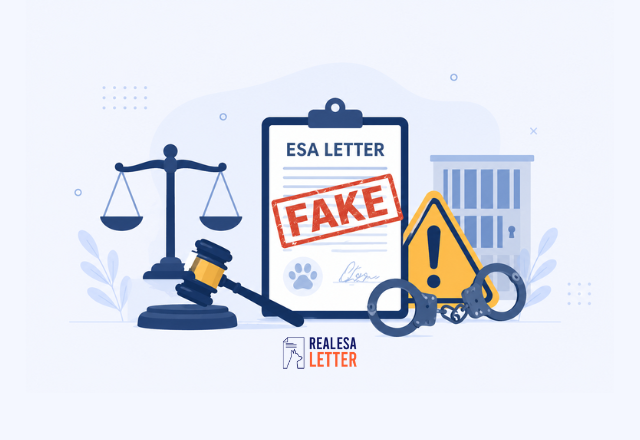
Under Florida Statute 817.265, anyone who submits a fake ESA letter can face a $500 fine, up to 60 days in jail, and mandatory community service. The law protects people with real disabilities and stops the misuse of ESA housing rights.
Let’s look at how Florida handles ESA fraud, what the law requires, the penalties involved, and why these rules matter for every housing community.

What Is ESA Fraud in Florida?
ESA fraud happens when someone lies about needing an emotional support animal or submits false documentation. Fraud also includes exaggerating symptoms, forging letters, altering legitimate documents, or paying for quick online ESA approvals without real evaluations.
The Florida ESA law is strict because fake ESA claims affected housing communities. Landlords saw many questionable letters, and some tenants abused ESA protections to avoid pet restrictions. The law now makes it clear that misrepresenting an ESA need is a crime, not a simple misunderstanding.
Florida ESA fraud became a major problem for several reasons:
- Many websites sold “instant ESA letters” with no evaluation.
- People used ESA registrations or certificates, which look official but hold no legal value.
- Housing communities faced unsafe animals mislabeled as ESAs.
- Some residents used ESA claims to bypass fees, deposits, or pet rules.
This growing trend made it difficult for people with real disabilities to receive fair treatment.
Understanding Florida Statute 817.265
Florida passed Statute 817.265 to punish the intentional misrepresentation of ESA needs. This law is designed to protect people who depend on ESAs while preventing abuse in housing settings.
The law makes it illegal to:
- Submit false disability information to obtain ESA approval
- Use or submit fake ESA letters to landlords or condo boards
- Claim an animal is an ESA to avoid pet rules when it is not
- Assist someone else in committing ESA fraud
- Provide disability details you know are untrue
Anyone involved in the creation, submission, or support of fake ESA documentation can face legal consequences.
The Florida statute ESA law applies to:
- Renters
- Condo owners
- Applicants seeking housing
- Family members acting on someone’s behalf
- Individuals helping others create fake ESA paperwork
The law reaches anyone knowingly participating in misrepresentation.
Penalties for Fake ESA Letters in Florida
Submitting a fake ESA letter is not a minor issue in Florida. Violating Statute 817.265 is a second-degree misdemeanor, which carries criminal consequences.
A person convicted of ESA fraud may face:
- Up to 60 days in jail
- A fine of up to $500
- 30 hours of community service, completed within six months
These penalties may be given separately or together. A judge decides the punishment based on the severity of the fraud and the intent behind it.
Second-Degree Misdemeanor
A second-degree misdemeanor in Florida is a criminal charge that may appear on background checks. This level of offense is similar to minor theft or disorderly conduct. It can affect job opportunities, housing applications, and future legal matters.
Florida uses this classification to show that ESA fraud is not a harmless action. The state wants residents to understand that lying about disability needs is a serious offense.
What Counts as a Fake ESA Letter in Florida?
Many people unknowingly use documents that Florida considers invalid. Some think ESA registrations or badges make their animal official, but this is incorrect.
Florida accepts only one form of ESA proof: a properly written letter from a licensed health professional with personal knowledge of the individual.
Access to legitimate providers varies across Florida. Jacksonville residents have faced challenges finding local ESA resources, which has sometimes led individuals toward questionable online services. Understanding what constitutes fraud helps residents in all Florida cities avoid legal consequences while obtaining legitimate documentation.
An ESA document is considered fake or unreliable when it:
- Comes from a provider who never evaluated the patient
- Was purchased online without a real mental-health assessment
- Was issued by a provider without a valid state license
- Is auto-generated or created using a short questionnaire
- Promises instant approval without clinical review
- Uses a generic template with no personalized details
- Was produced by an out-of-state provider without authorization
- Includes no evidence of a treatment relationship
Florida law also makes it clear that ESA registrations, ID cards, certificates, or patches carry no legal weight.
Miami residents seeking English and Spanish ESA letter services in their preferred language should understand that these warning signs apply equally to both English and Spanish providers.
Examples of fraudulent documents Florida treats as red flags:
- Letters claiming approval after a two-minute survey
- Certificates stating the animal is "officially registered."
- ESA ID cards are sold with no evaluation
- Letters with no provider license number
- Letters from providers not authorized to practice in Florida
- Documents with identical wording for every customer
- ESA registrations, badges, patches, or certificates (these carry no legal weight)
These items cannot prove disability or establish ESA need.
What Counts as Reliable ESA Documentation in Florida?
Florida law encourages housing providers to request “reliable documentation” when evaluating ESA requests. The goal is to confirm real disability needs while filtering out fraudulent documents.
A reliable Florida ESA letter must include:
- A mental or emotional disability recognized under housing laws
- A clear explanation of how the ESA supports the person
- The provider’s full name, license number, and licensing state
- Confirmation that the provider has personal knowledge of the patient’s condition
- A statement showing an ongoing treatment relationship
The letter must come from a licensed professional who has evaluated the patient and can legally practice in Florida.
Legitimate vs Fraudulent ESA Services: How to Tell the Difference in Florida
| Legitimate ESA Service | Fraudulent ESA Service |
|---|---|
| Provider licensed and verifiable in Florida | Out-of-state or unlicensed provider |
| Real evaluation with a clinical interview | Two-minute questionnaire or automated form |
| Letter personalized to your condition | Generic template identical for every customer |
| Ongoing treatment relationship established | One-time transaction with no follow-up |
| Provider contact information is verifiable | No working phone number or license number |
| Letter dated and signed on official letterhead | Certificate, badge, or ID card format |
| Complies with Florida's personal knowledge requirement | No evidence provider has personal knowledge of patient |
Florida’s “Personal Knowledge” Requirement Explained
The “personal knowledge” requirement is one of the strongest parts of Florida’s ESA law. It ensures that ESA letters come from real therapeutic relationships, not from online companies issuing same-day approvals.
A provider has personal knowledge when they:
- Conduct an evaluation
- Understand the patient’s symptoms and needs
- Have an existing relationship through treatment or counseling
- Review relevant medical or mental-health history
This requirement blocks online mills that offer fast ESA letters without professional involvement.
Why This Requirement Matters
The state added this requirement because many fraud cases involved letters from out-of-state providers or websites lacking credibility. Personal knowledge ensures that only people with legitimate needs qualify for ESA housing protections.
How Florida Enforces ESA Fraud Laws
Florida takes ESA fraud seriously, and enforcement is increasing every year. Housing providers now review ESA documents more carefully, and many report suspicious documents for verification.
Housing Providers Can Request More Information
Landlords and condo boards may:
- Ask for reliable documentation
- Confirm provider licensing
- Request clarification about the treatment relationship
- Reject ESA requests based on unreliable or suspicious paperwork
They cannot ask for private medical records, but they can review ESA letters for compliance.
Charges for ESA fraud may apply to:
- Individuals who submit fake documents
- Family members providing false paperwork
- Anyone helping create fraudulent ESA materials
- People denying or hiding relevant information
- Providers issuing letters without proper evaluation
Florida designed the law to hold all involved parties responsible.
What Happens After Fraud Is Reported
If fraud is suspected:
- Housing providers may report the issue
- Law enforcement may investigate
- Providers may be questioned or disciplined
- The individual may receive criminal charges
Cases vary in severity, but intentional ESA fraud often leads to legal action.
Rights of People With Legitimate ESA Needs
Florida's law does not harm people with real disabilities. Those with legitimate ESA needs remain fully protected under federal and state housing laws.
People with valid ESA letters have the right to:
- Request reasonable accommodations in housing
- Live with their ESA without pet fees or deposits
- Present legitimate documentation without discrimination
- Appeal denials if documentation meets legal standards
- File complaints with HUD if rights are violated unlawfully
- Expect consistent review processes from housing providers
- Receive accommodation regardless of the building's pet policy
- Maintain privacy regarding specific diagnosis details
The law targets abuse, not disability rights. Florida explicitly protects individuals who obtain ESA letters through proper clinical channels and genuine therapeutic relationships.
Responsibilities of Housing Providers
Housing providers must balance fairness and compliance. They should review ESA letters carefully while protecting legitimate tenants.
A landlord may deny an ESA request if:
- Documentation is unreliable or inconsistent
- The provider's license cannot be verified through state databases
- The animal poses a direct threat to health or safety
- The animal causes substantial property damage beyond normal wear
- The letter does not meet Florida's legal requirements
- The accommodation creates an undue financial or administrative burden
- The animal's presence fundamentally alters the housing operation
Providers must use reasonable judgment and review requests consistently. They cannot impose blanket bans on ESAs or charge additional screening fees for reviewing ESA documentation.
Housing providers must balance fairness and compliance. They should review ESA letters carefully while protecting legitimate tenants.
Why Florida Passed Strict ESA Fraud Penalties
Florida created strict penalties for several important reasons:
- ESA fraud was increasing rapidly across the state
- Fake letters harmed people with real disabilities by creating public skepticism
- Housing providers struggled to distinguish legitimate claims from fraudulent ones
- Online ESA mills sold misleading documents with no clinical evaluation
- Communities faced safety risks from untrained animals misrepresented as ESAs
Many websites sold "instant ESA letters" with no evaluation, often at suspiciously low prices. Check the ESA letter cost upfront so you know what a legitimate evaluation should actually charge before you commit.
- Legitimate mental health professionals faced credibility challenges due to fraud
- Property owners reported increased liability concerns from improperly vetted animals
- The volume of fraudulent claims overwhelmed housing complaint systems
Florida now uses criminal penalties to protect real ESA users and maintain fairness in housing.
Florida ESA Fraud Cases: What Enforcement Looks Like
Florida's enforcement of Statute 817.265 has produced documented cases that show how seriously the state treats ESA misrepresentation.
In one Broward County case, a tenant submitted an ESA letter purchased from an out-of-state online service that had conducted no evaluation.
When the housing provider requested license verification, the provider's credentials could not be confirmed through Florida's state database. The tenant faced both housing denial and a referral to local law enforcement for misrepresentation under 817.265.
In another case in Orange County, a landlord reported a pattern of identical ESA letters submitted by multiple applicants, all from the same online service, with identical templated language and no individualized clinical details.
The Florida Department of Business and Professional Regulation opened an investigation into the issuing provider for practicing without a valid Florida license.
These cases reflect the two most common enforcement paths in Florida: housing providers reporting suspicious documents to law enforcement, and state regulators investigating the services that produce them.
Ultimately, submitting a fake ESA letter in Florida is a criminal act with serious consequences. Violating Florida Statute 817.265 can lead to fines, jail time, and mandatory community service. The law ensures that people with genuine disabilities receive protection, while those who misuse ESA rules face legal penalties.
Anyone requesting an ESA should work with a licensed provider, undergo a proper evaluation, and maintain an honest treatment relationship. Florida’s ESA laws reward honesty and protect individuals who truly rely on emotional support animals.
A common question is what does an ESA letter do and how it helps individuals who rely on emotional support animals. An ESA letter provides official documentation from a licensed mental health professional confirming that an emotional support animal is part of a person’s mental health treatment.
Choosing the right support matters, and that starts with reliable documentation. Always use a legit ESA letter website like RealESALetter.com that connects you with licensed providers and follows proper evaluation standards. This ensures your ESA request stays compliant with Florida law and protects your housing rights.
If you need a properly structured ESA letter in Florida that holds up under Florida Statute 817.265, start your assessment today.
Dr. Avery Langston is a health and wellness writer with 12+ years of experience covering ESA rights, housing laws, and mental health. As a senior contributor for RealESALetter.com, she helps readers understand ESA regulations and legal protections.

James Mitchell is a licensed clinical social worker with active LCSW licenses across 13 states, including California, New Jersey, Texas, Florida, and Arkansas. He conducts ESA evaluations with direct clinical experience using pet therapy as part of mental health treatment.