Sign In / Create Account
Is Faking a Service Dog Illegal? State Laws and Penalties
Yes. Falsely representing a pet as a service dog is illegal in most U.S. states. Although the Americans with Disabilities Act (ADA) does not make service dog fraud a federal crime, 31 to 35 states have enacted laws that impose civil penalties or criminal consequences for misrepresenting a service animal.

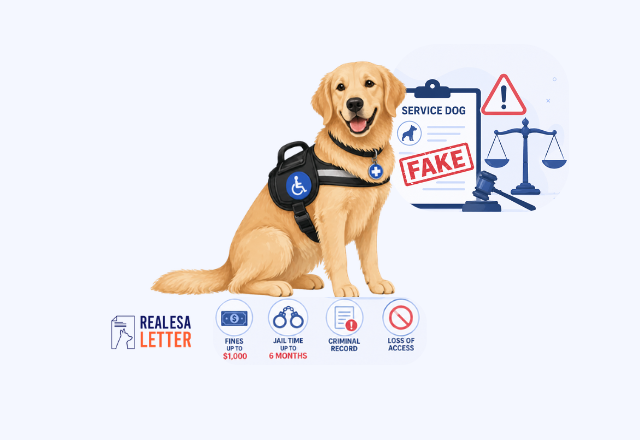
Federal law under the Americans with Disabilities Act (ADA) does not itself criminalize misrepresentation. That is left to the states. As of 2026, 35 states have laws specifically banning the fraudulent representation of a pet as a service animal, according to the Michigan State University Animal Legal & Historical Center. Fifteen states have no such law.
Below we cover what counts as service dog fraud, the penalties state by state, and how faking a service dog differs from the rules that govern emotional support animals.
Key Takeaways
- Faking a service dog is illegal in 35 states. Fines run from about $100 to $1,000+, with jail possible for repeat offenders.
- The ADA does not criminalize it. Federal law defines service animals; states punish the lying.
- It is not a felony anywhere. As of 2026, it's a civil infraction or misdemeanor.
- There is no federal service dog registry. Online certificates, IDs, and vests carry no legal weight.
- Businesses can only ask two questions. Whether the dog is disability-related and what task it performs.
- The fine is rarely the worst part. Eviction, airline bans, civil liability, and on-the-spot removal all follow.
- ESAs and service dogs are not the same. Service dogs get ADA public access; ESAs get FHA housing protection.
A legitimate ESA letter is the simpler path. One evaluation from a licensed clinician, no purchase required.
Verify your state's current statute. Statutes change every session. This isn't legal advice.
Why Is Faking a Service Dog a Crime in Most States but Not Under Federal Law?
The gap comes down to how the ADA is built. The ADA does two things. It defines a service animal as a dog individually trained to perform tasks for a person with a disability. It also protects that dog's access to public places. What it doesn't do is make lying about a service dog a federal crime.
That job is left to the states. Most have stepped in to fill the gap with their own misrepresentation laws, and the number has grown steadily over the past decade. The ADA also requires no paperwork for a genuine service dog. A PSD letter online from a licensed clinician documents a psychiatric disability for housing and air travel, but it cannot turn an untrained pet into a service animal.
The MSU Animal Legal & Historical Center counts 35 states with what it calls "true bans" on fraudulently representing a pet as a service animal.
Why Do State Counts for Fake Service Animal Laws Differ?
You will find three different numbers in circulation, and each one is counting something different.
35 states. This is the MSU Animal Legal & Historical Center's 2026 count of true bans, meaning statutes that specifically prohibit misrepresenting a pet as a service animal for public access. This is the figure we use throughout this guide.
31 states. An older count that predates several recent enactments. Some sites still publish it.
45 states or more. These counts add states that have no public-access misrepresentation law but do prohibit misrepresenting an assistance animal in housing, or that reach the conduct through general fraud, trespass, or false-pretenses statutes. MSU tracks housing misrepresentation on a separate map for exactly this reason.
The practical takeaway: if you are asking whether you can be charged for walking a pet into a store in a fake vest, the 35-state figure is the one that answers your question.
Is faking a service dog a felony?
No. No state currently treats service dog misrepresentation as a felony. It is charged as a civil infraction or a misdemeanor, depending on the state, and several states escalate the penalty for a repeat offender. That still means real consequences: fines, mandatory community service, and in some states the possibility of jail. But it is not a felony anywhere as of 2026.
What Counts as Service Dog Fraud?
Service dog fraud means knowingly passing off an untrained pet as a legitimate service dog to gain access or benefits you aren't entitled to. Most state laws require that the misrepresentation be intentional.
An honest mistake is not the target. Someone who genuinely believed their well-behaved dog qualified isn't who these laws go after. The target is deliberate deception.
In practice, misrepresenting a service animal usually looks like one of the following:
- Verbally claiming a pet is a service dog to enter a restaurant, store, hotel, or other place that doesn't allow pets.
- Dressing a pet in a service dog vest, guide dog harness, or patch to imply it is a trained service animal when it is not.
- Using a fake or purchased service dog certification, ID card, or "service dog papers" to back up the claim.
- Falsely claiming to have a disability that requires a service animal.
It's worth being clear on one point that trips up a lot of people: there is no official federal service dog registry, certificate, or ID. The Department of Justice does not recognize any online "certification" as proof that a dog is a service animal.
So the fake vests and ID cards sold online don't just fail to help. They're frequently the very thing that flags someone as a faker when a business follows up.
What Are the Penalties for Faking a Service Dog in Each State?
Penalties vary widely by state. On the low end, misrepresenting a service dog is a small civil infraction with a fine in the low hundreds. On the high end, it is a criminal misdemeanor. Kansas carries the steepest exposure at up to a year in jail and a $2,500 fine, and several states add mandatory community service for an organization that serves people with disabilities.
Two tables follow. The first covers all 50 states and D.C. and shows whether the state has a misrepresentation statute. The second gives penalty detail for the states where the figures are confirmed: maximum fine, maximum jail, offense classification, whether the penalty escalates on a repeat offense, and the year enacted.
These figures are statutory ceilings, not typical outcomes. What actually happens depends on the circumstances, whether it is a first or repeat offense, and prosecutorial discretion.
Last verified July 2026 against the MSU Animal Legal & Historical Center's 2026 state map. Citations marked with an asterisk are pending confirmation against primary statute text.
Which States Have a Fake Service Dog Law?
State | Misrepresentation law | Statute |
Alabama | Yes | Ala. Code § 21-7-5* |
Alaska | No | None |
Arizona | Yes | A.R.S. § 11-1024 |
Arkansas | Yes | Ark. Code § 20-14-310* |
California | Yes | Cal. Penal Code § 365.7 |
Colorado | Yes | C.R.S. § 18-13-107.3 |
Connecticut | No | None |
Delaware | No | None |
Florida | Yes | Fla. Stat. § 413.08(9) |
Georgia | No | None |
Hawaii | Yes | HRS § 347-2.6 |
Idaho | Yes | Idaho Code § 18-5811A |
Illinois | No | None |
Indiana | No | None |
Iowa | Yes | Iowa Code § 216C.11* |
Kansas | Yes | K.S.A. § 39-1112 |
Kentucky | No | None |
Louisiana | Yes | La. R.S. § 46:1975* |
Maine | Yes | 17 M.R.S. § 1314-A* |
Maryland | No | None |
Massachusetts | No | None |
Michigan | Yes | MCL § 752.61 |
Minnesota | Yes | Minn. Stat. § 609.833 |
Mississippi | No | None |
Missouri | Yes | Mo. Rev. Stat. § 209.204* |
Montana | Yes | Mont. Code § 49-4-222 |
Nebraska | Yes | Neb. Rev. Stat. § 28-1313* |
Nevada | Yes | NRS 426.510 |
New Hampshire | Yes | N.H. RSA § 167-D:8 |
New Jersey | Yes | N.J.S.A. § 10:5-29.5* |
New Mexico | Yes | N.M. Stat. § 28-11-6* |
New York | Yes | N.Y. Agric. & Mkts. Law § 118* |
North Carolina | Yes | N.C.G.S. § 168-4.5 |
North Dakota | Yes | N.D. Cent. Code § 25-13-2.2* |
Ohio | No | None |
Oklahoma | Yes | Pending confirmation* |
Oregon | No | None |
Pennsylvania | Yes | 43 P.S. § 405.6* |
Rhode Island | Yes | R.I. Gen. Laws § 40-9.1-3.1 |
South Carolina | Yes | S.C. Code § 47-3-980 |
South Dakota | No | None |
Tennessee | Yes | Tenn. Code § 39-16-304 |
Texas | Yes | Tex. Hum. Res. Code § 121.006 |
Utah | Yes | Utah Code § 62A-5b-106 |
Vermont | No | None |
Virginia | Yes | Va. Code § 51.5-44.1 |
Washington | Yes | RCW § 49.60.214 |
West Virginia | Yes | W. Va. Code § 5-15-9* |
Wisconsin | No | None |
Wyoming | Yes | Wyo. Stat. § 35-13-203 |
District of Columbia | No | None. See note below |
* Citation pending confirmation against primary statute text.
A note on D.C.: the District has no misrepresentation statute, but it is the one jurisdiction that expands what businesses may ask. D.C. Code § 7-1002 permits two questions beyond the ADA's standard two.
Penalty Detail by State
State | Max fine | Max jail | Classification | Escalates on repeat offense | Enacted |
California | $1,000 | 6 months | Misdemeanor | No | 1995 |
Colorado | $25 to $500 | None | Petty offense | Yes | 2016 |
Florida | $500 | 60 days | 2nd-degree misdemeanor | No | 2015 |
Idaho | $1,000† | 6 months† | Misdemeanor | No | 1997 |
Iowa | Not specified | 30 days | Simple misdemeanor | No | 2018 |
Kansas | $2,500† | 1 year† | Class A nonperson misdemeanor | No | 2015 |
Louisiana | None stated | None stated | Prohibited | No | Not confirmed |
Maine | $1,000 per occurrence | None | Civil violation | No | 2015 |
New Hampshire | None stated | None stated | Prohibited | No | Not confirmed |
New Jersey | $100 to $500 | None | Civil | No | Not confirmed |
New Mexico | None stated | None stated | Prohibited | No | Not confirmed |
North Carolina | $200† | 20 days† | Class 3 misdemeanor | No | 2005 |
South Carolina | None stated | None stated | Prohibited | No | Not confirmed |
Texas | $1,000 plus 30 hours community service | None | Misdemeanor | No | 2014, amended 2021 |
Virginia | $250† | None | Class 4 misdemeanor | No | 2016 |
† Not stated in the misrepresentation statute itself. This is the maximum under the state's general sentencing law for that offense class. Most published penalty figures for these states are derived this way, which is why numbers differ across sources.
"None stated" means the statute prohibits the conduct without specifying a penalty.
States not listed above either have no misrepresentation statute, which you can check in the previous table, or have one whose penalty figure we have not yet confirmed against primary text. We add rows as they clear.
A Closer Look at the States People Ask About
Texas. Misrepresenting a service animal is a misdemeanor punishable by up to a $1,000 fine plus 30 hours of community service under Human Resources Code § 121.006. This matters because the older $300 figure is still widely published, including on several pages currently ranking for this topic. HB 4164 raised it. Texas law also permits the animal to be seized in habitual-offender cases.
California. The same conduct is a misdemeanor under Penal Code § 365.7, which has been on the books since 1995, carrying up to $1,000 and six months in jail. Note that AB 468, passed in 2021, is a separate law regulating businesses that sell emotional support animal documentation. It did not create or amend the misrepresentation offense, though it is sometimes cited that way.
Florida.A second-degree misdemeanor with the added community service requirement, under the state law.
Colorado. One of the few states where the fine scales explicitly with offense count, running from $25 for a first violation up to $500. Minnesota and Nevada also escalate on repeat offenses, though we have not yet confirmed their exact figures.
Pennsylvania and Oklahoma. Both reach misrepresentation partly through housing law rather than public accommodations alone. Pennsylvania allows a fine of up to $1,000 for misrepresenting an animal as an assistance or service animal in a housing context.
Oklahoma routes the conduct through its Residential Landlord and Tenant Act under HB 3282, effective November 2018, with remedies including eviction, court costs, and damages up to $1,000.
States with no specific statute. Fifteen states and the District of Columbia have no misrepresentation law. That does not make the conduct consequence-free, and we cover what still applies in those states below.
One caution for readers relying on this in 2026: service animal law moves quickly, and bills are introduced or amended every legislative session. Always confirm your own state's current statute before relying on a specific figure. This article is informational and is not legal advice.
What Can a Business Do If It Suspects a Fake Service Dog?
A business has less power than most managers think, and more than most handlers expect. What you may do. Ask the two ADA questions: is the dog required because of a disability, and what work or task has it been trained to perform.
Remove any dog that is out of control or not housebroken, service animal or not. File a complaint under your state's misrepresentation statute if you believe the claim was knowingly false.
What you may not do. Ask about the customer's medical condition. Demand documentation, certification, or an ID card. Require the dog to demonstrate its task. Charge a pet fee or a cleaning deposit. Refuse service based on breed, size, or the absence of a vest.
Where managers get into trouble. Refusing access to a legitimate service dog is itself an ADA violation and carries real exposure. Every state misrepresentation law on the books preserves the ADA's ban on demanding paperwork. Having a state law against fakes does not give you a new right to ask for documents.
What If Your State Has No Fake Service Dog Law?
Fifteen states and D.C. have no statute specifically banning service dog misrepresentation. That does not make the conduct consequence-free.
A business can still refuse entry, remove the dog, or ban the person. General fraud, trespass, or false-pretenses statutes may still reach the conduct.
Several of these states prohibit misrepresenting an assistance animal in housing even though they have no public-access law. And civil liability for a bite or property damage does not depend on any misrepresentation statute existing.
Bills are introduced in these states most sessions, so absence of a law is a snapshot, not a permanent state.
Is Faking a Service Dog the Same as Getting a Fake ESA Letter?
No. These two get lumped together constantly, but the difference between an ESA and a service dog is exactly what the law turns on. Faking a service dog is a state offense tied to the ADA's public-access rules. A valid emotional support animal requires only an ESA letter under the Fair Housing Act, not task training.
A service dog is individually trained to perform a specific task for a person's disability. Under the ADA, it can accompany its handler almost anywhere the public can go.
An emotional support animal (ESA) provides comfort through its presence but is not trained to perform a task. Because an ESA isn't a service animal, the ADA emotional support animal rules give it no public-access rights. You cannot bring one into a no-pets restaurant or store.
What an ESA does have is a housing protection. Under the Fair Housing Act, a landlord generally must make a reasonable accommodation for an assistance animal even in a no-pets building. The landlord also cannot charge a pet fee for it. That protection is enforced by HUD, not the ADA.
So the two "fraud" scenarios are different. Misrepresenting a service dog is about faking task training to gain public access. Fake ESA letter problems are different. They involve documents issued without a real clinical relationship, or someone claiming a disability they don't have to keep an animal in housing.
An emotional support animal is not a service dog and requires no task training, only a valid ESA letter from a licensed provider. RealESALetter.com connects you with a licensed mental health professional in your state to determine whether you qualify under the Fair Housing Act.
What Happens If You Get Caught Faking a Service Dog?
The statutory fine is often the smallest part of the story. Misrepresenting a service dog can ripple out into consequences that cost far more than a $1,000 ceiling.
- Housing denial or eviction. If a landlord discovers a tenant faked an assistance-animal claim, it can void the accommodation. In some cases, it can also support eviction.
- Airline bans. Airlines removed emotional support animals from cabin protection in 2021. Trained service dogs still fly. But travelers caught misrepresenting a pet can face refusal and future booking restrictions.
- Civil liability. If a fraudulently presented dog bites someone or damages property, the handler is on the hook. Having misrepresented the dog can make that worse.
- Removal on the spot. A business can lawfully eject any dog that is out of control or not housebroken, service animal or not.
As for how people get caught, businesses can't demand paperwork, but they aren't powerless. Under the ADA's two-question rule, they may ask whether the dog is required because of a disability, and what work or task the dog has been trained to perform. They cannot ask about your medical condition, demand documentation, or require the dog to demonstrate its task.
How these laws actually get enforced
Almost entirely reactively. Police do not patrol for fake service dogs. In practice, a misrepresentation statute surfaces in one of three ways. A business owner files a complaint. An animal control officer is called after a behavioral incident like a bite, a lunge, or a mess. Or a manager refuses service and the situation escalates until police are called.
What triggers the complaint is nearly always behavior, not the claim itself. A dog that sits quietly under a table does not get questioned. A dog that barks at other diners does, and then the handler's inability to name a trained task is what turns a nuisance call into a citation.
A refusal to answer the two permitted questions can, in many states, create a presumption that the dog is not a service animal. If you want to report a suspected fake, the practical path is a complaint to the business, or a complaint to the DOJ for public accommodation access disputes.
How to Get a Legitimate ESA or PSD Letter Instead
If your goal was never public access but simply keeping a comforting animal in your home, you almost certainly don't need to fake anything. You need a legitimate ESA letter.
A legitimate ESA letter is issued by a state-licensed mental health professional and includes the clinician's license number, issue date, and contact information so a landlord can verify it under the Fair Housing Act.
The process is straightforward. You're evaluated by a licensed mental health professional who determines whether you have a condition that an emotional support animal would help. If you do, the clinician issues the letter.
There's no registry to join and no certificate to buy. The letter itself, from a real clinician, is the document that carries weight. If your need is task-based rather than comfort-based, for example a dog trained to interrupt a panic attack, that points toward a psychiatric service dog letter instead, which is a different pathway with public-access implications.
An ESA letter is not a service-dog credential and carries no public-access rights. Every RealESALetter.com letter is issued by a state-licensed mental health professional and includes the clinician's license number, issue date, and direct contact information, so a landlord can verify it independently under the Fair Housing Act.
The bottom line: faking a service dog carries real legal risk in most states, and it does genuine harm to people who rely on trained service animals. The legitimate alternatives are simpler than the fraud. If an ESA fits your situation, here's how online ESA letters actually work.
Frequently Asked Questions
Can I be fined under the ADA for faking a service dog?

No. The ADA doesn't impose criminal penalties for misrepresentation. Only state laws do.
What if I thought my dog qualified as a psychiatric service dog?
If your dog isn't specifically trained to perform tasks for a psychiatric disability, it isn't a service dog. Most state laws only penalize knowing misrepresentation, so an honest mistake usually isn't the target, but you shouldn't count on that as a defense.
Are online “service dog certificates” or “psychiatric dog registrations” valid?
No. They have no legal status under the ADA or state law. In California, AB 468 goes further and lets the state impose civil penalties of up to $2,500 for repeat violations on businesses that sell such credentials without the required disclosures.
Are penalties different for fake psychiatric service dogs?
No. The law treats a fake psychiatric service dog the same as any other fake service animal. If the dog isn't trained to perform tasks for a psychiatric disability, it's legally a pet, and misrepresenting it carries the same fines or jail time.
Do all states penalize fake service dogs?
Not all. 35 states currently have specific misrepresentation laws, per the MSU Animal Legal & Historical Center's 2026 count. Where no specific law exists, general fraud or trespass statutes may still apply.
Dr. Alex Morgan is a specialized writer focusing on animal assisted therapy, ESA rights, and psychiatric service dogs. With extensive research experience, he helps readers navigate ESA and PSD documentation and understand service animal rights accurately at RealESALetter.

Precious L. is a Licensed Mental Health Counselor (LMHC) and qualified supervisor whose work centers on trauma-informed care, family systems, relationship health, and emotional adjustment.

Don't worry. Your pet stays with you.
Housing law is on your side
- 1A few questions. That's your paperwork
- 2A licensed therapist reviews your case
- 3Official ESA letter, ready to send
Not accepted? Full refund, guaranteed