Sign In / Create Account
California AB 468 ESA Law: Requirements & Compliance Guide
California's AB 468 requires a licensed health care provider to have known a client for at least 30 days before writing an emotional support animal letter. The law also requires the letter to list the provider's license details, and it requires anyone selling support animals or to give buyers a written notice that the emotional support animal does not have service dog rights.

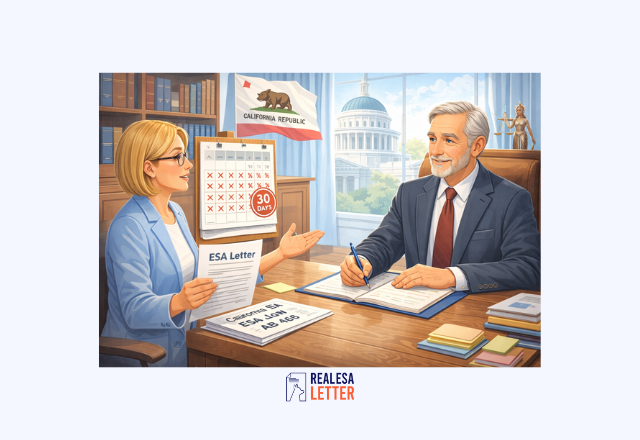
Understanding California ESA laws provides helpful context for how AB 468 fits into the broader regulatory landscape. Now let's explore what makes AB 468 necessary and what it actually requires.
Key Takeaways
It Is a Fraud-Prevention Law: AB 468 sets standards for who can issue ESA documentation in California.
The 30-Day Rule: A clinician must have ongoing contact with you for at least 30 days before writing the letter. Same-day letters break the law.
Four License Details Required: Section 12231.8(A) demands the license number. The effective date. The jurisdiction. The license type.
A Clinical Evaluation Is Mandatory: Therapist should document your condition after conducting clinical evaluation.
Penalties Are Real: Misrepresentation brings six months jail or a $1000 fine. Clinicians risk license suspension.
Out-of-State Letters Usually Fail: California landlords generally reject them. A California-licensed clinician is needed.
Any Species Counts: AB 468 covers cats and birds and all other ESAs.
The Problem AB 468 Solved
Before AB 468 was enacted, ESA documentation was largely unregulated. Anyone could issue an "ESA letter" without proper credentials or a clinical evaluation. Some sellers never even met with clients. This created a market for fraudulent ESA documentation.
It undermined the credibility of legitimate ESA letters. It also fueled confusion between ESAs and task-trained service dogs. California's Assembly recognized this problem and passed AB 468. The law was designed to prevent fraud and protect both ESA users and housing providers.
Key Requirements of AB 468
AB 468 establishes strict requirements for anyone involved in ESA documentation. These requirements apply to licensed practitioners issuing letters and to businesses selling ESA-related products.
Understanding these requirements is essential for compliance. The law covers four critical areas: provider credentials and processes, business disclosure obligations, penalties for fraud, and the crucial distinction between housing rights and public access rights.
Provider Rules for Licensed Healthcare Professionals
Licensed healthcare professionals who issue ESA documentation must comply with AB 468 § 12231.8(A). The official documentation must clearly display specific information. This includes the practitioner's state license number, effective date, and jurisdiction where the license is valid.
It also includes the type of professional license. Examples include Licensed Marriage and Family Therapist, Clinical Psychologist, or Licensed Professional Counselor.
The practitioner must also complete a documented clinical evaluation of the individual's mental health condition and need for an emotional support animal. This evaluation cannot be conducted until the 30-day client-provider relationship has been established. The law defines this relationship as ongoing clinical contact, not a single consultation.
Business and Seller Requirements
Any business selling or providing an ESA, or selling ESA-related products (vests, leashes, registrations, certificates), must provide written notice to the buyer.
Under AB 468 § 12231.8(D), this notice must state two things. First, the animal does not qualify as a service dog. Second, it is not entitled to the same rights and privileges as a task-trained service dog under the Americans with Disabilities Act (ADA).
Penalties for Misrepresentation
Fraudulently misrepresenting an ESA or pet as a service dog is a California misdemeanor under Penal Code § 365.7, punishable by up to 6 months in county jail, fines up to $1,000, or both.
Health care practitioners who violate AB 468 provider requirements are also subject to discipline from their licensing board, including license suspension or revocation.
Housing Rights vs. Public Access
The law clarifies a critical distinction. Emotional support animals are permitted in certain no-pet housing under California fair housing rules (FEHA). However, they are not granted the same public access rights or travel privileges as task-trained service dogs.
ESAs are not entitled to access restaurants, grocery stores, retail establishments, airplanes, or other public accommodations the way service dogs are. This distinction is essential to understanding what an ESA letter for housing does and does not provide.
Why California Created AB 468
The problem AB 468 was designed to solve was widespread and growing. Before the law's enactment, ESA documentation had become a largely unregulated market. This market was rife with fraud.
Bad actors were selling "ESA certifications," "registered ESA letters," and "official ESA paperwork." They did this without ever meeting clients, evaluating mental health conditions, or holding proper mental health licenses.
This fraudulent documentation industry created several problems:
For legitimate ESA users: Landlords became skeptical of all ESA letters, making it harder for people with genuine disabilities to exercise their housing rights.
For landlords: They received bogus ESA letters and had no clear way to verify compliance, increasing liability and confusion about fair housing obligations.
For housing providers: The market confusion between service dogs and ESAs led to misrepresentation and access disputes in common areas.
For mental health professionals: Legitimate practitioners saw their professional credibility undermined by fraudulent competitors who weren't licensed or qualified.
AB 468 closed these gaps by establishing clear, enforceable standards for anyone issuing ESA documentation in California.
Detailed Provider Requirements Under AB 468
Health care practitioners issuing ESA documentation must comply with strict rules under AB 468 § 12231.8(A). This section provides detailed guidance on exactly what clinicians must do to issue a valid ESA letter.
Required Documentation Details
AB 468 § 12231.8(A) requires health care practitioners to provide:
- Active, valid license including the effective date of the license, state license number, jurisdiction, and type of professional license (e.g., Licensed Marriage and Family Therapist, Clinical Psychologist, etc.)
- Licensed in relevant jurisdiction. The practitioner must be licensed in California to issue documentation for California use.
- 30-day client-provider relationship established prior to issuing documentation. This is critical and most commonly missed.
- Clinical evaluation. A documented assessment of the individual's mental health condition and need for an ESA.
- Written notice. A separate written notice stating that fraudulently misrepresenting an animal as a service dog is a California misdemeanor.
All of these elements must appear on what an AB 468-compliant ESA letter must include so landlords can verify compliance.
The 30-Day Rule Explained
The 30-day relationship requirement is one of the most misunderstood aspects of AB 468. This means the clinician must have been working with the client for a minimum of 30 days before the ESA evaluation and documentation can be issued. The relationship must be documented. Just meeting a client once and issuing a letter violates this requirement.
This rule prevents "fast-track ESA letters." It ensures clinicians have adequate time to conduct a thorough clinical evaluation of the individual's actual need for an ESA.
Clinical Evaluation Requirements
The clinical evaluation must assess the individual's specific mental health condition. It must demonstrate how an ESA would provide emotional support. The evaluation should document:
- The diagnosed mental health condition or disability
- How the condition substantially limits a major life activity
- The nexus between the condition and the need for an ESA
- How the specific ESA (type of animal) addresses the individual's disability
Every RealESALetter.com ESA letter includes the licensed California clinician's state license number, effective date, jurisdiction, and type of professional license, as required under AB 468 § 12231.8(A).
How to Verify Provider Credentials and Reputation
Before working with a clinician for your ESA letter, you should verify their credentials. This protects you from fraudulent providers and ensures you're getting a legitimate, compliant letter.
Step 1: Check the California Board of Psychology
Visit the California Board of Psychology website to verify the clinician's license. You can search by name or license number. The database shows whether the license is active and if there are any disciplinary actions against the practitioner.
Step 2: Confirm the License Type
Verify that the clinician holds one of these valid licenses:
- Licensed Marriage and Family Therapist (LMFT)
- Licensed Professional Counselor (LPC)
- Licensed Clinical Social Worker (LCSW)
- Clinical Psychologist
- Licensed Psychotherapist
AB 468 requires the license type to be clearly stated on the letter.
Step 3: Check for Disciplinary History
The California Board of Psychology maintains public records of disciplinary actions. If a practitioner has been disciplined, it will appear in this database. Common disciplinary actions include:
- License suspension
- Probation
- License revocation
- Fines and sanctions
Any recent discipline may indicate compliance issues.
Step 4: Verify the Effective Date
The license's effective date shows how long the practitioner has been licensed. Newer licenses are not necessarily a problem, but they should be recent enough to be currently active.
Business & Seller Requirements Under AB 468
Any person or business that sells, provides, or offers an ESA or ESA-related product must follow strict disclosure rules. This applies to online vendors, breeders, animal trainers, and registry services.
Under AB 468 § 12231.8(D), sellers must provide written notice to the buyer stating:
- The animal does not qualify as a service dog
- The animal is not entitled to the rights and privileges of a service dog
- Knowingly and fraudulently misrepresenting an animal as a service dog is a misdemeanor under California Penal Code § 365.7
This requirement prevents sellers from marketing ESAs as "service dogs." It also prevents them from implying that ESAs have the same public access rights as task-trained service dogs. Many fraudulent sellers deliberately blur this distinction to overcharge consumers.
How to Spot a Fraudulent ESA Letter
With so many fraudulent ESA letters circulating, knowing how to verify authenticity is essential. Here's what a legitimate AB 468-compliant letter must include.
Checklist: What a Compliant Letter Must Have
A real AB 468-compliant ESA letter includes all of these elements:
✓ Practitioner's Full Name clearly printed on official letterhead
✓ State License Number displayed prominently
✓ License Effective Date when the license became active
✓ Jurisdiction where the license is valid (California)
✓ Type of License such as Licensed Marriage and Family Therapist, Clinical Psychologist, or Licensed Professional Counselor
✓ Clinical Evaluation Statement describing your specific mental health condition
✓ Nexus Statement explaining how an ESA addresses your disability
✓ Dated Signature from the licensed practitioner
✓ Written Notice about misrepresentation penalties
✓ 30-Day Relationship Verification indicating ongoing clinical contact, not a single consultation
Red Flags: Signs of Fraudulent Letters
If an ESA letter is missing any of the above elements, it may be fraudulent. Watch for these specific red flags:
Red Flag #1: No license number or vague credentials. Legitimate practitioners always provide their full license number.
Red Flag #2: Generic letters with no reference to your specific condition. Fraudulent letters often use template language that doesn't mention your actual diagnosis.
Red Flag #3: Issued immediately without evaluation. AB 468 requires at least 30 days of clinical relationship. Same-day letters are illegal.
Red Flag #4: Using terms like "certified," "registered," or "official ESA." AB 468 requires written letters, not certifications or registrations.
Red Flag #5: No contact information for the practitioner. Legitimate providers include their office address and phone number.
Red Flag #6: Letter states the animal "qualifies as a service dog." Legitimate ESA letters clarify that the animal is NOT a service dog.
Red Flag #7: From an unlicensed vendor or "ESA registry." Real letters come from licensed mental health professionals, not online registries.
Penalties for AB 468 Violations
Violations of AB 468 carry serious legal consequences. Understanding these penalties is critical for both providers and ESA users.
Knowingly and fraudulently misrepresenting an ESA or pet as a service dog is a California misdemeanor punishable by:
- Up to 6 months in county jail
- Up to $1,000 in fines
- Or both
Health care practitioners who violate AB 468 provider requirements are also subject to discipline from their licensing board. Possible disciplinary actions include license suspension or revocation.
The penalties are strict because AB 468 recognizes that fraudulent ESA documentation harms legitimate ESA users and creates liability for housing providers.
Housing Rights & Public Access Under AB 468
This section clarifies what ESAs can and cannot do under California law. Users frequently confuse housing rights with public access rights; this distinction is legally significant and already highlighted in the law itself.
ESA Housing Rights Under FEHA
Under California's Fair Employment and Housing Act (FEHA), ESAs are permitted in no-pet housing. This is the primary benefit of an ESA letter. When you understand fair housing protections for ESA holders, you'll recognize that landlords cannot:
- Charge pet deposits or pet rent for ESAs
- Enforce breed restrictions on ESAs
- Deny housing to qualified individuals with ESAs
- Require the animal to be registered, certified, or trained
FEHA applies to: Rental apartments, condos, single-family rentals, housing communities, and co-ops.
Public Access: What ESAs Can and Cannot Do
Under the Americans with Disabilities Act (ADA), ESAs are NOT entitled to the same public access rights as task-trained service dogs. This is a critical distinction that many people misunderstand.
ESAs are NOT allowed in:
- Restaurants and food service establishments
- Grocery stores and retail shops
- Airplanes and public transportation
- Hotels (unless hotel policy explicitly allows them)
- Schools and universities (except in student housing)
- Workplaces (except where required by reasonable accommodations)
Service dogs (task-trained dogs for disabilities) ARE allowed in these locations. They are performing specific tasks related to the handler's disability. ESAs do not have this status under the ADA.
Service Dogs vs. ESAs: The Key Differences
Feature | Service Dog | ESA |
Required Training | Task-trained for specific disability | No training requirement |
Housing Rights (FEHA) | Permitted | Permitted |
Public Access (ADA) | Permitted | NOT Permitted |
Airline Travel | Allowed in cabin | Subject to airline policy |
Documentation | Varies; not always required | Requires AB 468-compliant letter |
The confusion between service dogs and ESAs is so common that AB 468 specifically requires sellers and practitioners to provide written notice clarifying the distinction.
How to Get a Compliant AB 468 ESA Letter
Getting an AB 468-compliant ESA letter is a multi-step process that typically takes 2-5 business days, depending on the provider and clinician availability.
To obtain an AB 468-compliant ESA letter in California, you'll work with a licensed mental health practitioner through the following process:
Step 1: Initial Evaluation You'll complete an intake form describing your mental health condition and how an ESA would provide emotional support.
Step 2: Establish 30-Day Relationship (or Document Existing One) If you're not already an established client, your clinician will schedule a series of sessions over 30 days before issuing documentation. If you have an existing therapeutic relationship, the clinician will verify that the 30-day requirement has been met.
Step 3: Clinical Evaluation Your clinician conducts a documented clinical evaluation of your mental health condition and need for an ESA. This assessment examines how your disability is substantially limited. It also examines how an ESA would help.
Step 4: ESA Letter Issuance Once the evaluation is complete and the 30-day relationship is documented, your clinician issues the ESA letter on official letterhead. The letter includes:
- Clinician's full name and state license number
- License effective date and type (e.g., Licensed Therapist)
- Jurisdiction where license is valid
- Date the letter was issued
- Statement of the individual's disability and need for an ESA
- Written notice about misrepresentation penalties
An ESA letter from RealESALetter.com is issued within 24 hours of your clinical evaluation. It includes all AB 468-required documentation. The letter is valid for housing requests and fair housing complaints in California.
Frequently Asked Questions
Does my ESA letter need to be updated for AB 468?

Yes. Any ESA letter issued before January 1, 2022 may not meet current AB 468 compliance requirements. Check if your letter includes your clinician's license number, jurisdiction, effective date, and type of license.
Also, verify that the 30-day client-provider relationship is documented. If either is missing, ESA letter renewal may be necessary to obtain a compliant version that meets AB 468 § 12231.8(A) standards.
Can I use an out-of-state ESA letter in California?
Only if it was issued by a California-licensed health care practitioner who complies with AB 468 § 12231.8(A). Out-of-state letters typically don't meet California's specific requirements. They often lack proper 30-day relationship documentation and clinician license verification.
Most California landlords and housing authorities will not accept out-of-state letters. If you've moved to California, obtain a California-compliant letter.
What if my landlord rejects my AB 468-compliant ESA letter?
If your letter meets all AB 468 requirements and your need for an ESA is legitimate, your landlord's rejection may violate the California Fair Employment and Housing Act (FEHA). You can file a complaint with your local housing authority. You can also contact the California Department of Fair Employment and Housing for guidance.
What's the 30-day relationship requirement, and why does it matter?
AB 468 § 12231.8(A)(3) requires the clinician to establish a documented client-provider relationship for at least 30 days before issuing ESA documentation. This prevents fast-track ESA letters.
It ensures clinicians have adequate time to evaluate your actual need for an ESA. Landlords can request documentation of this relationship if they question the letter's validity.
Does AB 468 apply to emotional support cats, birds, or other animals?
Yes. AB 468 applies to all emotional support animals in California, not just dogs. Any animal claimed as an ESA must have a valid ESA letter that follows the 30-day rule and all other AB 468 requirements. The law does not limit ESAs to specific animal types.
Does AB 468 apply to airlines or air travel with ESAs?
No. Air travel is governed by the Air Carrier Access Act (ACAA). Airlines do not accept ESAs anymore, regardless of AB 468. Only service dogs are allowed in airplane cabins. Your ESA letter provides housing rights, not travel rights.
Does AB 468 allow landlords to ask for more proof or medical records?
No. Even with AB 468, landlords cannot ask for medical records, details of your diagnosis, or your treatment history. They may only verify the provider's license and the authenticity of the letter. This protects your privacy under federal law.
Can a psychiatric nurse practitioner write an ESA letter in California under AB 468?
Yes. Psychiatric nurse practitioners licensed in California and providing mental health care can issue ESA letters. They must follow the law's 30-day requirement and complete a proper clinical evaluation. Their license type must be clearly stated on the letter.
Dr. Avery Langston is a health and wellness writer with 12+ years of experience covering ESA rights, housing laws, and mental health. As a senior contributor for RealESALetter, she helps readers understand ESA regulations and legal protections.

Tina Logan is a Licensed Marriage and Family Therapist with 20+ years of clinical experience and an active California Board of Behavioral Sciences license. She conducts ESA and psychiatric service dog evaluations for RealESALetter assessing whether an ESA or task-trained PSD is clinically appropriate.

Don't worry. Your pet stays with you.
Housing law is on your side
- 1A few questions. That's your paperwork
- 2A licensed therapist reviews your case
- 3Official ESA letter, ready to send
Not accepted? Full refund, guaranteed