

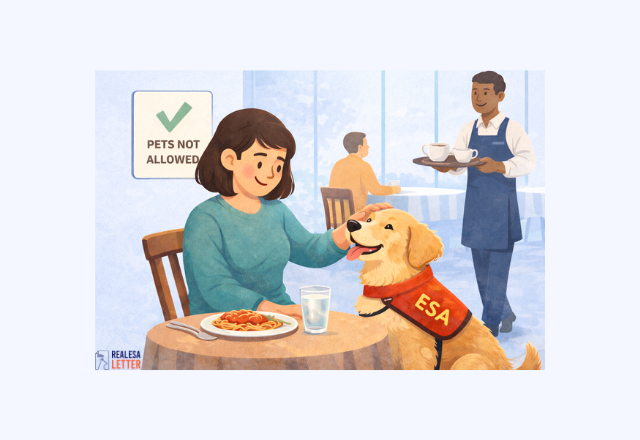
No, emotional support animals are not allowed in restaurants under federal law.
Unlike service dogs, ESAs have no public access rights to food establishments under the Americans with Disabilities Act (ADA).
This creates confusion because ESAs are protected in housing (Fair Housing Act) and previously had air travel protections. But restaurants operate under different legal frameworks: the ADA and FDA Food Code specifically exclude ESAs from dining establishments.
ESAs provide comfort through presence alone, while service animals perform trained tasks. Restaurants can only accommodate animals trained for disability-related work due to health codes and food safety regulations.
Now, let’s break down what the law says, when service dogs are allowed, and what to do if a restaurant denies entry.
When Are Emotional Support Animals Allowed in Restaurants?
The Americans with Disabilities Act (ADA) grants public access rights only to trained service dogs that perform specific tasks for a person with a disability. Because emotional support animals (ESAs) provide comfort through their presence rather than task-based work, they do not qualify for restaurant access protections under federal law. Restaurants are legally required to admit service dogs, but not ESAs.
Under the FHA, housing providers must make reasonable accommodations for emotional support animals, even in properties with strict no-pet policies. Landlords cannot charge pet fees, pet rent, or additional deposits for ESAs, although tenants are still responsible for any damage caused by the animal. This protection applies broadly to apartments, condominiums, rental homes, and college housing.
Air Carrier Access Act (ACAA):
Before January 2021, airlines were required to accommodate ESAs in aircraft cabins. However, the U.S. Department of Transportation updated its regulations to allow airlines to treat ESAs as regular pets. Most major airlines now require ESAs to travel under standard pet policies, including carrier requirements and pet fees, though policies vary by airline.
These laws highlight an important distinction: ESA rights are location-specific rather than universal. An emotional support animal that must be accommodated in housing does not have the same legal access to restaurants, grocery stores, or other public dining establishments.
What Restaurants Are Legally Required to Allow
Restaurants must allow trained service animals that perform disability-related tasks, even if the disability isn’t visible. ESAs, therapy animals, and pets do not fall under the same public access rules. This distinction between service animals and emotional support animals helps restaurants stay compliant while maintaining food safety standards.
Under the ADA, a service animal must meet three criteria:
- Be a dog (or miniature horse in specific circumstances)
- Be individually trained to perform specific work or tasks
- Perform tasks directly related to a person's disability
Examples of service animal tasks:
- Guiding people who are blind or have low vision
- Alerting people who are deaf or hard of hearing to sounds
- Pulling wheelchairs or providing mobility assistance
- Alerting to and protecting someone having a seizure
- Reminding someone to take medication at specific times
- Calming someone with PTSD during an anxiety attack through trained responses
- Detecting allergens in food for people with severe allergies
Public access rights: Service animals can accompany their handlers to virtually all public places, including:
- Restaurants and food service establishments
- Hotels and lodging
- Retail stores and shopping centers
- Medical facilities and hospitals
- Transportation services
- Entertainment venues
- Government buildings
The only legitimate reasons to exclude a service animal are if:
- The animal is out of control and the handler cannot regain control
- The animal is not housebroken
- The animal poses a direct threat to health or safety that cannot be mitigated
An ESA is an animal that provides therapeutic benefit through companionship and presence to a person with a mental or emotional disability. ESAs are prescribed by licensed mental health professionals but are not required to have any specific training.
How ESAs differ from service animals:
- Training: ESAs don’t require specialized emotional support dog training, while service animals must be trained to perform specific disability-related tasks
- Function: ESAs provide comfort through companionship; service animals perform disability-related work
- Species: ESAs can be any species (dogs, cats, birds, rabbits, etc.); service animals are limited to dogs and miniature horses
- Access rights: ESAs have housing and (formerly) airline protections; service animals have broad public access rights
- Documentation: ESAs require letters from licensed healthcare providers; service animals require no documentation
Where ESAs are protected:
- Private housing under the Fair Housing Act
- College dormitories and campus housing
- Some workplace accommodations under case-by-case reasonable accommodation analysis
Where ESAs are NOT protected:
- Restaurants and food service establishments
- Retail stores and shopping venues
- Hotels and public lodging (except as regular pets)
- Airlines (as of January 2021, treated as pets)
- Public transportation (no access rights)
- Entertainment and recreational facilities
The "Comfort vs. Task" Distinction
The fundamental legal difference comes down to function. A service animal performs trained behaviors that mitigate disability-related limitations. An ESA provides emotional comfort simply by being present.
Example scenario: Consider two veterans with PTSD:
Veteran A has a service dog trained to:
- Recognize signs of an impending panic attack
- Position itself between the veteran and other people in crowded spaces
- Apply deep pressure therapy during episodes
- Guide the veteran to exits when overwhelmed
This dog performs specific, trained tasks and qualifies as a service animal with restaurant access rights.
Veteran B has an ESA dog that:
- Provides companionship that reduces anxiety
- Offers comfort during difficult times
- Helps the veteran feel less isolated
This dog provides valuable emotional support but doesn't perform trained tasks. It qualifies as an ESA with housing protections but no restaurant access rights.
Both animals are important to their handlers' wellbeing, but the law draws clear lines based on training and function rather than the severity of the disability or the value of the animal.
Note: Psychiatric Service Dogs: A Special Category
It's important to note that psychiatric service dogs are NOT the same as emotional support animals.
Psychiatric service dogs are trained to perform specific tasks for people with mental health disabilities such as PTSD, severe anxiety disorders, or depression.
These tasks might include interrupting self-harm behaviors, retrieving medication during panic attacks, or performing room searches to help someone with PTSD feel safe.
Because they perform trained tasks, psychiatric service dogs have full public access rights, including in restaurants.
Why This Distinction Matters for Restaurants
Restaurant owners and staff need to understand these differences to:
- Comply with ADA requirements for service animals
- Enforce health codes by excluding ESAs
- Avoid discrimination lawsuits from improper service animal denials
- Respond appropriately to access requests
ESA owners need to understand these differences to:
- Have realistic expectations about access rights
- Avoid confrontations based on misunderstandings
- Plan dining experiences appropriately
- Explore legitimate alternatives and accommodations
Why Restaurants Follow Different Rules Than Housing
Restaurants are considered public accommodations, so they follow the ADA and local health food codes, not housing laws. That’s why ESA protections that apply at home don’t automatically extend to dining spaces. Understanding this difference prevents confusion and helps you plan outings with realistic expectations.
Understanding the Americans with Disabilities Act (ADA)
The ADA is the primary federal law that governs access rights for people with disabilities in public accommodations, including restaurants. Under ADA regulations revised in 2010, a service animal is defined as a dog (and in limited cases, a miniature horse) that has been individually trained to perform specific tasks or work for a person with a disability. These tasks must be directly related to the person's disability.
Key ADA provisions for restaurants:
- Service dogs must be permitted in all areas where customers are normally allowed
- Restaurants cannot charge fees or require special deposits for service animals
- Staff may only ask two questions: (1) Is the animal required because of a disability? (2) What work or task has the animal been trained to perform?
- Staff cannot ask for documentation, demonstration of tasks, or details about the person's disability
The ADA does not cover emotional support animals because they provide comfort through their presence rather than performing specific trained tasks. This legal distinction is not a judgment on the value of ESAs, it simply reflects how federal access laws are structured.
State and Local Health Department Regulations
Beyond federal disability law, restaurants must comply with state and local health codes that restrict animals in food preparation and service areas due to sanitation concerns.
Most jurisdictions' health regulations explicitly prohibit animals in restaurants except for:
- Service animals, as defined by the ADA
- Animals in outdoor dining areas (at the establishment's discretion)
- Working animals in agricultural or farm-to-table settings under specific conditions
These health codes exist to prevent contamination, control allergens, and maintain food safety standards. Even if a restaurant owner wanted to allow ESAs, doing so might violate their operating permits and health department approvals.
Health department concerns include:
- Animal dander and hair contamination
- Fecal matter and urine accidents
- Disease transmission vectors
- Allergen exposure for other patrons
- Behavioral unpredictability in crowded environments
Restaurant operators face potential fines, failed health inspections, or even temporary closure for violating these regulations. This creates a strong incentive to enforce animal policies strictly, regardless of the establishment's personal views on ESAs.
Behavioral Expectations
Bringing an ESA to an outdoor dining area requires honest evaluation of your dog’s temperament and training level. Restaurants are busy environments with food smells, servers moving quickly, and close proximity to strangers. Your ESA must be able to remain neutral despite these distractions.
Calm, predictable behavior is essential for maintaining a comfortable atmosphere for staff and other guests. Owners are fully responsible for their animal’s conduct at all times. If your ESA cannot consistently meet these expectations, a restaurant setting may not be appropriate.
Your ESA should:
- Stay calm and quiet during the meal
- Remain in a sit or down position under or next to the table
- Avoid begging, barking, or seeking attention
- Not approach other guests, tables, or restaurant staff
- Follow basic obedience cues such as sit, stay, come, and down
Warning Signs Outdoor Dining May Not Be Appropriate:
- Persistent barking, growling, or lunging
- Aggressive behavior toward people or other animals
- Difficulty settling or staying in one spot
- High anxiety in busy public environments
- Incomplete house training
Preparation Before Visiting a Restaurant:
- Practice “place” and “settle” commands at home
- Slowly introduce your ESA to outdoor café-style settings
- Reinforce calm, controlled behavior with rewards
- Consult a professional trainer if anxiety or reactivity is present
What Are the Rules for Service Animals in Restaurants?
Service animal policies in restaurants are governed by the Americans with Disabilities Act (ADA). These rules are designed to protect the rights of individuals with disabilities while ensuring a safe and orderly dining environment for all guests. The ADA applies specifically to trained service dogs—not emotional support animals.
Service Dogs Must Be Allowed Indoors:
Under the ADA, restaurants must permit service dogs in all areas open to the public. This guarantees equal access to dining establishments for individuals with disabilities.
No Documentation Can Be Required:
Restaurant staff may not ask for certification, identification cards, or proof of training. They are also not allowed to request details about a person’s disability.
The Dog Must Be Under Control:
Service dogs must remain under the handler’s control at all times, typically through a leash, harness, or voice command. The handler is responsible for managing the dog’s behavior.
No Additional Fees:
Restaurants cannot charge pet fees or cleaning surcharges for service animals. Service dogs are considered medical accommodations, not pets.
Only Dogs Qualify:
Under federal law, service animals in restaurants are limited to dogs. Other animals, including emotional support animals, are not covered.
These regulations help balance disability access rights with public health and safety standards in restaurants.
State-Specific Restaurant ESA Laws and Variations
While federal law provides the baseline framework, states have enacted their own legislation that affects ESA access to restaurants.
Many states have laws specifically prohibiting misrepresentation of ESAs as service animals:
California ESA laws: Penal Code Section 365.7 makes it a misdemeanor to fraudulently represent an animal as a service animal, with penalties up to $1,000 and six months in jail.
Florida ESA laws: State law (413.08) imposes a $500 fine and 30 hours of community service for falsely claiming an animal is a service animal. Review the complete for more details.
New York ESA laws: Agriculture and Markets Law Section 118 prohibits false representation of service animals with penalties up to $100 for first offenses and $250 for subsequent violations.
Texas ESA laws: Health and Safety Code Section 121.006 makes impersonating a service animal handler a misdemeanor punishable by fines up to $300 and 30 hours of community service.
At least 30 states have similar laws protecting the integrity of service animal designations by penalizing fraudulent claims.
States with More Flexible Interpretations
A few states have considered or implemented laws that expand protections for ESAs beyond federal requirements, though these rarely extend to restaurant access:
Illinois ESA laws: While Illinois law generally follows federal ADA guidelines, some local ordinances in cities like Chicago have explored broader accommodations for assistance animals in certain contexts.
Colorado ESA laws: State law recognizes multiple categories of assistance animals and has considered (though not fully implemented) expanded access provisions.
However, even in these states, restaurant access for ESAs remains limited due to health code considerations that supersede disability accommodation laws.
Many states have enacted ESA laws specifically prohibiting the misrepresentation of pets as service animals, with penalties including fines of $500 to $1,000 or more.
Learn more about fake service dog penalties.
Local Health Department Variations
County and city health departments have significant authority over food establishment regulations:
Strict enforcement jurisdictions: Major metropolitan health departments (New York City, Los Angeles County, Chicago) typically enforce animal restrictions rigidly except for ADA-defined service animals.
More flexible rural areas: Some smaller jurisdictions may have less stringent enforcement, particularly for outdoor dining spaces, though the law itself doesn't change.
Pet-friendly municipalities: Cities like Portland, Seattle, and Austin with strong pet-culture often have more restaurants voluntarily welcoming animals in outdoor areas, but this reflects business choice rather than ESA legal rights.
Native American Tribal Lands
Restaurants on Native American reservations may be subject to tribal law rather than state or federal regulations. Policies regarding ESAs can vary significantly:
- Some tribes follow federal ADA guidelines exactly
- Others may have more or less restrictive policies
- Always check with specific establishments on tribal lands
International Considerations
If you travel internationally with your ESA, understand that:
- Most countries do not recognize the ESA designation at all
- Restaurant access will be governed by that country's disability and health laws
- Some European countries have service animal provisions but none recognize ESAs
- You'll likely need to arrange pet-friendly accommodations rather than expect disability access rights
How to Dine Out With an ESA Without Conflict
Even though ESAs aren’t allowed inside most restaurants, some locations may welcome animals in outdoor patio areas. The best approach is to call ahead, be transparent that your animal is an ESA, and follow any leash or seating rules. A respectful request is far more effective than arguing about access rights.
Important considerations for outdoor dining:
- Call ahead: Contact the restaurant before visiting to ask about their outdoor pet policy
- Be honest: Explain you have an ESA, not a service animal, and ask if they allow animals in outdoor areas
- Follow rules: If allowed, comply with all establishment requirements (leashes, specific areas, behavior expectations)
- Be prepared to leave: Understand the restaurant may still decline or ask you to leave if your animal causes disturbances
- Respect other diners: Keep your ESA under control and minimize impact on other guests
Some restaurant chains and independent establishments have pet-friendly outdoor dining policies that welcome well-behaved animals. These businesses recognize that accommodating pets in outdoor spaces can be good for business while still complying with health regulations.
Individual Restaurant Policies
While federal law doesn't require ESA access, nothing prevents individual restaurants from choosing to allow ESAs as a customer service gesture (in outdoor areas or states with more flexible health codes).
Factors influencing restaurant policies:
- Local health department interpretation and enforcement
- Insurance and liability concerns
- Customer demographic and expectations
- Physical layout and space constraints
- Past experiences with animals in the establishment
How to approach restaurants about ESA accommodation:
- Be upfront and honest: Explain you have an emotional support animal, not a service animal, and you understand the legal distinctions
- Ask, don't demand: "Do you have any pet-friendly outdoor seating options?" is more effective than asserting non-existent rights
- Highlight your animal's behavior: "My ESA is well-trained, calm, and won't disturb other guests" addresses the restaurant's main concerns
- Offer solutions: Suggest sitting in a specific area, visiting during less busy times, or other accommodations that address the establishment's concerns
- Accept the answer gracefully: If declined, thank them for considering your request and choose another establishment
What About "ESA Vests" and Online Certifications?
The internet is filled with websites selling "official ESA registration," identification cards, and emotional support dog vests that supposedly grant public access rights. These are misleading at best and fraudulent at worst.
Important truths:
- No national ESA registry exists
- ESA vests and ID cards have no legal significance
- Legitimate ESAs require only a letter from a licensed mental health professional treating you
- Purchasing these items doesn't grant restaurant access rights
- Using them to claim service animal status is illegal in many states
Wearing an ESA vest in a restaurant doesn't change your animal's legal status. If questioned, you cannot legally claim your ESA is a service animal, and restaurant staff trained in ADA compliance will know to ask about the tasks your animal performs. To understand more about the difference between real and fake ESA letters, visit our comprehensive guide.
Legal consequences of misrepresentation:
- Fines ranging from $100 to $1,000+ depending on the state
- Potential criminal charges for fraud
- Civil liability if your animal causes harm or damage
- Undermining credibility of legitimate service animals
What to Do If a Restaurant Denies Your ESA
If a restaurant says no, stay calm and avoid confrontation; most denials are based on health code compliance. Ask if they have outdoor seating or if takeout is available. If you feel you were treated unfairly due to your disability (not the ESA), document the interaction and follow up through the appropriate channels.
What restaurants MUST do:
- Allow legitimate service animals
- Not discriminate based on disability when the person is unaccompanied by any animal
- Provide equal service to all customers regardless of disability status
What restaurants DON'T have to do:
- Allow emotional support animals inside dining areas
- Make exceptions to health code violations
- Accommodate animals that aren't trained service animals
What you SHOULD NOT do:
- Claim your ESA is a service animal
- Insist on rights that don't legally exist
- Cause a confrontation or scene
- Threaten legal action based on ESA denial
Productive Steps When Denied Access
- Remain calm and respectful: Getting angry or confrontational won't change the legal reality and may result in you being asked to leave entirely.
- Verify the denial is about your ESA specifically: Ask clarifying questions: "Just to confirm, are you saying you cannot accommodate my emotional support animal, or are you denying me service as a person with a disability?" This ensures the issue is the animal, not disability discrimination.
- Inquire about alternatives:
- "Do you have outdoor seating where pets are permitted?"
- "Can I order takeout and dine elsewhere?"
- "Are there specific times or circumstances when accommodation might be possible?"
- Educate politely (if appropriate): Some restaurant staff may genuinely not understand the difference between service animals and ESAs. A brief, non-confrontational explanation might help: "I understand ESAs don't have the same access rights as service animals under the ADA. I was hoping you might have pet-friendly outdoor seating options."
- Document the experience: If you believe you were discriminated against based on your disability (rather than appropriately denied access for your ESA), note:
- Date, time, and location
- Names of staff involved
- Exact statements made
- Whether you were accompanied by the ESA or unaccompanied
- Consider filing feedback: Corporate customer service departments (for chain restaurants) may appreciate feedback about customer experiences, even if the denial was legally appropriate. This could influence future pet policy decisions.
When Denial Might Actually Be Discrimination
In rare cases, what appears to be an ESA denial might actually be disability discrimination:
Scenarios that may constitute actual discrimination:
- You're denied service even when NOT accompanied by your animal
- Staff makes derogatory comments about your disability
- You're treated differently than other customers in ways unrelated to the animal
- You're asked intrusive questions about your disability when unaccompanied by any animal
If you believe you experienced disability discrimination separate from the ESA access issue, you can:
- File a complaint with the Department of Justice ADA Information Line
- Contact your state's civil rights agency
- Consult with a disability rights attorney
Finding ESA-Friendly Dining Alternatives
Rather than fighting an uphill legal battle, consider proactive strategies:
Build a list of ESA-friendly establishments:
- Ask other ESA owners in your area for recommendations
- Check online reviews mentioning pet policies
- Call ahead before visiting new places
Explore alternative dining options:
- Picnics in pet-friendly parks
- Takeout enjoyed in outdoor spaces
- Delivery services to your home
- Restaurants with large outdoor seating areas
Use technology to your advantage:
- Apps like BringFido identify pet-friendly restaurants
- Google Maps reviews often mention whether outdoor seating allows pets
- Social media groups for ESA owners share location-specific information
Practical Guidance for ESA Owners Who Dine Out
Plan your outing like you would any accessibility need: research first, confirm policies, and keep a backup option ready. Choose pet-friendly patios when possible, or order takeout and enjoy your meal in a park or at home with your ESA. This reduces stress while still allowing you to maintain an active social lifestyle.
Before You Go: Preparation Strategies
- Research extensively
Don’t assume any restaurant will accommodate your ESA. Instead:
- Call ahead to ask about pet policies (especially outdoor seating)
- Check restaurant websites for pet policy details
- Read recent reviews mentioning animals
- Look for pet-friendly districts or neighborhoods
- Plan for alternatives
Always have a backup plan:
- Keep takeout options in mind
- Identify a comfortable place to dine with your ESA if needed
- Consider bringing a trusted friend who can pick up food
- Be realistic about your needs
Ask yourself what will work best:
- Can you handle a brief separation during a meal?
- Would outdoor dining in different weather conditions be manageable?
- Is it acceptable for your ESA to stay nearby (only when safe and appropriate)?
- Time your visits strategically
If a restaurant allows outdoor animals:
- Visit during off-peak hours
- Choose weather-appropriate times
- Avoid peak rush periods when flexibility is limited
During Your Visit: Best Practices
If a restaurant allows your ESA in an outdoor dining area:
- Arrive prepared
- Bring cleanup supplies (bags, wipes, paper towels)
- Carry water for your ESA
- Ensure your animal is clean and well-groomed
- Use a secure leash or harness
- Minimize impact on others
- Sit away from busy walkways when possible
- Keep your ESA close and controlled
- Prevent excessive barking or disruptive behavior
- Don’t allow your ESA to approach other diners or food
- Be ready to leave if needed
If your ESA becomes distressed or disruptive:
- Leave voluntarily rather than waiting to be asked
- Apologize if your animal disturbed anyone
- Tip appropriately if staff still served you well
- Follow all establishment rules
- Stay in designated areas only
- Follow leash requirements
- Respect size/placement restrictions
- Listen to staff instructions
Managing Separation Anxiety and Dining Without Your ESA
For many people, an ESA helps manage anxiety, especially during social outings. If you can’t bring your ESA inside, coping tools like grounding techniques, breathing exercises, and anxiety management apps can help during meals.
Some people also benefit from comfort reminders like photos or familiar items, and gradual exposure work with a therapist can build confidence over time.
Building Positive Relationships with Restaurants
If you find establishments that accommodate animals outdoors:
- Express gratitude
- Thank staff and managers
- Leave a positive review mentioning pet-friendly seating
- Become a regular customer if the experience is good
- Be an exemplary guest
- Keep your ESA calm and controlled
- Show that ESA owners can be responsible diners
- Tip well and show appreciation
- Provide constructive feedback
If you notice policy improvements:
- Offer suggestions respectfully
- Acknowledge what they’re doing well
- Keep feedback friendly and helpful
- Advocate thoughtfully
Help restaurants understand the difference between:
- What they must allow (service animals)
- What they may choose to allow (pets/ESAs outdoors)
- Clear policies reduce conflict for everyone.
To wrap up, Learning that emotional support animals aren’t allowed in restaurants can feel discouraging, especially if your ESA supports your daily mental health. Still, understanding the law helps you avoid stressful confrontations and plan dining experiences with confidence. Knowing your rights clearly makes every outing easier.
The key takeaway is simple: the ADA gives public access rights only to trained service animals, not ESAs. ESAs are protected in housing under the Fair Housing Act, but restaurant rules are shaped by public accommodation laws and health codes. That’s why most restaurants can legally deny ESAs indoors, even if they are well-behaved.
Your best path forward is staying honest, calling ahead, and choosing ESA-friendly options like outdoor patios or takeout. Never misrepresent an ESA as a service dog, since it harms legitimate handlers and can lead to penalties. With realistic expectations and healthy coping tools, you can protect your wellbeing while still enjoying an active social life.
Obtaining a Legitimate ESA Letter
If you don't already have an ESA letter or your current letter needs renewal, obtaining legitimate documentation is important for housing and any other contexts where ESAs are protected. Understanding who can write an ESA letter is the first step.
Services like RealESALetter.com connect you with licensed mental health professionals who can evaluate your needs and provide appropriate ESA letters for housing accommodations. You can also learn how to ask your doctor for an emotional support animal letter if you prefer working with your existing healthcare provider.
Remember that legitimate ESA letters don't grant restaurant access, but they do ensure you have proper documentation for situations where ESAs are legally protected.
Frequently Asked Questions
Can I bring my emotional support dog to a restaurant if I have an ESA letter?

No. Even with a valid ESA letter, emotional support animals don’t have restaurant access rights under the ADA. ESA letters apply to housing accommodations, not public places like restaurants.
What's the difference between an emotional support animal and a psychiatric service dog?
An ESA provides comfort through companionship and does not require task training. A psychiatric service dog is trained to perform specific tasks for a mental health disability, so it has full public access rights.
Can I request accommodation for my disability even if I can't bring my ESA into a restaurant?
Yes. You can request reasonable accommodations like quieter seating, accessible tables, or other disability-related adjustments. However, restaurants still don’t have to allow ESAs indoors.
Are there any situations where an ESA must be allowed in a restaurant?
No. Under current federal law, restaurants are not required to allow emotional support animals inside. Only trained service animals are protected for public access.
Do online ESA registrations give my animal public access rights?
No. Online ESA registrations, ID cards, and vests are not legally recognized and don’t grant restaurant access. A legitimate ESA letter is mainly used for housing protections.
Can my landlord's ESA approval letter be used to bring my animal to restaurants?
No. Landlord approval only applies to housing under the Fair Housing Act. It does not give your ESA access rights in restaurants or other public places.
Are emotional support animals allowed in restaurants in Ontario?
No. In Ontario, only service animals are allowed in restaurants under the Accessibility for Ontarians with Disabilities Act (AODA). Emotional support animals (ESAs) are not granted public access rights unless they qualify as recognized service animals.
Are emotional support dogs allowed in restaurants in Florida?
No. Under the Americans with Disabilities Act (ADA), restaurants must allow trained service dogs, but emotional support dogs are not considered service animals and do not have the same access rights.
Are emotional support dogs allowed in restaurants in California?
No. California follows the ADA, which grants public access rights only to trained service dogs. Emotional support dogs are not legally allowed in restaurants unless the establishment chooses to permit them.
Are emotional support animals allowed in restaurants in California?
No. Emotional support animals are not protected for public access in restaurants under federal or California law. Only trained service animals are guaranteed entry.
Are emotional support dogs allowed in NYC restaurants?
No. In New York City, restaurants must allow trained service dogs under the ADA, but emotional support dogs are not legally permitted public access.
Can a Restaurant Deny a Service Dog?
Yes, in limited situations, a restaurant may ask a service dog to leave—even though service animals are generally protected under the ADA.
A restaurant can require removal if the dog is out of control and the handler does not take effective action to correct the behavior. Examples include repeated barking, lunging, or disrupting other diners. Access may also be denied if the dog is not housebroken, creating sanitation concerns. Additionally, a service dog that poses a direct threat, such as aggressive behavior toward staff or guests, can legally be removed.
However, restaurants cannot deny entry based on fear of dogs, allergies, or general discomfort.
WRITTEN BY
Share this Article