Sign In / Create Account
What a PSD Letter Template Looks Like?
An official Psychiatric Service Dog (PSD) letter looks like a standard plain medical prescription or a formal legal-medical correspondence. It does not look like a decorative certificate, and does not feature colorful graphics.

A PSD letter from RealESALetter.com is built to pass the first check.
This page shows the format field by field. It also flags what causes letters to get rejected.
Key Takeaways:
Format Is Fixed: A PSD letter follows five required fields. Missing any one field risks rejection.
Letterhead Confirms The Provider: The letter must show the provider's practice name and license. This lets landlords verify it directly.
Diagnosis Stays Private: The letter confirms a disability exists. It does not need to name the condition.
Task Training Sets It Apart: A PSD letter must describe trained tasks. This is what separates it from a general ESA letter.
License Number Is Required: A valid letter includes the provider's state license. Without it the letter cannot be verified.
What a PSD Letter Template Must Include
A valid PSD letter must include five specific fields.
- Official letterhead with contact information
- A date and a reference to the client
- A statement of ADA disability
- A description of trained tasks
- A signed license block
Each field plays a role in making the letter valid and verifiable. If you get a PSD letter online, make sure that the letter includes every field listed above.
Sample PSD Letter Template
This is what a complete PSD letter looks like when every field is filled in correctly.
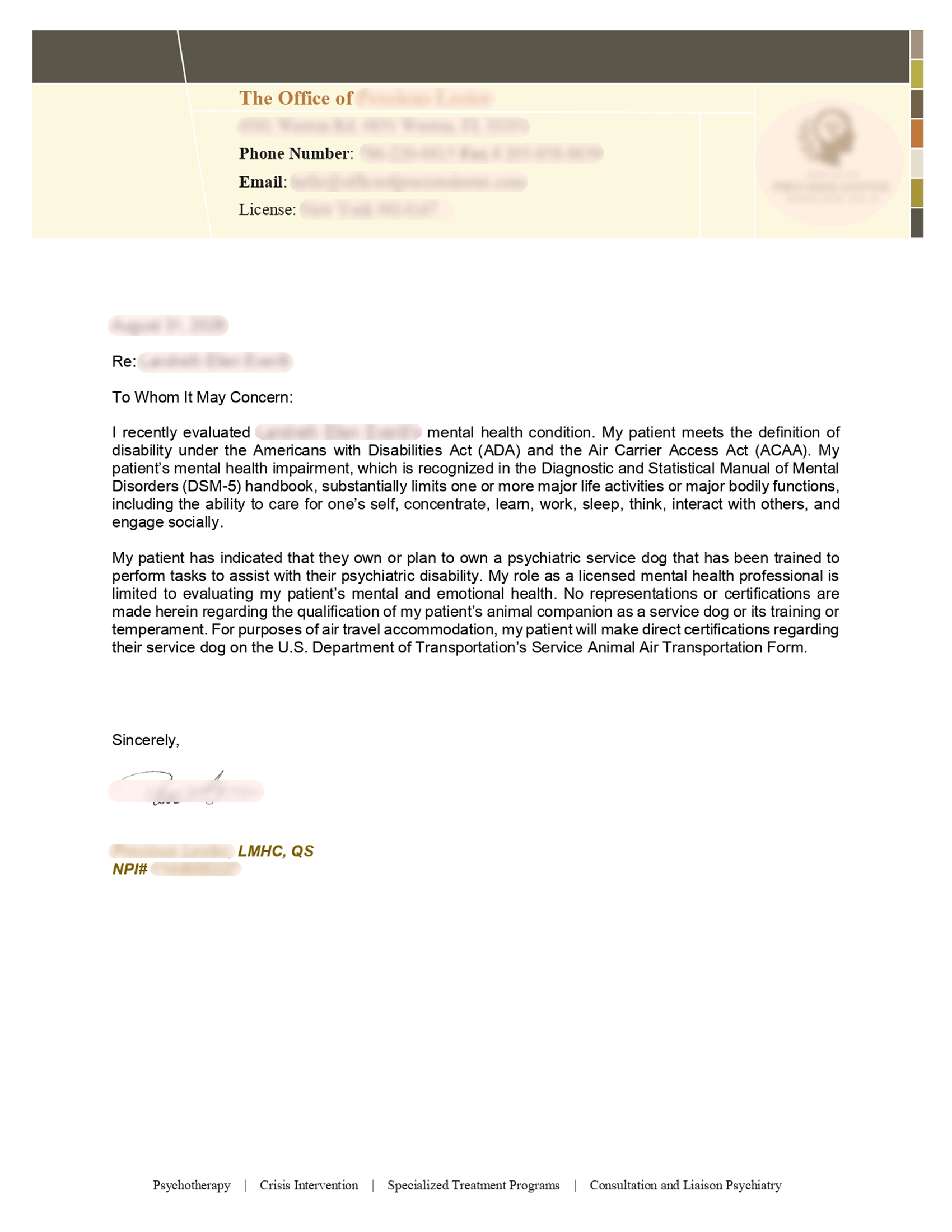
Sample PSD letter template. It shows the letterhead, the disability statement, the task-training clause and the signature block.
This template shows the format only. For the full picture of what a PSD letter is and what it covers see our psychiatric service dog letter guide.
What Each Field Means in PSD Letter Template
Each field in a PSD letter serves a specific legal purpose.
Provider's Letterhead and Contact Information
The letterhead confirms the letter came from a licensed practice.
Example: [Practice Name] [Address] [Phone Number] [License Credential Info]
This field proves the letter is not from an anonymous source. It gives landlords and employers a way to contact the provider directly. Not every provider is qualified to write this letter. See our guide on who can write a PSD letter to check if yours qualifies.
Date and Client Reference
The date ties the letter to a specific evaluation.
Example: Date: [Date] Re: [Client Name]
Without a date the letter cannot be checked against a treatment timeline. Some landlords require letters signed within the past year.
ADA Disability Statement
This statement establishes that a qualifying disability exists.
Example: [Client] meets the definition of disability under the ADA.
A PSD letter typically confirms a qualifying disability without naming the specific diagnosis. The ADA's official guidance on service animals explains how this determination works.
Task-Training Description
This field is what separates a PSD letter from a general ESA letter.
Example: [Client]'s dog has been trained to perform tasks that reduce [Client]'s disability-related symptoms.
A PSD letter must describe trained tasks not just companionship. This is the core difference between a PSD letter and an ESA letter.
Signature Credentials and License Number
The license number lets anyone verify the letter independently.
Example: [Signature] [Printed Name Credentials] [State of Licensure License Number]
Without this field a landlord cannot confirm the provider is real. This is the single most common reason letters get rejected.
What Gets a PSD Letter Template Rejected
A PSD letter template gets rejected when a required field is missing.
Every RealESALetter.com PSD letter template pairs the ADA disability statement with a task-training description and a state license number in the format shown above.
The task training field causes the most confusion. A letter without it reads as general support documentation rather than a PSD letter. See our guide on PSD letter vs ESA letter for how the two differ.
Missing Field | What Happens |
No official letterhead | Reads as unverifiable |
No date or client reference | Cannot be tied to a specific evaluation |
No ADA disability statement | Core legal basis is missing |
No task-training description | Reads as an ESA letter not a PSD letter |
No license number | Cannot be verified independently |
This table covers the fields most likely to cause rejection. For the complete list of what a PSD letter must legally include see our PSD letter requirements guide.
Conclusion
A PSD letter only works if every field is filled in correctly. One missing field can get your letter rejected by a landlord or an airline. A complete letter protects you and speeds up approval. If you want a letter that includes every required field you can start your PSD letter evaluation here in just a few minutes.
Frequently Asked Questions
Does a PSD letter need to state my specific diagnosis?

No. It confirms a qualifying disability exists without naming the condition.
Is a PSD letter valid without a license number?
No. Without it the letter cannot be independently verified.
Does a PSD letter need to be on an official letterhead?
Yes. This confirms the letter came from a licensed practice.
Can I use a generic PSD letter template found online?
Only as a reference. The provider must fill it in and sign it directly.
Is a typed letter required or can it be handwritten?
Typed is standard. What matters is every required field is present and signed.
Does the letter template change depending on where I use it?
The core fields stay the same. Only the accommodation setting sentence changes.
What happens if my letter is missing the task-training description?
It reads as a general support letter not a PSD letter. It may get rejected for the wrong document type.
Sarah Connell is a Mental Health Writer (M.S.) with extensive expertise in psychiatric wellness and behavioral health writing. She specializes in the research and documentation of Psychiatric Service Dogs (PSDs) and their role in mental health support. With a deep commitment to mental health awareness and advocacy, Sarah is passionate about helping people understand their PSD rights, benefits, and responsibilities clearly and simply at RealESALetter.
Stephanie W. is a Licensed Clinical Social Worker (LCSW) whose professional focus includes trauma recovery, behavioral health assessment, emotional regulation, and crisis support. Her approach combines trauma-informed care with practical therapeutic strategies designed to help clients understand emotional patterns, strengthen coping skills, and navigate challenging experiences.

Wherever you travel, your dog goes with you.
Trained, documented, federally protected
- 1A few questions. That's your paperwork
- 2A licensed therapist reviews your case
- 3Official PSD letter, ready to send
Not accepted? Full refund, guaranteed