Sign In / Create Account
Getting ESA Approval From a Condo Board in 2026
To get ESA approval from a condo board, submit a written reasonable accommodation request under the Fair Housing Act along with a signed ESA letter from a licensed mental health professional. The board may verify that the letter is genuine, but it cannot demand your diagnosis or medical records.

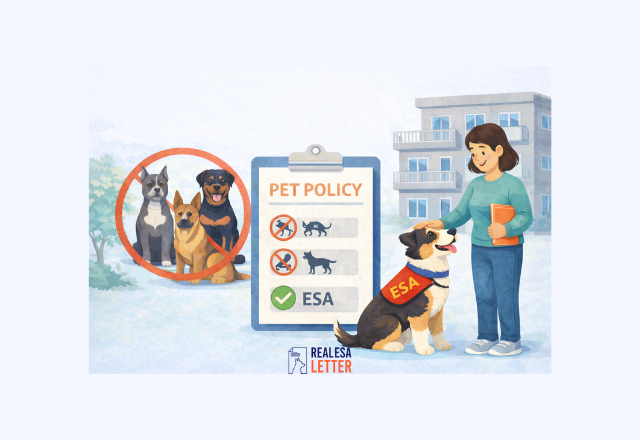
Here is what we'll cover: the step-by-step approval process, how condo boards differ from landlords, what your letter must include, the rules before and after May 2026, and what to do if the board says no.
Key Takeaways
The request is written: Approval starts with a written reasonable accommodation request, not a conversation with the property manager.
The letter does the work: A valid ESA letter from a licensed mental health professional is the only documentation a board can reasonably expect.
The rules changed in 2026: On May 22, 2026, HUD rescinded its 2013 and 2020 assistance animal notices and replaced the old categorical protections with an individualized assessment standard.
The law itself did not change: The Fair Housing Act still requires condo associations to consider reasonable accommodation requests, even in no-pet buildings.
Denial is not the end: A denied request can be escalated to HUD or your state fair housing agency within one year.
How Do You Get ESA Approval From a Condo Board? Step-by-Step
You get ESA approval from a condo board take the following steps:
Review your bylaws and CC&Rs.
Most condo associations publish an accommodation or pet-exception procedure in their governing documents. Following the stated procedure removes the board's easiest reason to delay.
Obtain a valid ESA letter.
The letter must come from a licensed mental health professional or treating provider. If you don't yet have one, you can get an ESA letter online from a clinician licensed in your state.
Submit a written request.
Send a short letter or email to the board or management company stating that you are requesting a reasonable accommodation under the Fair Housing Act for an emotional support animal, with your ESA letter attached. Use certified mail or email so a time-stamped record exists.
Respond to permissible verification.
The board may confirm that your provider's license is active and that the letter is authentic. It may not ask for anything beyond that.
Receive the decision.
Boards are expected to respond within a reasonable time. Ignoring a request or dragging it through months of committee review can amount to a constructive denial under fair housing law.
This condo-specific process sits inside the broader ESA accommodation request process that applies to all housing providers.
How Condo Board Approval Differs From Landlord Approval
Condo board approval differs from landlord approval because the decision runs through governing documents and a voting body rather than a single owner.
That structural difference changes the timeline and the paper trail, not your underlying rights.
Three differences matter in practice:
- Bylaws replace the lease. A landlord enforces a lease; a condo board enforces recorded bylaws and CC&Rs. An approved ESA accommodation overrides a no-pet bylaw the same way it overrides a no-pet lease clause, because an approved ESA is not legally a pet.
- Committees slow the clock. Requests often route through a board meeting, a pet committee, or association counsel. Longer review is normal; indefinite review is not.
- Counsel gets involved earlier. Associations frequently have standing law firms that review accommodation paperwork, which is why documentation quality matters more with a board than with an individual landlord.
If your building is governed by a homeowners association rather than a condominium board, the HOA ESA rules work slightly differently.
What Your ESA Letter Must Include for Condo Board Review
An ESA letter ready for condo borad approval must contain:
- The clinician's state license number and licensing jurisdiction
- The issue date and the clinician's signature
- A statement that you have a disability-related need for the animal (no diagnosis required)
- The nexus: how the animal alleviates one or more symptoms of that disability
Only certain professionals can issue this documentation; learn who can write an ESA letter.
Every RealESALetter.com letter includes the clinician's state license number, issue date, and direct contact information, so a condo board can verify credentials without requesting the resident's medical records.
Once submitted, the board's review is limited: it may confirm the license is active and the letter is genuine, but it cannot request your medical records, your diagnosis, or an interview with your provider about your condition. This is the same standard that governs how ESA letters are verified by the landlord.
What a Condo Board Can and Cannot Require for ESA Request
Explore what your condo board can and cannot require regarding your ESA request:
The board CAN | The board CANNOT |
Require a written accommodation request | Impose a blanket ban on ESAs |
Verify the provider's license is active | Demand your diagnosis or medical records |
Require standard vaccination and local licensing records | Require "ESA registration," certificates, or ID cards |
Deny a specific animal that poses a documented direct threat or would cause substantial property damage | Apply standard pet rules, such as breed or weight limits, to an approved accommodation |
Evaluate fees and deposits case by case under current HUD guidance | Interview your provider about your condition |
One point worth stating plainly: no federal ESA registry exists. Online registrations, certificates, and ID cards carry no legal weight in a condo board's accommodation review, and presenting them instead of a valid letter usually hurts a request.
Remember: Questions about fees and deposits are now assessed case by case, after May 2026 HUD memo,rather than automatically waived.
What to Do If the Condo Board Denies Your Request
If the condo board denies your ESA request, take these steps in order:
Request the denial in writing.
Including the board's stated reason. Boards that cannot articulate a lawful reason often reverse course at this step.
Answer any legitimate follow-up.
If the board questioned your documentation rather than refusing outright, a corrected or verified letter usually resolves it. Our guide on what to do when an ESA letter is rejected covers the most common objections.
File a complaint with HUD.
You can file with HUD's Office of Fair Housing and Equal Opportunity through the HUD complaint portal within one year of the denial, or with your state's fair housing agency.
Consider a private civil action.
Because the Fair Housing Act statute is unchanged, a wrongful denial can still be challenged in state or federal court. This is a last resort, and most disputes resolve well before it.
If a condo board disputes an ESA letter, RealESALetter.com provides direct support during the review and issues a full refund if the matter is unresolved.
The Bottom Line
Getting ESA approval from a condo board comes down to two things: a written reasonable accommodation request and documentation the board's counsel cannot pick apart. The Fair Housing Act still protects your right to make that request, even after HUD's May 2026 rule change, but under the new individualized standard, the strength of your letter now decides the outcome.
If you're preparing a request and don't yet have valid documentation, you can start your ESA evaluation and have a board-ready letter before you submit.
Frequently Asked Questions
Can a condo board reject my ESA if the building has a no-pet policy?

No. A no-pet policy cannot be used to reject a valid ESA accommodation request, because an approved emotional support animal is not legally a pet. The only animal-specific grounds for rejection are a documented direct threat to health and safety or evidence the specific animal would cause substantial property damage.
Can a condo board charge pet fees or a deposit for an ESA?
It depends on when you ask. Before May 22, 2026, HUD guidance categorically prohibited pet fees and deposits for approved ESAs. After HUD rescinded that guidance, fee questions are assessed individually rather than automatically waived, so a board's ability to charge depends on the facts of the request and any applicable state law.
How long does a condo board have to respond to an ESA request?
A condo board must respond within a reasonable time, and fair housing guidance generally treats roughly ten business days as the benchmark. Ignoring a request or stretching review across months without explanation can be treated as a constructive denial.
Can the condo board make me attend a board meeting or interview about my ESA?
No. Written verification of your letter is sufficient. A board may confirm your provider's license and the letter's authenticity, but it cannot condition approval on you appearing before the board or disclosing medical details in person.
Does my ESA approval transfer if the board or management company changes?
Yes. The accommodation attaches to your disability-related need, not to the board that granted it. A new board or management company may ask you to recertify documentation under the post-2026 standard, but it cannot treat an existing approval as void simply because leadership changed.
Harper Jefcoat is a content writer with 10+ years of experience covering ESA laws, mental wellness, and emotional support animal benefits. As a blog author for RealESALetter, he educates readers on ESA regulations and promotes ethical documentation practices.

Darren Rafel is a licensed clinical social worker with active LCSW licenses across 13 states, including California, New Jersey, Texas, Florida, and Arkansas. He conducts ESA evaluations with direct clinical experience using pet therapy as part of mental health treatment.

Don't worry. Your pet stays with you.
Housing law is on your side
- 1A few questions. That's your paperwork
- 2A licensed therapist reviews your case
- 3Official ESA letter, ready to send
Not accepted? Full refund, guaranteed