


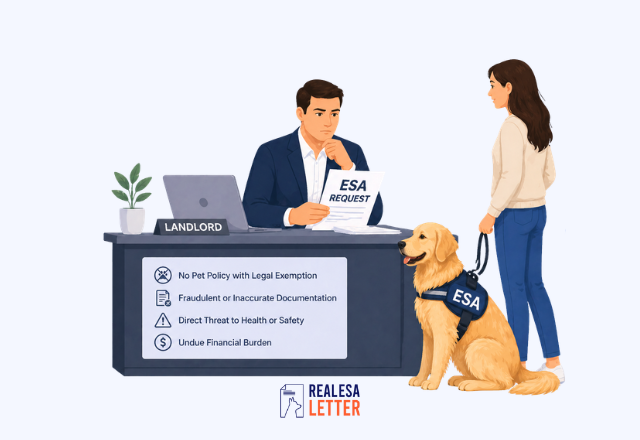
Getting your ESA rejected by a landlord does not always mean the denial is legal.
Landlords routinely cite no-pet policies, breed restrictions, or personal preference, none of which hold legally. Under the Fair Housing Act, a landlord can only reject an ESA if the documentation is invalid, the animal poses a documented direct threat, the property qualifies for an FHA exemption, or the accommodation creates an undue financial burden.
Let's uncover each ground in detail, what landlords cannot legally use as a reason, and what tenants can do after an unlawful denial.
What the Law Requires Before Rejection Is Even Possible
The Fair Housing Act was enacted in 1968 and amended in 1988 to include people with physical and mental disabilities as a protected class. That amendment is the foundation of ESA housing rights. In 2020, HUD released updated guidance on assistance animals that significantly clarified how landlords are expected to handle ESA accommodation requests.
Under that guidance, housing providers covered by the FHA must engage in what HUD calls an individualized assessment. This means a landlord cannot rely on building-wide policies, personal opinions about animals, or generalized assumptions about breeds or species to justify a denial.
Every request must be evaluated on its own facts. A landlord who denies an ESA without completing that individualized review is likely in violation of the law, even if a valid exception might have technically applied.
The reasonable accommodation framework requires more than passive tolerance. A landlord must actively adjust rules, policies, or practices that would otherwise prevent a person with a disability from equally enjoying their housing.
A no-pets policy is exactly the kind of rule the FHA requires landlords to waive for a properly documented ESA. The same applies to breed restrictions, pet fees, and weight limits written for ordinary pets.
HUD's analysis follows a two-part structure. Both questions must be satisfied for the accommodation to be required:
- Does the person have a disability as defined under the FHA?
- Is there a disability-related need for the specific animal?
A landlord who cannot establish that one of these elements is missing, and who cannot point to a recognized legal exception, does not have grounds to deny. Acting on personal preference or general policy instead is what turns a denial into a fair housing violation.
The FHA covers most residential housing: apartments, condominiums, cooperatives, rental homes, and most subsidized housing programs. Rejection is only lawful when a specific, recognized exception applies. Those exceptions are narrow, fact-specific, and require objective evidence. The sections below cover each one.
When a Landlord Can Legally Reject an ESA
The grounds below represent the complete set of lawful bases for rejection under federal law. Each carries a defined legal standard. A landlord who denies based on anything outside these categories is exposed to a fair housing complaint.
The ESA Letter Is Invalid, Incomplete, or Expired
An ESA letter that does not meet HUD's documentation requirements gives a landlord legitimate grounds to deny the request until proper documentation is provided. This is the most frequently cited basis for rejection, and it is one of the few that tenants can resolve quickly by obtaining a compliant letter from a qualified provider.
For a letter to be valid under federal guidelines, it must come from a licensed mental health professional who holds an active license in the state where the tenant lives. This licensing requirement exists because mental health professionals are licensed at the state level, not federally.
A therapist licensed in one state cannot legally evaluate or treat patients in another. A letter from that provider does not satisfy the FHA documentation standard regardless of how legitimate the provider is in their home state.
This matters particularly for telehealth: the platform's state of incorporation is irrelevant. What controls is where the treating professional holds their active license and whether the tenant's state of residence falls within that license's jurisdiction.
A ESA letter for housing must include:
- Provider's full legal name, license type, license number, and state of licensure
- Date of issuance
- Provider's contact information or official practice letterhead
- A statement confirming the tenant has a disability-related need for the emotional support animal
That statement does not need to name the diagnosis or provide clinical detail, but it must establish the relationship between the condition and the animal.
Letters older than one year are routinely questioned, and landlords are within their rights to request updated documentation. An expired letter no longer reflects a current clinical relationship. If the provider has retired, moved states, or lost their license since the letter was issued, the document loses its verifiability entirely.
Landlords can verify any provider's credentials directly through state licensing databases. A license that does not appear in the registry, or shows as expired or revoked, is a defensible basis for rejecting the submitted letter.
Generic certificates, ESA registrations, and online animal ID cards are not ESA letters. They carry no legal standing under the FHA. A real evaluation has a real ESA letter cost. Suspiciously low fees are often the first sign of a fake service.
The law recognizes one document type: a letter from a licensed mental health professional who has evaluated the tenant and established a clinical basis for the accommodation.
The rules around who can write an ESA letter are more specific than most people expect, and submitting documentation from a provider who does not qualify is one of the most common reasons requests are denied.
Your ESA letter questioned or rejected? A valid letter requires a licensed provider, active state credentials, and a current issuance date. |
The Animal Poses a Direct Threat
A landlord can reject an ESA accommodation if that specific animal poses a direct threat to the health or safety of other residents, or would cause substantial physical damage to the property, and that threat cannot be reduced to an acceptable level through reasonable conditions or modifications.
The legal standard here is high, and it is entirely animal-specific. HUD's guidance explicitly prohibits threat assessments based on breed characteristics, species generalizations, size, or neighbor discomfort.
A landlord cannot look at the breed listed in an accommodation request and conclude a direct threat exists. The standard requires documented, objective evidence of that particular animal's behavior. Evidence that can support a direct threat finding includes:
- Dated incident reports with specific details
- Records of documented aggressive behavior
- Prior property damage linked to that specific animal
- Formal behavioral assessments from a qualified professional
Assumptions, general concerns, and neighbor complaints without specifics do not meet this standard.
The same individualized standard applies when noise or disruptive behavior is at issue. Persistent conduct that significantly interferes with other residents' quiet enjoyment can become a serious issue.
If it continues after the tenant has had a reasonable opportunity to correct it, it may support denial or lease enforcement action.
An isolated noise complaint, or complaints without documentation that the issue was addressed and persisted, does not meet the standard.
Before denying on direct threat grounds, a landlord is also required to consider whether the threat can be mitigated through reasonable conditions. This step is legally required, not optional.
A landlord might require proof of behavioral training, assign a unit with reduced shared-wall contact, or impose specific conditions on how the animal uses common areas.
If reasonable mitigation steps exist and the landlord denies without exploring them, the denial may remain unlawful. This can apply even if the underlying behavior concern was legitimate.
One issue that often causes confusion: a successful ESA accommodation does not remove a tenant's financial liability for damage.
If an ESA causes property damage beyond normal wear and tear, the landlord can charge for repairs just as they would for any other tenant-caused damage. The accommodation does not insulate the tenant from that responsibility, and landlords are entitled to enforce it.
The Property Is Exempt from the Fair Housing Act
Not all residential properties fall under FHA jurisdiction. Landlords who qualify for a statutory exemption are not required to follow the reasonable accommodation standard, and a denial based on a valid exemption is not a fair housing violation.
However, these exemptions are specific and carry conditions that many landlords assume apply when they do not.
The three recognized FHA exemptions for housing providers are:
- Owner-occupied buildings with four or fewer units, where the landlord actually lives in one of those units. The landlord must be physically residing in the building, not just owning or managing it.
A landlord who owns a four-unit property but lives at a different address does not qualify, even if they manage the building personally. This exception is sometimes called the "Mrs. Murphy" exemption.
- Single-family homes rented or sold by the private owner without using a real estate broker or agent. The owner cannot own more than three single-family rental homes at one time, and discriminatory advertising is prohibited even under this exemption.
If a real estate agent is involved at any stage of the rental or sale, including advertising, showing, or leasing, the exemption does not apply.
- Private clubs that restrict housing occupancy to their own members. These are uncommon in standard residential contexts but exist in some membership-based communities.
The practical risk for landlords here is significant. Incorrectly claiming an exemption and denying an ESA based on it creates serious liability exposure.
Many states do not include these exemptions in their own fair housing statutes. California, New York, Illinois, New Jersey, and several other states extend protection to properties that would be exempt under the FHA.
A landlord who believes they are operating outside federal jurisdiction may still face a state-level complaint, and the standards in those states often favor the tenant more than the federal baseline does.
Any landlord invoking an exemption should verify how their state's emotional support animal laws apply before acting on it.
The Accommodation Would Cause an Undue Financial Burden or Fundamental Alteration
This is the narrowest of the valid exceptions and is almost never successfully applied in standard residential housing. HUD recognizes that, in rare circumstances, a specific accommodation request could impose an undue financial burden on a housing provider.
It may also require a fundamental change to the nature of the housing program. In those circumstances, denial may be lawful.
When evaluating an undue financial burden claim, HUD considers:
- The overall financial resources of the housing provider
- The size and type of the housing operation
- The specific cost the accommodation would impose
- Whether any alternative accommodation could reduce that burden
A regional property management company overseeing hundreds of units would need to demonstrate extraordinary and unusual costs to meet this standard. A single landlord owning a small number of properties faces a similarly high bar. Ordinary administrative inconvenience, minor disruption, or added operational work does not constitute an undue burden.
A fundamental alteration claim is even more difficult to establish in a housing context. It would require showing that the accommodation would substantially change the nature of the housing program. Such a change would prevent it from continuing to serve its defined purpose.
This might theoretically apply in a highly specialized residential care setting with very specific restrictions tied to its program mission. In ordinary apartments, rental homes, or condominiums, it has virtually no practical application.
The interactive process requirement applies equally here. Before denying based on undue burden or fundamental alteration, landlords must engage in genuine dialogue. They must also make a good-faith effort to explore whether an alternative accommodation could work.
HUD's guidance treats the interactive process as a mandatory step, not a formality. A landlord who skips it and denies outright may have an unlawful denial even in a case where the underlying concern had genuine merit.
What Landlords Cannot Use as a Reason to Reject
The categories below come up regularly in ESA disputes. None of them are lawful bases for denial under the FHA, regardless of how they are framed in a lease, building policy, or landlord communication.
A no-pet policy, on its own, carries no legal weight against a valid ESA request. The FHA requires landlords to make exceptions to ordinary rules as a form of reasonable accommodation.
A no-pets clause in a lease is exactly the type of rule that must give way when a tenant presents documented disability-related need. The policy exists for pets. ESAs are not pets under federal law.
Apartment pet policy breed restrictions are written for pets and cannot be applied to assistance animals. Breed-based denials are one of the most clearly prohibited actions under HUD's guidance. A landlord who denies because the animal is a pit bull, Rottweiler, German Shepherd, or any other restricted breed has no legal basis for that decision. The FHA requires evaluation of the specific animal's conduct and history, not the category it belongs to.
Insurance restrictions are not a recognized defense. If a landlord's insurance carrier excludes certain breeds or imposes animal-related limitations, the landlord's obligation is to seek policy modifications or alternative coverage.
They are not permitted to deny a tenant's accommodation on that basis alone.
Courts and HUD have consistently held that an insurer's internal policies do not override a landlord's fair housing obligations.
Neighbor allergies and personal preferences are generally not sufficient grounds for denial. One tenant's medical condition cannot automatically override another tenant's accommodation rights.
For an allergy to become a relevant factor in a denial, it would need to rise to the level of a serious, documented medical condition that cannot be managed through any reasonable measure.
General complaints or moderate sensitivities do not meet that standard, and a landlord who denies based on neighbor preference is likely in violation.
Co-op boards, condominium associations, and HOAs are subject to the same FHA obligations as individual landlords or property management companies. The FHA does not create an exception for shared governance arrangements.
A co-op board that applies its no-pets rule to an ESA, or a homeowners association that invokes its pet restrictions against a tenant with a valid accommodation request, is operating outside the law in the same way any other housing provider would be.
What Documentation Landlords Can Legally Request
HUD's guidance gives landlords a defined and limited scope of documentation they are permitted to request. When a tenant's disability-related need for an ESA is not obvious, a landlord may ask for reliable documentation.
That request is appropriate and does not constitute harassment or discrimination. What the landlord can request, however, is narrower than many assume.
The inquiry is bounded by HUD's two-part framework. The landlord may ask for documentation showing that the person has a disability as defined under the FHA, and that there is a disability-related need for the animal.
A valid ESA letter from a licensed mental health professional satisfies both parts of that inquiry. Once a compliant letter is submitted, the landlord's documentation request is satisfied. They are not entitled to supplemental records simply because they remain skeptical.
The letter must include the provider's full name, license type, license number, state of licensure, contact information, and date of issuance. It must contain a statement establishing the tenant's disability-related need for the animal.
These elements allow the landlord to independently verify the provider's credentials using the relevant state licensing board's public database. That verification is entirely appropriate and is one of the most useful steps a landlord can take to confirm a letter's legitimacy.
What a landlord cannot request includes:
- The specific name or diagnosis of the tenant's condition
- Medical records, clinical notes, or treatment history
- A description of symptoms
- Completion of a specific form or registration with any animal registry
- Animal certification or training records as a blanket prerequisite
There is no official ESA registry recognized by federal law. Requiring registration is not a permissible condition for granting an accommodation.
Beyond documentation, landlords cannot charge application fees specific to ESA requests, impose additional administrative hurdles that do not apply to other accommodation requests, or delay a response indefinitely as a way of avoiding the obligation.
HUD recommends that landlords respond to accommodation requests within approximately ten days. Extended delays combined with repeated requests for additional documentation can themselves constitute a fair housing violation.
For landlords evaluating a submitted letter, our ESA letter checklist identifies every required element, which makes verification both straightforward and legally defensible.
What Tenants Can Do If a Landlord Rejects an ESA Without Legal Grounds
An unlawful denial does not have to be accepted. Tenants have a structured set of legal options, and acting on them promptly matters because fair housing complaint deadlines are time-limited.
The first step is to put everything in writing. If a landlord has denied verbally, the tenant should follow up in writing asking the landlord to confirm the denial and state the specific legal basis for it.
Many denials happen because a landlord misunderstands the law, assumes their policy controls, or has not considered whether their stated reason meets the legal standard.
A written request for clarification, one that references the FHA's reasonable accommodation requirements, often prompts a landlord to reconsider before a formal complaint is necessary.
If the landlord maintains the denial, the tenant can file a fair housing complaint with HUD through the Fair Housing Equal Opportunity portal at no cost. The complaint must generally be filed within one year of the alleged violation.
HUD investigates, and if it finds reasonable cause to believe a violation occurred, it can pursue enforcement. HUD mediation is also available as an earlier step in the process if both parties are willing.
State and local fair housing agencies offer a parallel path that often moves faster than the federal process. Many states have their own fair housing laws with broader coverage than the FHA and different complaint timelines.
Some allow tenants to file directly in state court without going through an agency first. Local human rights commissions in larger cities frequently have ESA-specific enforcement authority and dedicated housing discrimination units.
When a case reaches litigation, the FHA allows for compensatory damages to cover actual harm from the denial, including costs of alternative housing, emotional distress, and other documented losses.
In cases involving willful or egregious violations, courts may award punitive damages. Attorney fee awards are also available, which means tenants do not necessarily need to absorb full legal costs out of pocket if they prevail.
Tenants facing ongoing housing pressure, including threatened eviction tied to the ESA, should also know their separate rights around being evicted with an ESA, which involves a distinct legal analysis from the initial denial.
For a full breakdown of the FHA's protections throughout the housing process, the Fair Housing Act and emotional support animals page covers the statutory framework in detail.
Frequently Asked Questions
Can a landlord reject an ESA without giving a reason?

No. A denial must be grounded in a specific, lawful exception under the FHA. A landlord who refuses to state a reason, or who states a reason that does not correspond to a recognized legal basis, may be in violation of federal law. Tenants should request the basis for any denial in writing before deciding on next steps.
Can a landlord reject an ESA based on the breed?
No. HUD's guidance specifically prohibits breed-based denials. Breed is not a permissible factor in evaluating an ESA accommodation request. The assessment must focus on the actual behavior and documented history of the specific animal, not the breed category it belongs to.
Can a landlord reject my ESA because a neighbor is allergic?
Generally no. A neighbor's allergy, on its own, does not override a tenant's right to a reasonable accommodation. For an allergy to be a relevant factor, it would need to constitute a serious, documented medical issue that cannot be addressed through any reasonable alternative. General neighbor complaints or mild sensitivities do not meet that standard.
Can a landlord charge a pet deposit for an ESA even if they approve the request?
No. Landlords cannot charge for emotional support animals in the form of a pet deposit, pet fee, or monthly pet rent. The tenant remains financially responsible only for actual property damage the animal causes, on the same basis as any other damage they are responsible for under the lease.

WRITTEN BY
Dr. Avery Langston
Dr. Avery Langston is a licensed clinical therapist with more than 12 years of professional experience in emotional support animal (ESA) assessments, mental health counseling, and evidence-based therapeutic interventions. With a strong foundation in clinical psychology and a passion for mental-health education, Avery has guided thousands of individuals through the ESA qualification process while promoting emotional healing and stability. As a senior content contributor for RealESALetter.com, Avery focuses on writing accurate, accessible, and legally informed articles on ESA rights, housing protections, and mental wellness. Her mission is to help readers understand their ESA benefits clearly and confidently, backed by real clinical expertise.

Share this Article