Sign In / Create Account
What Are the Penalties for Florida ESA Letter Fraud Under Statute 817.265?
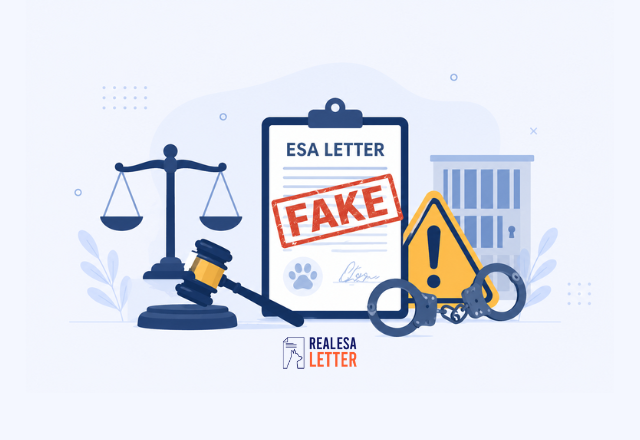
Florida Statute 817.265 makes it a second-degree misdemeanor to fraudulently claim the need for an Emotional Support Animal (ESA) or use a fake ESA letter. Violations may result in up to 60 days in jail, a fine of up to $500, and mandatory community service.

Understanding these penalties also helps explain how Florida identifies ESA fraud and what actions can lead to a violation.
Key Takeaways
Florida Statute 817.265 makes ESA fraud a second-degree misdemeanor: up to 60 days jail, up to $500 fine, plus 30 hours community service.
Three ways to violate it: falsified paperwork, a verbal claim, or conduct.
It covers housing only. Passing an ESA off as a service animal for public access falls under Fla. Stat. 413.08(9) instead.
Buying a letter online isn't itself a crime. The offense is falsifying documentation or knowingly misrepresenting a need.
Clinicians face separate liability. Issuing a letter without personal knowledge of the patient risks board discipline under Fla. Stat. 456.072(1)(pp).
Your letter needs a named licensed practitioner, license number, contact details, issue date, and a real evaluation behind it.
Registrations and certificates don't count. Florida's statute says so directly.
A non-compliant letter is fixable. Replace it with one from a Florida-licensed clinician who evaluated you.
State law now carries the weight. HUD narrowed federal enforcement in May 2026, but Fla. Stat. 760.27 is unaffected.
What Florida Statute 817.265 Covers, and What It Doesn't
Florida Statute 817.265 makes it a second-degree misdemeanor to falsify information or written documentation for an emotional support animal. The same applies to knowingly and willfully misrepresenting having a disability or a disability-related need for one.
The statute names three routes, not one: written notice, verbal notice, and conduct. Someone who submits altered paperwork is covered. So is someone who submits nothing and simply tells a housing provider they have a need they do not have.
So is someone who never says it aloud but behaves as though the animal is something it is not. Asking for an accommodation is not itself the offense. Falsifying the documentation behind it is.
The statute is written around Fla. Stat. 760.27, which governs emotional support animals in Florida housing. That is the setting it describes: proof of need presented to a housing provider, whether a landlord, a property manager, or a condominium association.
That boundary is often blurred online. Florida Statute 817.265 addresses false or fraudulent proof of need for an emotional support animal under Fla. Stat. 760.27, Florida's ESA housing law.
Presenting an emotional support animal as a service animal for public access is a separate offense under Fla. Stat. 413.08(9). Getting a dog into a restaurant by calling it a service animal is charged under 413.08(9), not under 817.265. Service animal misrepresentation turns on the animal's claimed training rather than the patient's documented need.
What Are the Penalties for Florida ESA Letter Fraud?
A conviction under 817.265 is a second-degree misdemeanor, the lower of Florida's two grades.
Penalty element | Maximum under Florida law |
Offense classification | Second-degree misdemeanor |
Jail | Up to 60 days |
Fine | Up to $500 |
Community service | 30 hours for an organization serving people with disabilities, or another organization at the court's discretion |
Completion deadline | Within six months |
The statute says a violation is punishable as provided in 775.082 or 775.083, so jail and the fine are alternatives available to the court rather than a stacked total. Jail time, a fine, or both are possible. The community service obligation is written into 817.265 itself and applies on conviction.
A second-degree misdemeanor under Florida law carries up to 60 days in jail and/or a fine of up to $500. A conviction under 817.265 additionally requires 30 hours of community service completed within six months. These are ceilings, not sentences, and the statutory maximum is rarely the outcome at this grade.
Where the Penalties Come From
Section 817.265 does not set its own maximum sentence. It classifies the offense, then points to Fla. Stat. 775.082 and Fla. Stat. 775.083, the general sentencing and fine provisions that govern any misdemeanor of that grade in Florida. The offense itself was created by Senate Bill 1084, enacted as Chapter 2020-76 and effective July 1, 2020. The housing framework the statute references sits in Florida ESA laws rather than in the fraud provision itself.
What Florida's Rule for Practitioners Means for Your Letter
The 2020 legislation did not only create an offense for applicants. Effective July 1, 2020, it added a duty on the clinician's side.
Under Fla. Stat. 456.072(1)(pp), a health care practitioner may not provide information indicating that a person has a disability, or supporting a person's need for an emotional support animal, without personal knowledge of the patient's need.
The prohibition covers written documentation and information given any other way. A practitioner who breaches it faces professional discipline from their licensing board.
That consequence lands on the practitioner, not on the patient. Board discipline is a proceeding about a license, not a criminal charge against the person who received the letter. Florida split the liability deliberately: the applicant answers to 817.265, the clinician answers to 456.072, and the two run on separate tracks.
Does discipline against a clinician make your letter void? Those are two different questions, answered by two different statutes. Section 456.072 governs whether a clinician may be sanctioned. Section 760.27 governs whether supporting information is reliable, and it treats information as reliable when the practitioner has personal knowledge of the patient's need and is acting within the scope of their practice.
A housing provider evaluating your documentation is asking the second question, not the first. The practical test is not whether your clinician has a clean disciplinary record. It is whether the letter reflects an actual clinical relationship.
How to Verify a Florida ESA Letter Is Legally Compliant
Everything below is one exercise: check the letter you hold against what Florida accepts, then act on the result.
Florida ESA Letter Requirements
A compliant letter should show:
- A named practitioner. A real person with a credential, not a department or a brand.
- Florida licensure, or a documented in-person visit. A Florida-licensed clinician is the clean case. An out-of-state practitioner needs at least one documented in-person occasion of care.
- Evidence of a clinical relationship. The letter should read as though someone assessed you, reflecting personal knowledge of your need rather than a template.
- A license number and working contact details. A housing provider needs a way to confirm the letter came from who it says it came from.
- An issue date. Undated documentation is difficult for anyone to rely on.
- Language about your need, not the animal's status. A determination of disability and the support the specific animal provides are what Florida's housing law asks about. Vests, tags, and ID cards are not part of the legal test.
These criteria are Florida-specific. Whether online ESA letters are legit as a category is a separate question, and it turns on the provider rather than the state.
What Documentation Florida Accepts
A clinician's letter is the most common route, not the only one. Where a disability is not readily apparent, Fla. Stat. 760.27(2)(b) lets a housing provider request reliable supporting information, and lists five things that can supply it:
- A determination of disability from a federal, state, or local government agency
- Receipt of disability benefits or services from a federal, state, or local government agency
- Proof of eligibility for housing assistance or a housing voucher received because of a disability
- Information from a health care practitioner, a telehealth provider, or a similarly licensed practitioner in good standing in another state
- Information from any other source the housing provider reasonably determines to be reliable under the federal Fair Housing Act
Where the need for the particular animal is not readily apparent, the provider may separately ask what support that specific animal provides. The same subsection lets a provider deny a request where the animal poses a direct threat to health, safety, or property that no other accommodation can address.
It also lets a provider require proof of state and local licensing and vaccination for each animal. Where more than one animal is requested, the provider may ask about the specific need for each.
If Your Letter Doesn't Pass
Purchasing a letter is not, by itself, the offense 817.265 describes. The statute turns on falsifying documentation or knowingly misrepresenting a disability-related need. Documentation that came from the wrong source is a documentation problem, and documentation problems are fixable.
- Confirm who signed it. Look for a named health care practitioner, a credential, a license number, and a state. A letter signed only by a company name, a "certification department," or an unnamed clinician cannot be verified by anyone.
- Confirm an evaluation happened. Did a clinician assess you, in person or by telehealth, before the letter was issued? A form you filled in with no clinical contact does not satisfy Florida's personal-knowledge standard.
- Replace rather than resubmit. Obtaining a new letter from a Florida-licensed clinician who has evaluated you resolves the underlying issue. Continuing to submit documentation you have reason to doubt does not.
- Respond to the provider, do not stall. A housing provider, including a condominium association, is entitled to the reliable supporting information listed above while a replacement is in progress. Silence reads worse than an imperfect letter.
Holding an ESA letter that fails Florida's documentation requirements is not the same as knowingly misrepresenting a disability-related need, and replacing a non-compliant letter with one from a Florida-licensed clinician resolves the documentation problem.
Replacement follows the same route as obtaining an ESA letter in Florida in the first place: an evaluation by a clinician who can document the need.
Every RealESALetter.com letter for a Florida client includes the clinician's Florida license number, the issue date, and direct contact information, so a housing provider can verify it independently under Fla. Stat. 760.27.
Why an ESA Registration or Certificate Is Not a Letter
Florida's statute addresses this directly. Documentation of that kind obtained from the internet, whether an ID card, a patch, a certificate, or similar, is not by itself sufficient to establish a disability or a disability-related need.
These products are not what a housing provider is asked to evaluate. What separates an ESA registration from a clinician's letter is the evaluation behind it.
Where to Report ESA Fraud or Practitioner Misconduct in Florida
Three different situations, three different routes.
Suspected fraudulent documentation. Section 817.265 is a criminal statute, so a report goes to local law enforcement or the office of the state attorney for the county. Housing providers and associations are the usual reporting parties.
A practitioner who issued documentation without personal knowledge. This is the 456.072 route. Complaints about a licensed health care practitioner go to the Florida Department of Health, which handles discipline through the relevant professional board.
Housing discrimination against a legitimate ESA holder. Complaints go to the Florida Commission on Human Relations within 365 days of the alleged act. This state route now carries most of the weight for emotional support animals.
On May 22, 2026, HUD's Office of Fair Housing and Equal Opportunity permanently rescinded FHEO Notice 2020-01, the January 2020 assistance-animal guidance.
In its place it adopted an enforcement standard focused on animals individually trained for a specific disability, which narrows the federal path for an untrained animal. Fla. Stat. 760.27 is state law and is unaffected by the change.
Dr. Avery Langston is a health and wellness writer with 12+ years of experience covering ESA rights, housing laws, and mental health. As a senior contributor for RealESALetter, she helps readers understand ESA regulations and legal protections.
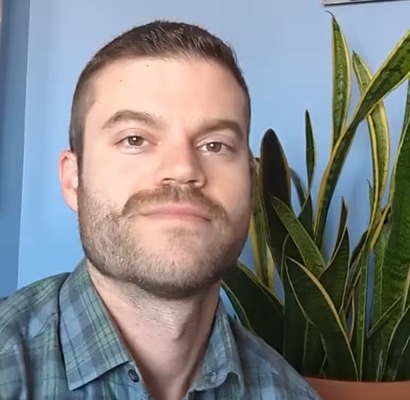
Darren Rafel is a licensed clinical social worker with active LCSW licenses across 13 states, including California, New Jersey, Texas, Florida, and Arkansas. He conducts ESA evaluations with direct clinical experience using pet therapy as part of mental health treatment.

Don't worry. Your pet stays with you.
Housing law is on your side
- 1A few questions. That's your paperwork
- 2A licensed therapist reviews your case
- 3Official ESA letter, ready to send
Not accepted? Full refund, guaranteed